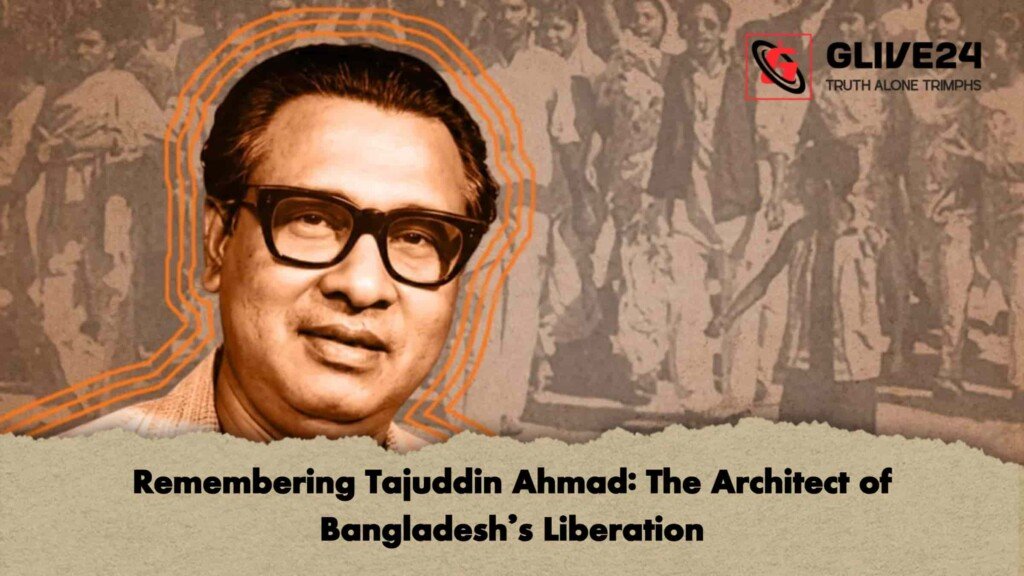
On 23 July, Bangladesh marks the 101st birth anniversary of Tajuddin Ahmad, the nation’s first Prime Minister and a towering figure whose political acumen, unyielding integrity, and administrative mastery helped forge an independent state from the ashes of genocide and war.
Born in 1925 in the village of Dardaria, located in the Kapasia region of Gazipur, Ahmad emerged as a central pillar of the Bengali nationalist movement long before the tumultuous events of 1971. A disciplined organizer with a sharp intellect, he rose through the ranks of the Awami League to become one of the most trusted lieutenants of Bangabandhu Sheikh Mujibur Rahman.
When the Pakistani military launched its brutal crackdown on the night of 25 March 1971, arresting Sheikh Mujibur Rahman, the burden of steering a nation in crisis fell squarely on Ahmad’s shoulders. Displaying remarkable foresight and diplomatic resolve under immense pressure, he mobilized political forces and swiftly coordinated with international partners. On 17 April 1971, he orchestrated the historic swearing-in ceremony of the Provisional Government of Bangladesh at Baidyanathtala (now Mujibnagar) in Meherpur, formally assuming the role of Prime Minister.
Throughout the nine-month Liberation War, Ahmad served as the strategic mastermind of the wartime government in exile. He systematically organized the Mukti Bahini (freedom fighters), established effective administrative frameworks, managed massive refugee flows into India, and secured vital international diplomatic support. His steadfast leadership kept internal political factions united during the nation’s darkest hour, culminating in total victory on 16 December 1971.
Following the triumphant return of the provisional government to Dhaka on 22 December 1971, and the subsequent homecoming of Sheikh Mujibur Rahman on 10 January 1972, Ahmad selflessly handed over the premiership to Bangabandhu. He then assumed responsibility as Minister for Finance and Planning, taking on the daunting task of reconstructing a war-ravaged economy.
Ahmad’s tenure as Finance Minister set the baseline for the country’s economic trajectory. He formulated Bangladesh’s very first national budget and laid the groundwork for its initial Five-Year Plan, emphasizing self-reliance, planned economic development, and equitable resource distribution. In the 1973 general election, he was elected to Parliament representing the Dhaka-22 constituency.
Despite his close personal and political ties with Sheikh Mujibur Rahman, ideological differences regarding governance and state policy began to surface in the post-war years. At the 1974 Awami League council, Ahmad advocated for closing the gap between the government, the party, and the populace, insisting that a political organization’s strength rests entirely on public trust and democratic practice.
When the transition towards a one-party system (BAKSAL) was initiated in 1975, Ahmad chose principle over power and stepped down from the cabinet. In his resignation letter, he famously wrote:
“The people of a country who have fought endlessly for democracy will never accept this political shift simply for the convenience of administration.”
His principled stance defined his legacy. Tragically, in the aftermath of the assassination of Sheikh Mujibur Rahman on 15 August 1975, Ahmad was arrested alongside other prominent national figures. On 3 November 1975, he was brutally murdered inside Dhaka Central Jail alongside three other national leaders—Syed Nazrul Islam, A.H.M. Quamruzzaman, and Muhammad Mansur Ali—an event remembered solemnly in Bangladesh as Jail Killing Day.
Tajuddin Ahmad remains a rare exemplar of selfless statesmanhood. Free from the lure of personal power or wealth, his devotion to democratic values, administrative precision, and social justice continues to serve as a beacon for modern political thought in South Asia.