Madhabpur (Habiganj) Correspondent
Former State Minister for Home Affairs and son of Tajuddin Ahmad, one of Bangladesh’s four national leaders, Tanzim Ahmed Sohel Taj has expressed outrage over the removal of portraits of the four national leaders from the Freedom Fighters’ Square in Madhabpur, Habiganj. Sharing a report about the incident on Facebook, he called on the Bangladesh Nationalist Party (BNP) government to clarify whether it supports such actions and whether it respects and upholds the ideals of the country’s Liberation War.
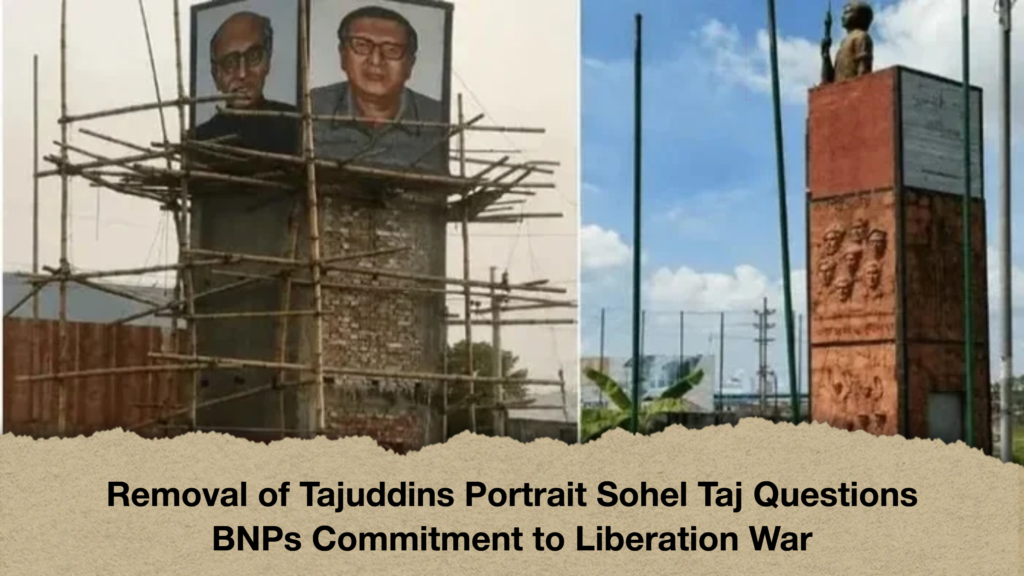
Local freedom fighters have also expressed anger over the removal of mural-style portraits of the four national leaders—Syed Nazrul Islam, Tajuddin Ahmad, Captain Muhammad Mansur Ali and AHM Quamruzzaman—from the Freedom Fighters’ Square at Jagadishpur, adjacent to the Teliapara Memorial. According to them, the portraits had been displayed at the site, which was built with government funding, for many years.
Local freedom fighters said the portraits were removed about a month ago on the instructions of the then Upazila Nirbahi Officer (UNO) of Madhabpur, Zahid bin Kasem, who reportedly described them as ‘irrelevant’. Following reports on the matter in various media outlets, local freedom fighters publicly protested against the decision.
Late on Friday night, former State Minister for Home Affairs Sohel Taj, son of Tajuddin Ahmad, shared a report concerning the incident on social media and called on the BNP government to make its position clear.
In his Facebook post, he wrote: ‘The BNP government must clearly state whether it supports such actions. It must also clearly state whether it respects and upholds the ideals of our great Liberation War.’
Following Sohel Taj’s remarks, the removal of the portraits of the four national leaders in Madhabpur has once again become a subject of political discussion. In particular, the removal of the portrait of Tajuddin Ahmad, one of the four national leaders, has prompted his son to directly call on the government to clarify its current position towards the ideals of the Liberation War.
Freedom Fighters’ Anger: Allegations of No Consultation
Local freedom fighter Abdus Shahid said the portraits of the four national leaders had been displayed at the Freedom Fighters’ Square, which was built with government funding, for a long time. He alleged that the portraits were removed without following proper procedures and called for a fair investigation and appropriate action over the incident.
Leaders of the Freedom Fighters’ Children’s Command have also protested against the removal. They said the four national leaders are an integral part of Bangladesh’s history of the Liberation War and the country’s independence. They argued that an explanation was needed as to why the portraits commemorating their memories and contributions had been removed.
Former president of the Madhabpur Press Club, Md Alid Mia, also protested against the incident on social media. He said those who played significant roles in establishing an independent Bangladesh should be accorded due respect.
Local freedom fighters have questioned how portraits of the four national leaders could be considered ‘irrelevant’ at a Freedom Fighters’ Square. They have also demanded disclosure of the decision-making and administrative process through which the portraits were removed.
They alleged that neither local freedom fighters nor other relevant stakeholders were consulted before the portraits were taken down. They have therefore called for an investigation into the reasons behind the removal and demanded that the portraits be restored to their previous location.
Several attempts were made to contact the current Upazila Nirbahi Officer of Madhabpur, Mehedi Hasan, for his comments on the matter, but he could not be reached.
Alongside protests by local freedom fighters, Sohel Taj’s remarks have brought the removal of the four national leaders’ portraits into the wider political spotlight. The key questions now are why the portraits were removed, what basis the former administration had for taking the decision, and what position the government will adopt on the matter.