Banks and financial institutions are primarily controlled by their sponsors and directors, who make key decisions on lending, fund management and other major financial matters. Ordinary shareholders generally have little or no direct role in those decisions. Yet when mismanagement, alleged embezzlement, irregular lending and governance failures push an institution into crisis, ordinary investors can end up bearing a substantial part of the financial loss.
The problem has become particularly visible in the cases of five banks and several non-bank financial institutions. Many ordinary investors had already suffered as share prices fell amid deteriorating financial conditions. The subsequent suspension of trading, regulatory intervention and moves towards resolution or liquidation have created further uncertainty over whether investors will recover any portion of their remaining capital.
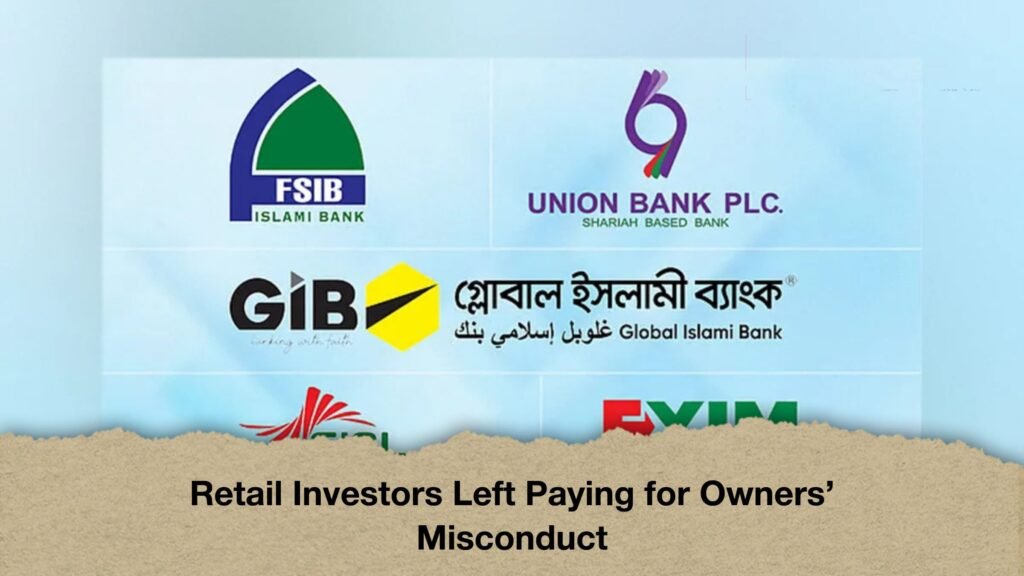
The five-bank episode remains one of the clearest examples. As part of the process of merging First Security Islami Bank, Social Islami Bank, EXIM Bank, Global Islami Bank and Union Bank, trading in their shares was suspended about a year ago. Their share values were later declared zero under the Bank Resolution Ordinance, 2025, after it was determined that their liabilities exceeded their assets. As a result, existing shareholders were told that there would be no residual value available to them.
The boards of the five banks were dissolved in November last year, after which Bangladesh Bank assumed responsibility. The Dhaka Stock Exchange and Chittagong Stock Exchange subsequently halted trading in their shares. The shareholder base included not only sponsors and directors but also thousands of ordinary investors who had purchased the shares through the stock market.
At the time, then Bangladesh Bank Governor Ahsan H Mansur said the shareholders’ equity in the five banks had become negative, meaning their shares would effectively be treated as having zero value. The net asset value per share was reportedly negative by between Tk350 and Tk420. There was also a plan not to allocate shares in the newly formed Sammilito Islami Bank to the shareholders of the former institutions.
For ordinary investors, the decision created a difficult situation. They had no role in approving questionable loans, transferring funds or running the institutions, yet their investments were exposed to the consequences of those decisions. The issue of whether such investors should receive compensation subsequently entered government discussions.
Former interim government Finance Adviser Dr Salehuddin Ahmed had said that the authorities were considering returning part of the investment made by ordinary shareholders. The Finance Ministry was expected to decide how such payments could be made after consultations with relevant stakeholders. Nearly a year later, however, the issue remains unresolved, leaving affected investors uncertain about whether they will receive any relief.
A similar concern has now emerged among shareholders of three listed non-bank financial institutions.
On 9 August, Bangladesh Bank declared four non-bank financial institutions, or NBFIs, non-functional. They are Aviva Finance, Fareast Finance and Investment, FAS Finance and Investment, and International Leasing and Financial Services. All except Aviva Finance are listed on the stock market.
Bangladesh Bank dissolved the boards of all four institutions and appointed its own officials as administrators. The action followed prolonged financial weakness, irregularities and declining prospects for recovery. From 10 August, trading in the shares of the three listed institutions was suspended indefinitely by the Dhaka and Chittagong stock exchanges.
The move has left ordinary shareholders facing a familiar question: if the institutions collapse because of failures attributed to their owners and management, what protection is available to investors who had no involvement in those decisions?
Industry observers say the financial difficulties at Fareast Finance, FAS Finance and International Leasing did not emerge overnight. The institutions had struggled for years, including difficulties in returning funds to depositors. Despite their weak financial position, the share prices of some of these companies rose sharply at different points. Market rumours and speculation sometimes drove prices higher, while investors remained without meaningful returns over extended periods.
The wider NBFI sector has faced persistent problems involving loan defaults, governance weaknesses and alleged financial irregularities. In 2025, the nine NBFIs facing liquidation measures from Bangladesh Bank had non-performing loan ratios ranging from 75 per cent to 98 per cent. Fareast Finance, FAS Finance and International Leasing were among those institutions.
There have also been allegations involving businessman PK Halder. Various reports have alleged that at least Tk3,500 crore was misappropriated from several financial institutions, including International Leasing and FAS Finance. These allegations have added to concerns over the quality of governance and lending practices in parts of the NBFI sector.
The distinction between depositors and shareholders is central to the current debate. Under the normal liquidation process, an institution’s assets are first used to settle its liabilities. Only after creditors and other liabilities have been addressed can shareholders potentially receive anything that remains. Where liabilities exceed the recoverable value of assets, there may be little or nothing left for shareholders.
For that reason, the authorities have placed greater emphasis on protecting depositors at troubled NBFIs. More than 12,000 depositors of six distressed NBFIs have reportedly been seeking the return of their funds for a prolonged period. Bangladesh Bank has said that depositors’ money is expected to be returned on a priority basis through a two-stage arrangement or a special scheme.
The position of ordinary shareholders, however, remains less certain. Their ability to recover money will depend largely on the valuation and disposal of the institutions’ remaining assets. Bangladesh Bank spokesman Arif Hossain Khan said sponsors and directors would not receive anything following liquidation, while the possibility of payments to ordinary investors would be clarified under the scheme to be announced.
This has raised a broader question about the fairness of the existing framework. If public resources are used to support the repayment of depositors at distressed institutions, should some consideration also be given to ordinary shareholders who lost money because of failures over which they had no control?
A Bangladesh Securities and Exchange Commission official said the commission’s scope for intervention would be limited if the institutions were directly liquidated without a specific provision for ordinary investors.
BSEC Executive Director and spokesman Md Abul Kalam said the commission had written to Bangladesh Bank well before the latest developments, urging that the interests of ordinary investors be considered while preparing liquidation schemes. The commission also proposed that if public funds were allocated for any category of stakeholders when a listed financial institution was closed, ordinary shareholders should also be considered for an allocation.
Former BSEC chairman Faruq Ahmed Siddiqi, however, has stressed the responsibility of investors to assess a company before putting money into it. In his view, investors should avoid companies that do not meet reasonable investment criteria. He also pointed out the difficulty of recovering money even for depositors of financially weak institutions. If depositors themselves cannot readily recover their funds, he argued, returning money to shareholders becomes an even more complicated proposition.
Siddiqi also questioned whether taxpayers should ultimately bear the cost of compensating investors. If ordinary shareholders are to receive financial assistance, he said, such a decision would have to be taken by the government as a special policy measure. Using taxpayers’ money to cover losses suffered by a relatively small group of investors, however, raises a separate question of public interest and fairness.
University of Dhaka accounting professor Md Al-Amin takes a different view of the issue. He argues that the legal framework should not be the only consideration when ordinary people have suffered losses because of institutional failures. Investors who bought shares in a bank or financial institution did not necessarily participate in its lending decisions, fund transfers or board-level management.
According to him, regulators should move beyond correspondence between institutions and work collectively on a practical mechanism to protect ordinary shareholders where financial institutions fail because of serious governance problems.
At present, there is no clear and comprehensive mechanism specifically designed to compensate ordinary shareholders in such circumstances. Under conventional rules, shareholders stand at the bottom of the repayment hierarchy and can receive money only if assets remain after liabilities have been settled.
That principle becomes particularly contentious when an institution’s collapse is linked to alleged misconduct, excessive related-party lending, weak oversight or financial mismanagement. The central challenge for regulators is therefore to maintain the basic principles of corporate liability while ensuring that ordinary investors are not automatically treated as if they had participated in decisions that caused the losses.
The cases involving the five banks and the three listed NBFIs have brought that unresolved tension into sharp focus. For thousands of ordinary shareholders, the issue is no longer simply whether a share price has fallen. It is whether the regulatory system has any meaningful mechanism to protect investors when the institution itself becomes unviable because of failures at the top.