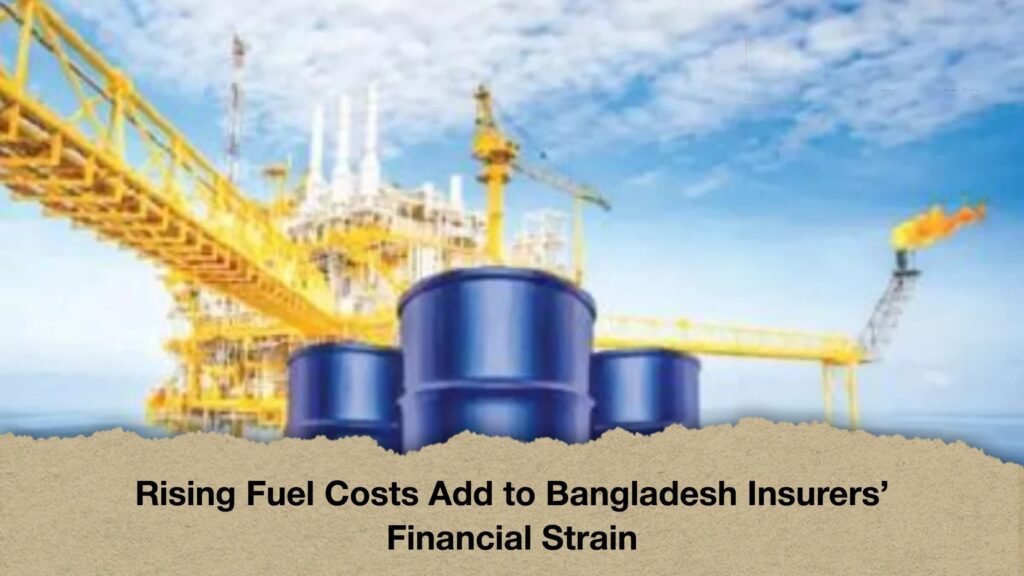
Bangladesh’s insurance industry is facing mounting financial pressure following a sharp increase in fuel prices, with higher travelling costs affecting field agents and additional operating expenses expected to weigh on insurers. The situation has also raised concerns about whether companies will be able to absorb the extra costs while staying within legally prescribed limits for management expenditure.
The government raised the retail prices of all major fuels by Tk 20 per litre, with the revised rates coming into effect from midnight on Monday, 21 September. Diesel is now priced at Tk 135 per litre, while octane costs Tk 165, petrol Tk 160 and kerosene Tk 155.
The latest prices are significantly higher than those recorded at the end of 2025. In December last year, diesel was sold at Tk 104 per litre, kerosene at Tk 116, petrol at Tk 120 and octane at Tk 124. Octane has therefore increased by Tk 41 per litre, representing a rise of more than 33 per cent in less than a year.
The increase is creating an immediate challenge for insurance agents, particularly those who rely on motorcycles to visit customers and prospective policyholders. Field representatives regularly travel between different locations to collect premiums, maintain relationships with existing clients and secure new policies. Their commission rates, however, have not risen in line with the higher cost of travelling.
A field agent working for a life insurance company, speaking on condition of anonymity, said representatives spend much of their working day travelling by motorcycle to meet customers.
The agent said the rise in fuel prices had substantially increased daily travelling costs, while commission rates remained unchanged. As a result, agents are being forced to spend more of their own money to generate the same level of business.
Another insurance employee said the financial pressure extended beyond fuel costs. Expenses associated with travelling had also increased, while transport allowances and other benefits provided by companies had remained unchanged.
According to the employee, the growing gap between income and field expenses could discourage some commission-based workers from actively pursuing new policies. Such a development could add another layer of pressure to an industry that depends heavily on field-level customer acquisition and policy collection.
Higher costs for insurers
The impact of the fuel price increase is not confined to individual agents. Insurance companies themselves are likely to face higher costs for maintaining their vehicle fleets and supporting employee travel.
Under guidelines issued by the Insurance Development and Regulatory Authority (IDRA), the chairman and chief executive officer of an insurance company may each use a vehicle worth up to Tk 4 million from company funds. An insurer may also operate four vehicles in its transport pool, with each vehicle subject to a maximum value of Tk 2.5 million. Vehicles can also be allocated to senior officials.
Financial reports from several leading life and non-life insurers provide an indication of the scale of vehicle-related operations. One life insurance company alone has 268 vehicles, including private cars, microbuses and motorcycles.
IDRA data from 2018 showed that 28 life insurance companies were using 1,841 vehicles, while 46 non-life insurers had 1,128 vehicles. Fuel expenses for company-owned vehicles, together with travelling and conveyance costs, are treated as part of insurers’ management expenditure.
The latest increase in fuel prices could therefore affect several areas of insurers’ operating budgets simultaneously. Companies may face higher costs not only for their own fleets but also for employee travel and other field activities linked to business development.
Fuel bills could rise sharply
Financial reports from 23 life and non-life insurance companies show that insurers already spend substantial amounts on fuel.
In 2025, 11 life insurance companies spent a combined Tk 123,631,871 on fuel. During the same period, 12 non-life insurance companies spent Tk 30,653,554.
If fuel consumption remains at a similar level, the higher prices could increase the annual fuel bill of those 11 life insurers to around Tk 163,194,070. That would mean an additional expense of Tk 39,562,199 compared with their previous expenditure.
Non-life insurers are also expected to face a comparable increase in fuel-related costs if their consumption remains unchanged. The actual financial impact, however, will depend on fuel usage, vehicle operations and other travelling requirements during the year.
The additional expenditure has become particularly significant because insurers operate within prescribed limits for management expenses. A substantial increase in fuel and travelling costs could make it more difficult for some companies to keep their total management expenditure within the statutory ceiling.
Concern over management-expense limits
Under the Insurance Act 2010, spending beyond the prescribed management-expense limit constitutes an offence and may result in penalties. The government has also introduced separate rules governing the maximum permissible management expenditure for life and non-life insurance businesses.
The relevant regulations are the Non-Life Insurance Business Management Expenditure Maximum Limit Determination Rules 2018 and the Life Insurance Business Management Expenditure Maximum Limit Determination Rules 2020.
The central issue for insurers is whether the regulator will take the exceptional increase in fuel-related costs into account when assessing compliance with those limits.
So far, IDRA has not issued any specific instruction on whether additional expenditure arising from the latest fuel price increase will receive separate consideration.
SM Nuruzzaman, joint secretary-general of the Bangladesh Insurance Forum (BIF), said the rise in fuel prices would have a direct impact on insurers’ operating and management expenses.
He said companies would have to spend considerably more on fuel for their own vehicles as well as on travelling allowances for employees. If the statutory management-expense ceiling is not adjusted or relaxed to reflect the increased costs, some insurers could face difficulty remaining within the prescribed limits, he added.
Nuruzzaman said the industry expected the regulator to consider the changed operating environment and provide appropriate guidance.
IDRA spokesperson Sadik Arman said the regulator was aware of the recent increase in fuel prices. He said the authority would take necessary measures to address the situation arising from the higher fuel costs.
For the insurance industry, the issue has created pressure on two fronts. Companies must continue maintaining field operations, customer services and business development while absorbing higher travelling and vehicle-related costs. At the same time, they must ensure that overall management expenditure remains within the limits established under the law.
For agents and other field-based employees, the immediate concern is the rising cost of reaching customers. If commissions and allowances remain unchanged while travel expenses continue to increase, the cost of acquiring and servicing policies could become increasingly difficult to manage.
The longer-term impact will depend on how fuel prices evolve, how insurers manage their vehicle and travelling expenses, and whether IDRA introduces any clarification or adjustment concerning management-expenditure limits. For companies already operating with tight cost structures, the latest fuel-price increase adds another financial consideration to an industry where field operations remain central to business generation and customer service.