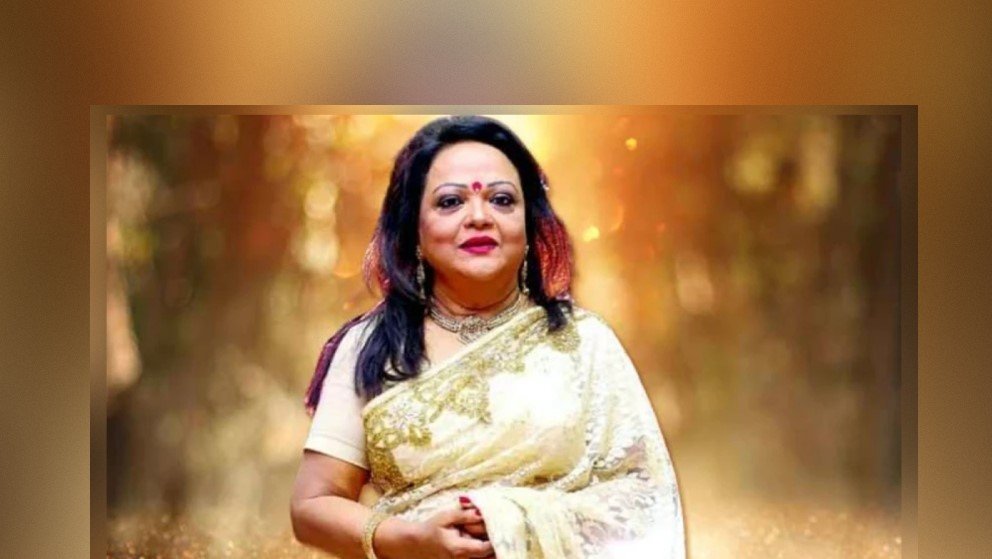
Few voices do more than carry a melody. Some become part of a nation’s collective memory, accompanying people through moments of joy, sorrow, love, struggle and celebration. In Bangladesh, Sabina Yasmin’s voice has occupied that rare place for generations.
The legendary Bangladeshi singer celebrates her 72nd birthday today, 4 September. Born in 1954, she grew up in a family deeply connected with music, with her ancestral home in Satkhira. Her mother, Begum Mouluda Khatun, was also a singer, while four of the five sisters in the family—Farida Yasmin, Fauzia Yasmin, Nilufar Yasmin and Sabina Yasmin—became involved in music.
Sabina’s association with music began at an exceptionally early age. She would sit beside her elder sister Farida Yasmin while she learnt music from Ustad Durgaprasad Roy, listening carefully and reproducing the melodies herself. At just six, Sabina won first prize at the All-Pakistan School Music Competition. A year later, she appeared on stage as a singer.
Her musical education continued under the guidance of renowned teacher Ustad P C Gomez, from whom she received training for 13 years. As a member of Khelaghar, she also performed regularly on radio and television during her childhood. Those early experiences helped shape the disciplined and versatile singer she would become.
Sabina entered the world of film music at a young age. Her formal playback career began with the 1967 film Agun Niye Khela, in which she sang ‘Madhu Jochhona Dipali’. She had, however, already gained experience lending her voice to films as a child performer.
Her breakthrough came in 1970 with the film Jibon Theke Neya. The song ‘Eki Sonar Aloy Jibon Bhoriye Dile’, composed by Khan Ataur Rahman, became immensely popular and established Sabina as one of the most distinctive voices in Bangla music.
From there, her career continued to expand across generations and musical traditions. She has sung patriotic songs, modern Bangla songs, folk music, Rabindra Sangeet, Nazrul Sangeet, ghazals and classical compositions. Her patriotic repertoire, in particular, has become closely associated with Bangladesh’s cultural identity and the spirit of the Liberation War.
Among the many songs that have achieved enduring popularity in her voice are ‘Shob K’ta Janala Khule Dao Na’, ‘Majhi Nao Chhariya De’, ‘Shundor Shuborno’, ‘Shadhinota Tumi’, ‘Ekti Bangladesh Tumi Jagroto Jonotar’ and ‘Jonmo Amar Dhonno Holo Ma Go’. These songs have continued to reach new listeners long after their original release.
Across a career spanning more than six decades, Sabina Yasmin has reportedly recorded around 16,000 songs, including a substantial body of film music. Her ability to move between different genres without losing the character of her voice has been one of the defining features of her career.
Her contribution to Bangladeshi cinema has also brought an extraordinary collection of honours. She is recognised as a record 15-time recipient of the National Film Award for Best Singer, reflecting the scale and consistency of her contribution to the country’s film industry.
Beyond the National Film Awards, Sabina received the Ekushey Padak in 1984 and Bangladesh’s Independence Award, the country’s highest civilian honour, in 1996. She has also received recognition outside Bangladesh, including an honorary doctorate and other cultural distinctions.
Her reputation has extended well beyond the country’s borders. She has performed in England, Sweden, Norway, Hong Kong, the United States, Bahrain and other countries, as well as in India and Pakistan. Her repertoire has also included songs in different languages, demonstrating the breadth of her musical career.
Sabina has worked with some of the most celebrated names in South Asian music. She had the opportunity to sing to compositions by legendary Indian music director R D Burman and performed alongside artists such as Kishore Kumar, Manna Dey, Asha Bhosle, Shyamal Mitra and Kumar Sanu.
Music has remained at the centre of her career, but her artistic work has not been confined to singing. She acted in Ulka, directed by Gazi Mazharul Anwar, and in 2010 served as a judge on Channel i’s Shera Kontho singing competition.
Her family also played an important role in her development as an artist. Khan Ataur Rahman, her brother-in-law and one of Bangladesh’s prominent filmmakers, actors, lyricists and composers, was among those who encouraged and supported her musical journey. His contribution remained an important part of Sabina’s recollections of her career.
What distinguishes Sabina Yasmin’s legacy is not simply the number of songs she has recorded or the awards she has received. Her voice has travelled through changing eras of Bangladeshi society and remained familiar to successive generations. She has sung of love and separation, nature and everyday life, patriotism and national identity.
Her career also reflects the evolution of Bangladesh’s music industry itself—from the early days of radio and stage performances to the golden era of film songs and the changing musical landscape of later decades.
For many listeners, a Sabina Yasmin song is more than a recording. It can evoke a particular period of life, a family memory or a defining moment in the country’s cultural history. That enduring connection has helped make her one of the most recognisable and respected voices in Bangla music.
At 72, Sabina Yasmin’s career stands as a remarkable record of artistic longevity. Generations of listeners have grown up with her songs, while her contribution to Bangladeshi music continues to be remembered through the works that have become part of the country’s cultural heritage.
On her birthday, the celebrated singer remains a defining presence in Bangladesh’s musical landscape—a voice whose long journey has left an indelible mark on the nation’s songs and memories.