
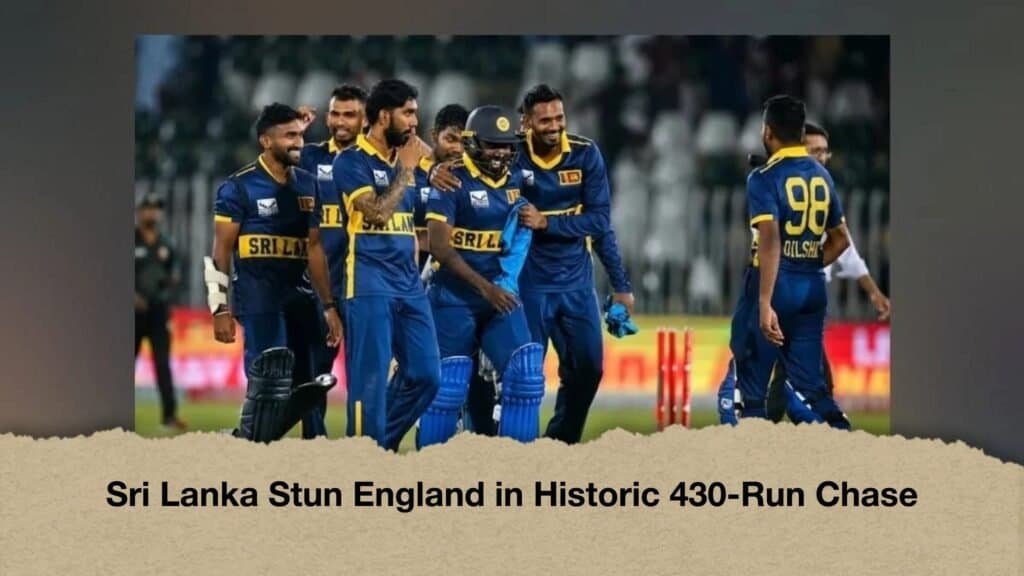
Despite a record-breaking double century from England captain Harry Brook, Sri Lanka completed the second-highest successful run chase in ODI history, reaching their target with just one delivery remaining.
The dramatic victory came on Thursday (22 October) in the third match of a tri-nation ODI series, with Sri Lanka displaying exceptional resilience after suffering an early batting collapse.
The contest reached a thrilling conclusion when Sri Lanka required eight runs from the final over. With the pressure mounting, Janith Liyanage struck Josh Tongue over long-off for six from the fifth delivery, sealing a memorable triumph.
The result placed Sri Lanka among the leading teams in ODI cricket’s record books. The combined total of 859 runs also became the second-highest match aggregate in the format’s history, underlining the extraordinary batting performances from both sides.
Brook’s Historic Double Century Powers England
England appeared firmly in control after posting an imposing 429 for four from their allotted 50 overs, largely thanks to a sensational innings from captain Harry Brook.
The England skipper initially adopted a cautious approach, scoring just 13 runs from his first 24 deliveries. However, once he settled at the crease, his batting transformed into a devastating display of aggressive stroke-making.
Brook accelerated rapidly, reaching his century from just 75 balls before increasing the tempo even further. His relentless assault on Sri Lanka’s bowling attack carried him to a double century from only 114 deliveries.
The innings made Brook the first England batter to register a double century in men’s ODI cricket. According to the match report, he also established a new record for the fastest double century in the format.
The previous record had reportedly been set by India’s Shubman Gill, who reached 200 from 117 deliveries against the West Indies the preceding month. Brook bettered that mark by three balls.
His performance demonstrated an exceptional ability to change gears, turning a relatively measured beginning into one of the most destructive innings described in ODI cricket.
England’s eventual total of 429 for four represented their fourth-highest ODI score. It was also reported to be their highest total against a Test-playing nation in an ODI played away from home.
With such a substantial score on the board, England entered the second innings as strong favourites. Yet the match was far from decided.
Sri Lanka Recover from Early Collapse
Chasing 430 for victory, Sri Lanka endured a disastrous start, losing two wickets with only 24 runs on the scoreboard.
At that stage, England appeared well positioned to capitalise on their imposing total. The required scoring rate was already demanding, and further wickets could have brought the contest to a premature conclusion.
However, Pavan Rathnayake and Avishka Fernando responded with an outstanding batting effort that gradually shifted the momentum towards Sri Lanka.
Batting at number four, Rathnayake delivered a magnificent innings of 130 runs from 106 deliveries. His commanding performance included 15 boundaries and three sixes, providing the foundation for Sri Lanka’s remarkable recovery.
Rather than allowing England’s bowlers to dictate proceedings, Rathnayake maintained an attacking approach while ensuring the scoreboard continued moving.
Fernando offered crucial support with an impressive 97 runs, narrowly missing what would have been a deserved century.
Their contributions helped Sri Lanka recover from their early setbacks and remain within striking distance of the daunting target.
Dasun Shanaka then played another decisive innings, contributing 97 runs at a critical stage of the chase.
The combined efforts of Rathnayake, Fernando and Shanaka transformed the contest. What had initially appeared an almost impossible pursuit gradually became a realistic opportunity.
Sri Lanka maintained an aggressive scoring rate throughout much of their innings, refusing to allow the pressure of the target to overwhelm their batting approach.
Liyanage Delivers Dramatic Final-Over Victory
Despite Sri Lanka’s remarkable recovery, the outcome remained uncertain heading into the final over.
With eight runs still required, England retained an opportunity to defend their total and prevent one of the greatest successful chases in ODI history.
The pressure was considerable. Every delivery carried significance, and a single mistake could have changed the result.
Janith Liyanage, however, remained composed.
Facing Josh Tongue, he struck the fifth delivery of the final over for six over long-off, completing Sri Lanka’s extraordinary victory with one ball to spare.
The decisive stroke brought an unforgettable conclusion to a match dominated by aggressive batting, remarkable individual performances and repeated changes in momentum.
Rathnayake was named Player of the Match for his outstanding 130-run innings, which played a central role in keeping Sri Lanka’s pursuit alive after their early difficulties.
Although Liyanage provided the finishing touch, the contributions of Fernando and Shanaka were equally significant in ensuring Sri Lanka remained competitive deep into the innings.
Historic Chase Approaches South Africa’s Record
Sri Lanka’s successful pursuit of 430 placed the team second on the list of highest successful run chases in ODI cricket.
The record remains associated with South Africa’s famous victory over Australia in Johannesburg in 2006.
In that historic encounter, Australia amassed 434 for four, setting South Africa a seemingly impossible target of 435.
South Africa responded with an extraordinary batting performance, reaching 438 for nine to complete one of the most celebrated victories in international cricket.
The two teams accumulated 872 runs, establishing a record for the highest combined match aggregate in ODI history.
England and Sri Lanka’s latest encounter produced 859 runs, just 13 fewer than the Johannesburg record.
The comparison highlights the scale of Sri Lanka’s achievement and the exceptional scoring witnessed throughout the contest.
While South Africa’s 2006 triumph remains the benchmark for successful ODI run chases, Sri Lanka’s latest performance has earned a prominent place in the format’s history.
England’s Bowling Struggles Prove Costly
For England, the defeat represented a deeply disappointing outcome after a batting performance that would ordinarily have provided a commanding advantage.
Brook’s extraordinary double century had placed his side in an apparently dominant position, while the total of 429 left Sri Lanka facing an enormous challenge.
England’s bowlers initially responded positively, dismissing two Sri Lankan batters for just 24 runs.
However, they struggled to maintain that advantage as Rathnayake and Fernando began rebuilding the innings.
The absence of experienced leg-spinner Adil Rashid was particularly significant for an attack that failed to contain Sri Lanka’s increasingly confident batting line-up.
England were unable to establish sustained control during the middle overs, allowing the opposition to maintain the scoring rate required for an unprecedented pursuit.
Shanaka’s subsequent contribution further exposed the difficulties facing the English bowling attack, while Liyanage’s final-over six completed a dramatic reversal.
Brook’s individual achievement will remain a major highlight of the contest, but his record-breaking performance ultimately proved insufficient to secure victory.
For Sri Lanka, the result demonstrated the importance of collective batting contributions and maintaining composure under extreme pressure.
From losing two early wickets to successfully chasing one of the largest targets in ODI history, Sri Lanka produced a performance defined by determination, calculated aggression and remarkable execution.
The extraordinary 859-run encounter will be remembered not only for Brook’s double century and Rathnayake’s match-winning contribution, but also for the dramatic finish that secured Sri Lanka a place in ODI cricket history.