
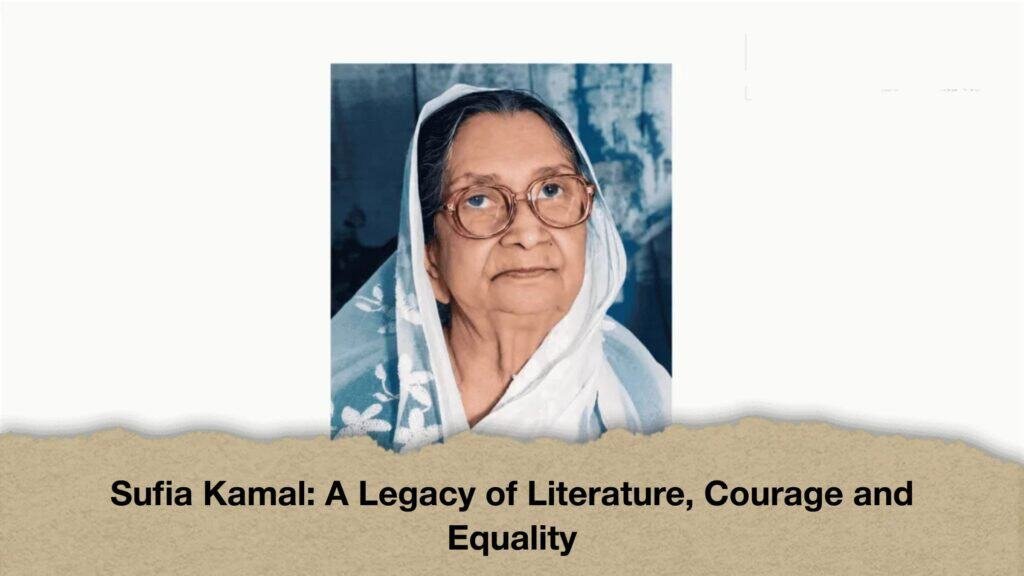
She was more than a poet. Sufia Kamal was a pioneering advocate of women’s rights, a prominent cultural personality and a courageous organiser of democratic movements. Her writings explored love, nature, human emotions, grief and the complexities of life, while also addressing patriotism, social inequality, freedom and compassion. She believed literature could serve as a powerful instrument for challenging injustice and raising social consciousness.
Born on 20 June 1911 in Shayestabad, Barishal, into an aristocratic family, Sufia Kamal grew up at a time when women, particularly in conservative Muslim communities, had limited access to education and opportunities for independent expression. Her father was Syed Abdul Bari and her mother, Sabera Begum.
Despite the restrictions of the era, she developed a strong passion for learning. Her mother introduced her to the Bengali language, and although she did not receive formal schooling, she educated herself through reading, determination and intellectual curiosity. Her journey from a socially restrictive environment to becoming one of the most influential literary figures of Bengal stands as a testament to her resilience and dedication.
At the age of 13, she married her cousin, Syed Nehal Hossain, in 1924. Hossain was relatively progressive and had an interest in literature and culture. His encouragement helped her devote greater attention to reading and writing. The works of Rabindranath Tagore, Kazi Nazrul Islam and other contemporary literary figures significantly influenced her intellectual and creative development.
Her first poem, Basanti, was published in the magazine Saugat in 1926. Her emergence as a literary voice was particularly significant at a time when Muslim women faced considerable social barriers to creative expression. She gradually established her own identity in Bengali literature, earning recognition for her distinctive style and thoughtful treatment of social and human concerns.
She later became the first editor of Begum, a pioneering women’s magazine that played an important role in encouraging female writers and expanding opportunities for women’s creative expression. Her contribution helped create a platform where women could share their ideas, literary works and perspectives, challenging traditional restrictions on their participation in intellectual life.
Following the Partition of India in 1947, Sufia Kamal moved from Kolkata to Dhaka with her family. Her involvement in literary, cultural and social activities grew significantly after settling in the city.
She played an active role in the Language Movement of 1952, supporting the struggle to establish Bengali as a state language. She encouraged women to participate in the movement and stood firmly in defence of linguistic and cultural rights. Her activism reflected a broader commitment to justice, freedom and the rights of ordinary people.
In 1961, when the Pakistani authorities sought to restrict Rabindra Sangeet, she became involved in cultural resistance against the initiative. Her position reflected her determination to defend Bengali cultural identity and artistic freedom. She also played a significant role during the mass uprising of 1969, standing in solidarity with the movement for democratic rights.
During the Liberation War of 1971, she protested against the atrocities committed by the Pakistani military and supported the struggle for Bangladesh’s independence. Her moral courage and commitment to human dignity remained evident during one of the most difficult periods in the country’s history.
After independence, she continued her activism without interruption. Women’s rights, education, social justice, democracy, secularism and humanitarian values remained central to her work. She firmly believed that a society could not achieve meaningful progress if women were denied education, dignity, equal rights and opportunities.
Through her involvement in establishing and leading Bangladesh Mahila Parishad, she made a significant contribution to organising and strengthening the women’s rights movement. She served as the organisation’s president for many years, advocating for women’s empowerment, equality and greater participation in social and public life. Her leadership helped establish women’s rights as an important issue in Bangladesh’s social and political discourse.
Her literary achievements extended across poetry, short stories, memoirs, travel writing and other forms of creative expression. Among her notable poetry collections are Sanjher Maya, Maya Kajal, Mon O Jibon, Udatta Prithibi, Diwan, Abhijatrik and Soviet Din-guli. Her writings combined emotional depth with a keen awareness of society, reflecting both the beauty of human experience and the struggles faced by people.
Her memoir Ekattorer Diary remains an important literary record of the Liberation War, documenting experiences and realities from that turbulent period. The work offers a valuable perspective on the human dimension of the country’s struggle for independence.
In recognition of her contributions to literature, social reform, women’s empowerment and national life, she received numerous honours, including the Bangla Academy Award, Ekushey Padak, Begum Rokeya Padak and the Independence Award. In 1997, she was awarded the Independence Award, Bangladesh’s highest civilian honour.
Sufia Kamal died in Dhaka on 20 November 1999, aged 88. Her death marked the end of an extraordinary life, but her literary legacy, ideals and spirit of resistance continue to influence society.
She was a woman who transformed her pen into an instrument of protest, literature into a vehicle for social consciousness and her life into a sustained struggle for human rights and dignity. Despite the social barriers and challenges of her time, she remained steadfast in her convictions and helped illuminate the path towards a more inclusive and humane society.
On the anniversary of her death, Begum Sufia Kamal is remembered with profound respect and affection as a celebrated poet, pioneer of women’s emancipation, cultural activist and champion of human freedom.
Her legacy lives on through her writings, ideals and lifelong dedication to justice, equality and humanity. Her life continues to remind us that courage, education, compassion and conviction can make an individual a powerful force for social transformation.