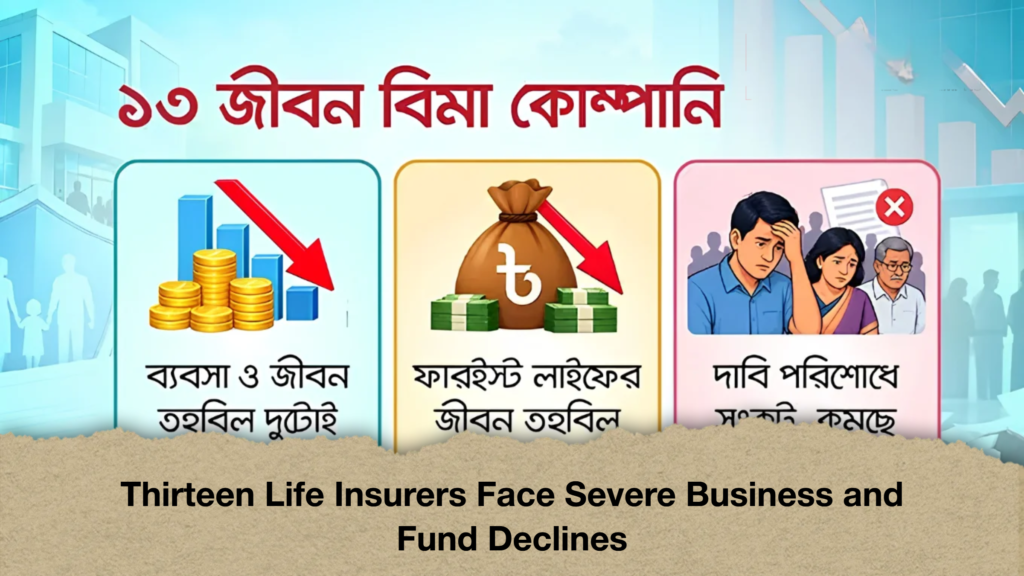
Thirteen life insurance companies in Bangladesh have suffered a sustained decline in both business and life funds between 2020 and 2025, raising concerns over their financial health, management practices and ability to meet long-term obligations to policyholders.
The deterioration stands in contrast to the overall performance of the country’s life insurance industry. Aggregate business across life insurers increased from Tk9,528 crore in 2020 to Tk13,102 crore in 2025, representing growth of Tk3,574 crore. Yet a group of companies moved sharply in the opposite direction, recording declines in premium income while their life funds also contracted.
Life insurance specialists have described the prolonged deterioration as resembling a company being affected by a serious disease. Their concern is that when business continues to shrink alongside life funds, the problem can become progressively harder to resolve. They argue that weaknesses in management, investment, claims settlement or governance need to be identified before they threaten the wider sector.
The 13 companies identified with declining business and life funds are Far East Islami Life, Padma Islami Life, Golden Life, BAIRA Life, Meghna Life, Popular Life, Rupali Life, Prime Islami Life, Homeland Life, Sunflower Life, Sun Life, Progressive Life and Protective Life.
Meghna Life recorded a substantial decline during the period. Its business fell from Tk422 crore in 2020 to Tk283 crore in 2025, a reduction of Tk139 crore. Its life fund also decreased from Tk1,890 crore to Tk1,570 crore, meaning Tk320 crore was wiped from the fund over the six-year period.
Popular Life’s business stood at Tk591 crore in 2020 and rose to Tk677 crore in 2023 before falling to Tk501 crore in 2025. That represented a decline of Tk176 crore from its 2023 level and Tk90 crore compared with 2020. Its life fund fell from Tk1,752 crore to Tk1,492 crore.
Far East Life faced an even more dramatic deterioration. Its business dropped from Tk974 crore in 2020 to Tk283 crore in 2025, a fall of Tk691 crore. Its life fund, meanwhile, deteriorated from Tk2,003 crore to a negative Tk847 crore.
Prime Life’s business declined from Tk414 crore to Tk388 crore, while its life fund fell from Tk837 crore to Tk744 crore. Rupali Life’s business decreased from Tk248 crore to Tk215 crore, although its life fund remained unchanged at Tk505 crore.
Sunflower Life’s business dropped from Tk65 crore in 2020 to just Tk15 crore in 2025. Its life fund also declined, from Tk138 crore to Tk88 crore. Homeland Life suffered a particularly steep contraction, with business falling from Tk101 crore to Tk9 crore and its life fund declining from Tk261 crore to Tk168 crore.
Golden Life’s business decreased from Tk24 crore to Tk17 crore, while its life fund fell from Tk261 crore to Tk168 crore. Padma Life’s business declined from Tk49 crore to Tk15 crore, while its life fund moved from Tk13 crore into negative territory, reaching minus Tk309 crore.
Smaller insurers also experienced significant deterioration. BAIRA Life’s business fell from Tk4 crore to Tk2 crore, while its life fund declined from Tk66 crore to negative Tk65 crore. Sun Life’s business dropped from Tk105 crore to Tk19 crore, accompanied by a fall in its life fund from Tk182 crore to Tk49 crore.
Progressive Life’s business decreased from Tk42 crore to Tk30 crore. Its life fund dropped by Tk204 crore, from Tk273 crore to Tk69 crore. Protective Life, a relatively new-generation insurer, saw its business fall from Tk39 crore to Tk31 crore, while its life fund plunged from Tk10 crore to just Tk1 crore.
The decline in life funds is particularly concerning because these funds are closely connected with policyholders’ long-term interests. Life insurers collect premiums today but often face significant liabilities many years later. If new and renewal business weakens while claims on older policies continue to be paid, a company’s fund can come under increasing pressure.
Industry observers have linked the difficulties to several factors. Some insurers have reportedly suffered from alleged financial irregularities in previous years, while difficulties in settling claims have damaged public confidence. A decline in consumer interest in insurance has, in turn, affected new business and renewals. The broader economic environment has also placed pressure on household finances and business activity.
However, the sector’s overall figures suggest that economic conditions alone cannot explain the performance of the weakest insurers. Several companies expanded considerably during the same period.
National Life’s business increased from Tk1,201 crore in 2020 to Tk2,340 crore in 2025. Delta Life rose from Tk732 crore to Tk1,019 crore, while Jiban Bima Corporation increased from Tk601 crore to Tk976 crore. Pragati Life’s business more than doubled, rising from Tk319 crore to Tk667 crore.
MetLife also expanded from Tk2,786 crore to Tk3,481 crore. Sandhani Life rose from Tk186 crore to Tk247 crore, while Sonali Life’s business surged from Tk135 crore to Tk866 crore. Guardian Life increased from Tk283 crore to Tk886 crore, and Zenith Life rose from Tk15 crore to Tk47 crore.
Pragati Life’s chief executive, Md Jalalul Azim, said sustained growth in both insurance business and life funds should normally be expected from a properly functioning life insurer. He argued that a prolonged decline could indicate weaknesses in management, investment, claims settlement or other areas of operation.
He also said that if the decline were caused solely by economic conditions, its impact would be visible across the industry. Since several insurers have continued to expand, he believes companies that are consistently losing business need to examine their own internal problems, including customer confidence and claims payment practices.
Meghna Life chairman Nizam Uddin attributed some of the industry’s difficulties to long-standing weaknesses in management and oversight. He said some insurers had spent heavily on offices, vehicles and projects without adequately considering future policy liabilities. Life insurance differs from many other businesses because substantial amounts collected from customers may have to be paid out 10, 12 or even 15 years later.
According to him, some funds are also trapped in banks and leasing companies. He said Meghna Life has around Tk400–500 crore tied up in various financial institutions, restricting the company’s access to those funds when they are needed.
He explained that a life fund is largely made up of policyholders’ money. When new and renewal business falls but payments on older policies continue, money flows out of the fund faster than new premiums can replenish it.
The chairman of Prime Islami Life, Mohammad Akhtar, alleged that Tk800–900 crore had been misappropriated in the past and said the company was now facing difficulties as a consequence. These are allegations made by the chairman and would require appropriate investigation and determination by the relevant authorities.
The industry’s current difficulties therefore extend beyond falling sales figures. For insurers experiencing persistent contraction, restoring policyholder confidence, strengthening management and controls, improving claims settlement, recovering trapped investments and ensuring adequate funds for future liabilities will be crucial.
The contrasting performance of insurers within the same market also indicates that the sector’s problems are not universal. While some companies have expanded substantially over the five-year period, the 13 insurers facing simultaneous declines in business and life funds require closer scrutiny.
For regulators and company management, the challenge is to identify the underlying causes before financial weakness becomes more difficult to reverse. Early intervention, transparent governance and stronger protection of policyholders’ funds will be essential if confidence in the affected insurers—and in the wider life insurance market—is to be restored.