US President Donald Trump has suggested that Washington may have gone too far in targeting Iran’s leadership, acknowledging that his administration is struggling to identify whom to approach for negotiations with Tehran.
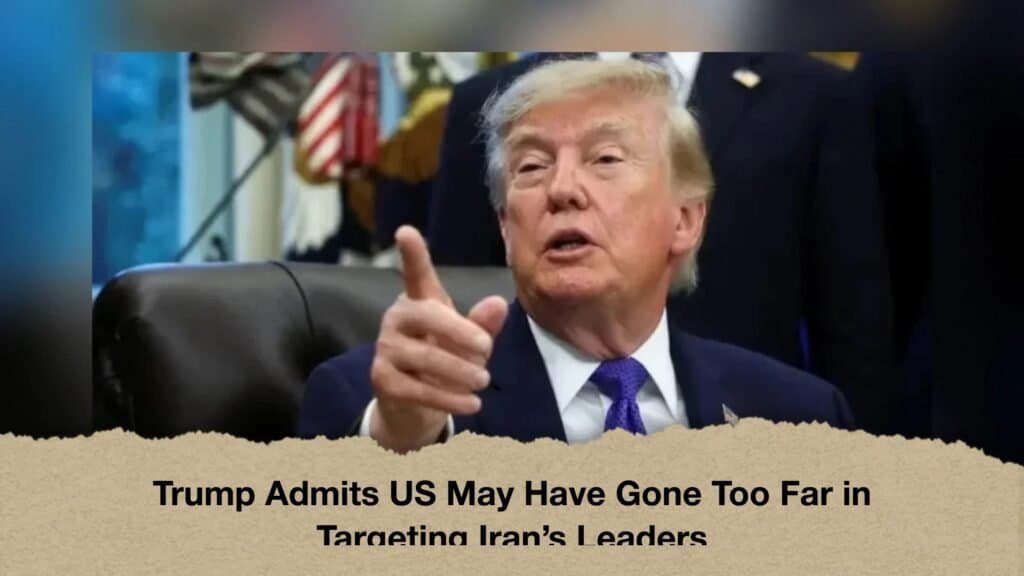
Speaking at an election rally in Youngstown, Ohio, on Tuesday, 12 October, Trump said the US may have pushed its campaign against Iranian leaders too far, making it difficult to determine who should represent Iran in potential discussions.
“We may have gone too far with the leaders, because we really don’t know who to talk to now,” Trump said.
He added that identifying the right person to negotiate with had become a challenge. In an unusually candid remark, the US president acknowledged that Washington might have overstepped in its efforts against Iran’s leadership.
Trump also repeated his claims about the damage inflicted on Iran’s military capabilities. He said the country had lost its air force and all 159 of its ships, which he described as now resting at the bottom of the sea. The claims were not independently verified in the information available for this report.
His remarks come amid continuing tensions in the Gulf, where a series of attacks on commercial vessels has raised concerns about maritime security and the safety of international shipping routes.
The United Kingdom Maritime Trade Operations (UKMTO) has reported at least 19 attacks on commercial vessels since 1 October. The incidents have heightened concerns over the risks facing ships operating in the region.
The Gulf is a strategically important corridor for global trade and energy transportation. Disruptions to shipping in the area can affect the movement of goods, increase security risks for commercial operators and create uncertainty in international markets.
Trump’s comments have highlighted a potential complication in Washington’s approach to Iran: military pressure may weaken an adversary’s capabilities, but it can also make diplomatic engagement more difficult if the people needed for negotiations cannot be identified.
Iranian President Masoud Pezeshkian has held office since July 2024. Trump’s assertion that nobody wants to become Iran’s president therefore appears to have been a political remark rather than a literal description of the country’s leadership arrangements.
It remains unclear whether Trump’s comments signal any change in the US administration’s approach to Tehran. No new diplomatic initiative or formal decision on negotiations was outlined in the reported remarks.
As tensions continue in the Gulf, the challenge for both sides will be to establish reliable channels of communication while addressing the security concerns surrounding the region’s commercial shipping routes.