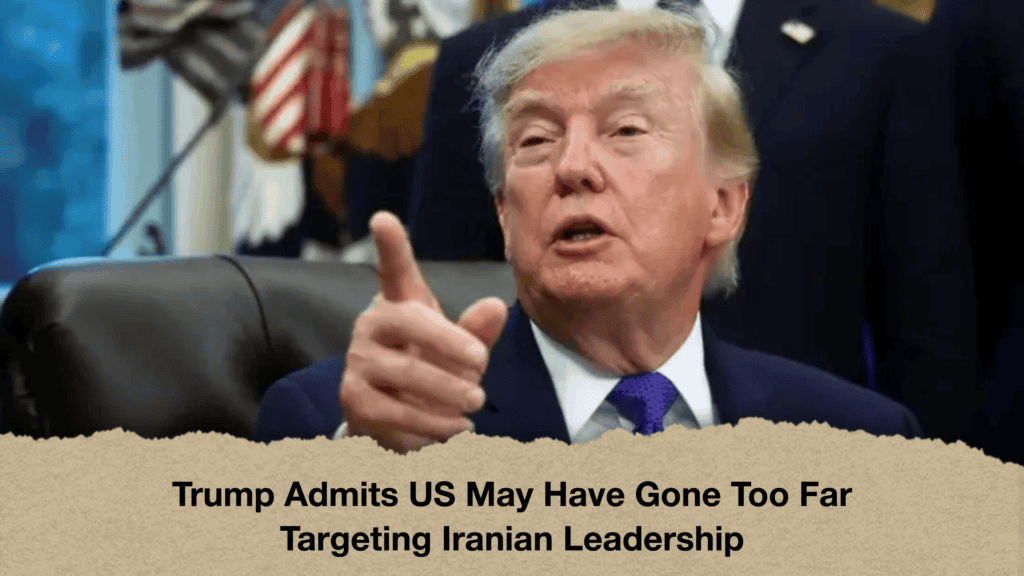
In an unusually candid admission, former US President Donald Trump suggested that Washington may have overreached in its aggressive campaign targeting Iranian leadership, leaving American officials in a dilemma over how to establish diplomatic dialogue with Tehran. His remarks have raised fresh questions about the long-term effectiveness of the United States’ foreign policy and military strategy in the Middle East.
Addressing supporters on Tuesday, 12 October, at a campaign rally in Youngstown, Ohio, Mr Trump admitted that the intense pressure applied to Iranian officials has inadvertently complicated efforts to reach a political settlement. By severely weakening Tehran’s authority, Washington has made it increasingly difficult to identify a clear, credible counterpart for future negotiations.
“We may have gone too far with the leaders, because now we don’t know who to speak to,” Mr Trump told the crowd. Expressing genuine frustration over the diplomatic deadlock, he acknowledged that determining a viable partner for discussions had become a major hurdle for US foreign policy planners.
During the address, Mr Trump also claimed that “nobody wants to be president” in Iran—a statement that stands in sharp contrast to political realities on the ground. Masoud Pezeshkian has served as Iran’s elected president since July 2024. Observers view Mr Trump’s remark as a dramatic rhetoric on Iran’s internal leadership dynamics rather than an accurate reflection of a vacant presidency.
Reiterating his previous claims about Iran’s military losses, Mr Trump asserted that Tehran had lost its entire air force along with 159 naval vessels, adding colorfully that the ships were now “resting nicely at the bottom of the sea.” Independent verification of these military figures remains difficult, as neutral defense analysts and international observers caution that such statements should be treated as political assertions rather than confirmed combat statistics.
These controversial statements come at a moment of heightened maritime insecurity across vital Middle Eastern trade corridors. The United Kingdom Maritime Trade Operations (UKMTO) recently reported at least 19 separate attacks on commercial shipping vessels since 1 October alone.
The Gulf region serves as a crucial artery for global commerce, particularly for international energy shipments. Persistent strikes on commercial traffic force shipping companies to alter trade routes, implement costly security protocols, or delay voyages entirely—driving up freight tariffs and threatening global supply chains.
While heavy military pressure and economic sanctions can diminish an adversary’s operational capabilities, maintaining functional diplomatic channels remains vital for crisis de-escalation. Mr Trump’s admission highlights the paradox of a policy that successfully applies pressure yet stifles the very avenues needed to negotiate a lasting peace.