Sabbir Ahmed
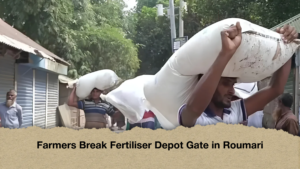
The government claims there is no fertiliser crisis—stating that adequate reserves are available. However, the picture on the ground tells a very different story. Day after day, farmers are forced to move from one dealer’s door to another without receiving fertiliser at the government-set prices, ultimately having to buy it from the black market at an inflated rate of BDT 300 to BDT 400 extra per bag. According to a report by the Dhaka Tribune, farmers who purchase fertiliser by the kilogram are being forced to pay anywhere between 11 percent and 175 percent more, depending on the type of fertiliser. The situation has become so unbearable that, out of sheer frustration, farmers in Kurigram’s Bhurungamari were forced to seize 197 bags of fertiliser directly from a dealer’s warehouse. It requires little imagination to understand how backed into a corner farmers must feel to resort to such extreme measures.
Attributing the blame to dealers, the government asserts that dealers are failing to lift their allocated quantities of fertiliser. On the other hand, dealers contend that the government has supplied a volume far below actual requirements. A Research Fellow at the Centre for Policy Dialogue (CPD) told The Daily Star, “The surplus reserve shown by the government is so minimal that it fails to reassure the market, and dealers are taking advantage of weak market monitoring mechanisms.” He further noted, “Many dealers operate under multiple licences, with some effectively controlling the fertiliser trade across an entire district—creating what is, in practice, a monopoly.”
The ongoing fertiliser crisis stems primarily from four core factors: 1) increased demand compared to last year, 2) the gas shortage, 3) changes in dealer policy, and 4) a lack of timely planning and management inefficiency. Due to the absence of floods this year and favourable weather conditions, significantly more land has been prepared for cultivation. More cultivated land naturally demands a greater volume of fertiliser, thereby driving up overall demand.
As a result of the ongoing gas crisis, the Ashuganj Fertilizer Factory has remained shut since February 2025, while the Jamuna Fertilizer Company Limited suspended operations in February this year. Public anticipation of an impending fertiliser shortage had been building since then, and those fears have now materialized. This shortfall has created room for dealers to manipulate the market. Although three out of BCIC’s seven fertiliser factories are currently operational, gas shortages have forced them to run far below their installed capacities. The total demand for chemical fertiliser in Bangladesh for the 2026–27 fiscal year stands at 5.8 million tonnes. Despite possessing a domestic production capacity of 3.7 million tonnes, gas constraints reduced actual output in 2025–26 to a mere 1.106 million tonnes—just 30 percent of total capacity. With the gas crisis worsening in the current fiscal year, domestic production is bound to drop even further. Consequently, over 70 percent of the nation’s fertiliser requirements must now be met through imports.
Historically, Bangladesh imports urea fertiliser from Saudi Arabia, the United Arab Emirates, and Qatar. However, extensive bombardment by Iran in these countries has disrupted their production, while the closure of the Strait of Hormuz has halted urea shipments from these three nations altogether. Russia and China are two other major exporters of urea, but both suspended fertiliser exports following the outbreak of the Iranian war. Alternative suppliers—such as Algeria, Nigeria, Brunei, Vietnam, Indonesia, and Malaysia—export urea in smaller quantities, and supplies could potentially be secured from them. Egypt is another major urea exporter; according to World Fertilizer Magazine, Egypt’s fertiliser production increased by 25 percent this year compared to the last. Procuring urea from Egypt could help bridge Bangladesh’s current deficit.
For TSP, DAP, and MOP fertilisers, Bangladesh has historically relied on imports from Russia, Canada, Morocco, China, Tunisia, Jordan, and Egypt. While Russia and China have halted exports, procuring non-urea fertilisers from the remaining trade partners presents no major technical hurdles. Furthermore, TSP, DAP, and MOP can also be imported from the United States, Lithuania, and Mexico. What is urgently required is sound planning and decisive initiative. Fertilisers ensure national food security—financial costs should not be the primary constraint.
Another contributing factor to the current impasse is the Fertiliser Dealer Appointment and Management Policy 2025. Under this new policy, dealers appointed separately by BCIC and BADC have been brought under a unified framework. This policy shift has introduced widespread uncertainty among long-established dealers, who fear heightened competition and the potential loss of their dealerships. The appointment of two new dealers per union is viewed by veteran distributors as an infringement upon their existing market share. This comes on top of pre-existing tensions between BCIC- and BADC-appointed dealers. Furthermore, allegations have emerged regarding the inequitable distribution of fertiliser among dealers, severely impacting their businesses and livelihoods. The Chairman of the Bangladesh Fertilizer Association informed the Dhaka Tribune that established dealers remain deeply dissatisfied with the new policy.
Following the joint military strikes on Iran by the United States and Israel in February, Bangladesh experienced an immediate fuel crisis. Farmers and the general public alike were forced to stand in queues at petrol pumps for 12 to 14 hours at a time to secure fuel. It was evident even then that a severe crisis in power and fertiliser would soon follow. Although these issues were widely discussed across social and mainstream media as early as March, proactive measures involving sound planning, demand forecasting, and efficient management could have averted the current crisis—enabling the country to import gas, fuel, and fertiliser at significantly lower costs than today.
Under the present circumstances, there is a strong likelihood that agricultural yield will decline while production costs escalate significantly this year. Farmers failed to secure fair prices from the government during the previous Boro season. The government fixed the procurement price of rice at BDT 32.97 per kg—an increase of just one paisa over last year’s price of BDT 32.96—despite having raised fuel prices itself and failing to supply adequate electricity for irrigation. Compounded by inflation exceeding 9 percent, farmers have faced growing impoverishment and distress. Their plight will only worsen if they fail to receive fertiliser on time or are forced to purchase it at exorbitant prices on the black market.
Despite the greater geographical distances and higher freight costs, securing an adequate supply of fertiliser remains achievable by opening dialogue with diverse exporting nations to expand import sources. Concurrently, the government must ensure the equitable allocation of fertiliser among dealers according to their legitimate entitlements, while establishing a digital surveillance system without delay to keep dealers under continuous oversight. Failing this, national food security will be severely compromised, forcing the country to import food at exorbitant prices and risking the realization of the UN World Food Programme’s dire July prediction: that 18.1 million people in Bangladesh could face severe food insecurity.
7 September 2026
Kalabagan, Dhaka.