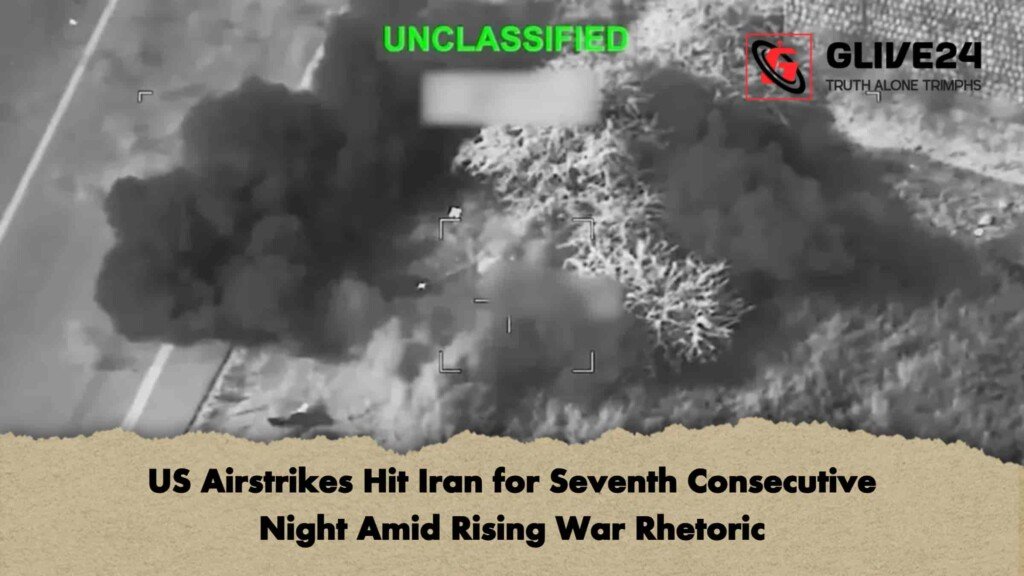
Tensions in the Middle East have escalated to a critical flashpoint as United States forces conducted airstrikes against Iran for the seventh consecutive night. The continuous military campaign, which bypasses the previous Islamabad Accord, has drawn fierce condemnation from Tehran, with Iranian officials warning that persistence from Washington will plunge the region into a full-scale, unrestricted war.
US Central Command Confirms Ongoing Campaign
United States Central Command (CENTCOM) confirmed the latest wave of strikes in a statement released on the social media platform X early on Friday morning. According to the military command, the operations are designed to systematically degrade Iran’s strategic capabilities.
“CENTCOM has been conducting operations in Iran for seven consecutive nights. In accordance with the directives of the Commander-in-Chief of the US Armed Forces, President Donald Trump, our efforts to diminish Iran’s military capabilities remain ongoing.”
The relentless aerial campaign marks a significant departure from diplomatic channels. The military action has targeted key infrastructure across various regions, with the latest strikes focusing heavily on the southern coastal areas of the Islamic Republic.
Casualties and Contested Incidents in the Gulf
The humanitarian and infrastructural toll of the campaign is beginning to emerge. According to independent reports from the French news agency AFP, the latest strikes on Friday targeted the southern coastal province of Hormozgan. The Deputy Governor for Political, Security, and Social Affairs in Hormozgan confirmed to the state-run IRNA news agency that extensive bombing had occurred across multiple sectors of the province. The bombardment resulted in at least three fatalities and left eight others injured.
Simultaneously, a shadow war appears to be unfolding in the strategic maritime corridors of the region. The Islamic Revolutionary Guard Corps (IRGC), the elite branch of the Iranian Armed Forces, claimed that two foreign commercial tankers were damaged by explosions on Friday whilst navigating through a heavily mined sector of the Strait of Hormuz.
However, CENTCOM moved swiftly to dismiss the Iranian allegations, officially categorising the IRGC’s claims regarding the tanker explosions as entirely “baseless”.
Tehran Warns of All-Out Regional Warfare
The sustained bombardment has provoked an aggressive response from the highest echelons of Iran’s military leadership. Tehran has demanded an immediate cessation of all US aerial operations, explicitly warning that further intervention will trigger a massive military retaliation.
Major General Mohsen Rezaei, the military advisor to Iran’s Supreme Leader, issued an uncompromising warning immediately following Friday night’s strikes:
“Should the United States continue these attacks, Iran will not confine itself merely to retaliatory strikes. We will engage in full-scale war, and in such an eventuality, no political borders within the Gulf region will remain secure.”
Diplomatic observers note that Rezaei’s rhetoric indicates that any expansion of the conflict could destabilise neighbouring Gulf states, effectively nullifying international borders in a broader regional conflagration.
The Collapse of the Islamabad Accord
The current hostilities stem from a severe breakdown in diplomatic relations that began earlier this month. The fragile peace maintained under the Islamabad Accord shattered on 5 July, when Iranian forces launched drone attacks targeting two United Arab Emirates (UAE) commercial vessels in the Strait of Hormuz. Washington viewed the incident as an unacceptable breach of international maritime law and a direct violation of the accord.
Following the maritime assault, political relations deteriorated rapidly. On 8 July, during a press briefing with journalists in the Turkish capital of Ankara, US President Donald Trump declared that the ceasefire between Washington and Tehran had officially reached its end.
President Trump delivered a scathing assessment of the Iranian administration, stating:
“Our ceasefire with Iran is over. Their recent attack on commercial vessels in the Strait of Hormuz is a flagrant violation of the Islamabad Memorandum of Understanding. The leaders of the ruling regime in Iran are erratic and malicious. Following their assault on commercial shipping in the Strait, I believe further negotiations for a peace treaty with them would be nothing short of a waste of time.”
Following the President’s declaration, CENTCOM initiated its targeted aerial campaign on the night of 11 July. With neither Washington nor Tehran showing a willingness to retreat, the international community faces the growing prospect of an uncontained conflict in one of the world’s most critical energy corridors.