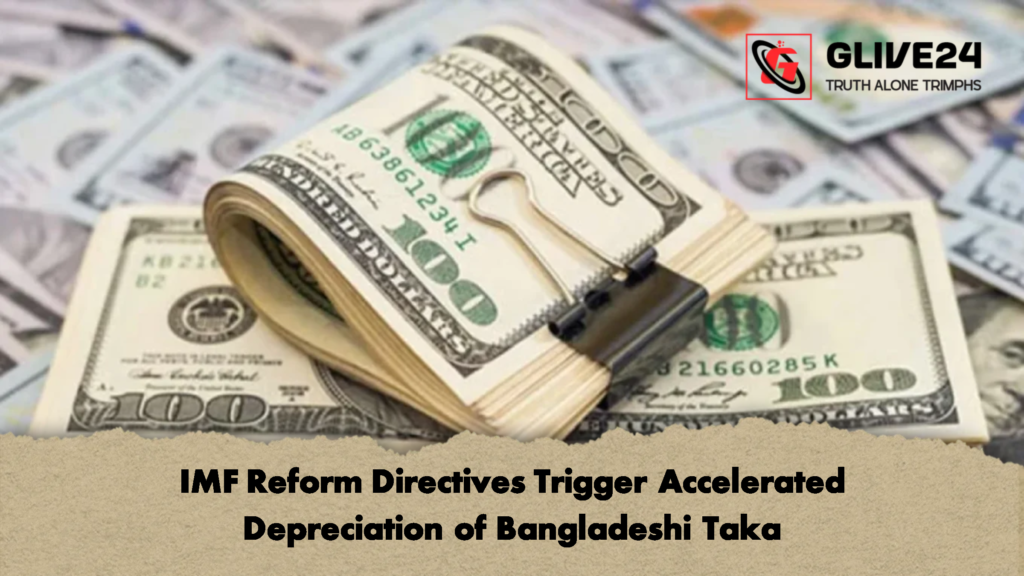
Bangladesh’s international trade and commercial landscape continues to expand in alignment with global economic shifts, driving notable volatility across major foreign exchange rates. Despite adequate liquidity reserves in the domestic market, the local currency has faced a series of controlled depreciations as the central bank systematically enforces macroeconomic reforms mandated by the International Monetary Fund (IMF).
As part of this ongoing regulatory alignment, the interbank foreign exchange market witnessed the US Dollar ascend by an average of 13 paise to a peak increment of 15 paise earlier this month. The upward momentum has accelerated significantly during the current trading week, with the greenback registering a sharp increase of approximately 50 paise. This contrasts noticeably with the preceding month, during which interbank transaction rates for the US Dollar had maintained a steady equilibrium, plateauing at a uniform maximum and minimum threshold of 122.85 Taka.
Official Interbank Exchange Matrix
Data released by Bangladesh Bank and leading commercial banking institutions outlines the minimum interbank conversion rates recorded on 20 July 2026. The comprehensive trading register spans major global, regional, and Gulf Cooperation Council (GCC) currencies.
| Currency Name | Currency Code | Interbank Exchange Rate (BDT) |
| Kuwaiti Dinar | KWD | 398.01 |
| British Pound | GBP | 166.25 |
| Euro | EUR | 141.36 |
| US Dollar | USD | 123.58 |
| Singapore Dollar | SGD | 95.64 |
| Canadian Dollar | CAD | 88.12 |
| Australian Dollar | AUD | 86.25 |
| Qatari Rial | QAR | 33.72 |
| UAE Dirham | AED | 33.53 |
| Saudi Riyal | SAR | 32.77 |
| Malaysian Ringgit | MYR | 30.09 |
| Chinese Yuan | CNY | 18.23 |
| Indian Rupee | INR | 1.28 |
Financial analysts note that these official figures remain highly fluid and subject to intra-day market corrections based on real-time settlement volumes.
Market Stabilisation Amid Importer Disquiet
Economic commentators and financial sector strategists have observed that aggressive oversight by the central bank, paired with a resilient influx of inward remittance from expatriate workers, has successfully narrowed the historically volatile spread between the official banking rates and the open curb market. However, the systematic push to satisfy the IMF’s structural benchmarks has introduced a layer of deliberate pressure on the Taka.
According to central bank ledgers, the baseline value of the US Dollar has shifted from its early-month position of 122.85 Taka to the current floor of 123.58 Taka. While this crawling peg adjustment serves broader fiscal consolidation goals, the sudden escalation within a single week has triggered a wave of anxiety among commercial importers and industrial manufacturers, who face swelling import bills and heightened operational expenditures.