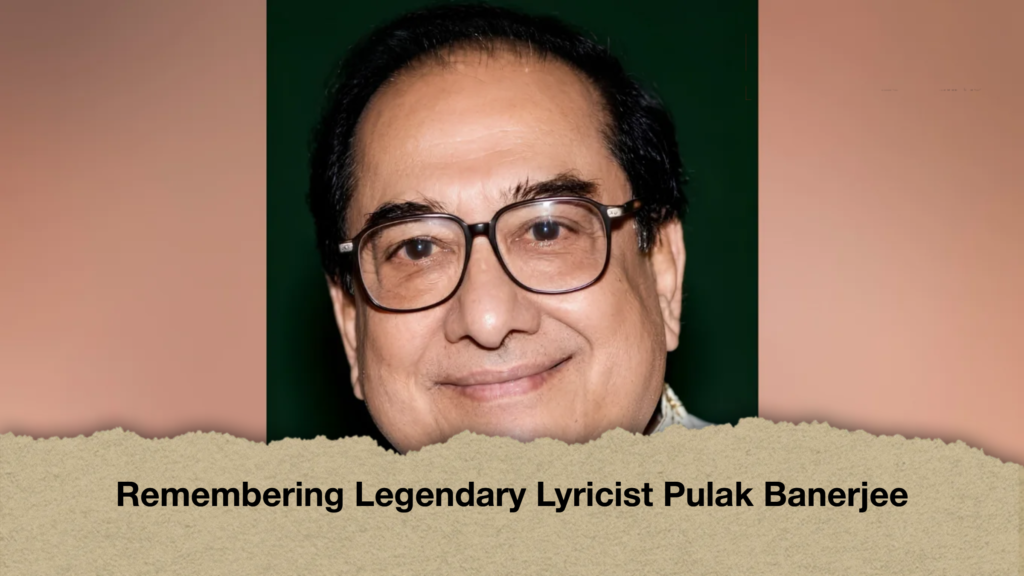
Some songs are heard, while others are felt. They speak of first love, separation, longing and the quiet joys of everyday life. Then there are songs that seem to knock gently on the doors of memory, bringing back a forgotten afternoon, an old relationship or an emotion that never truly disappeared.
The songs of Pulak Bandyopadhyay belong to that rare category. His lyrics captured love, heartbreak, tenderness, resentment, nature, society and the many shades of human emotion with remarkable simplicity. Decades after his death, his words continue to resonate with listeners across generations.
Among his most enduring creations is Ke Prothom Kachhe Esechhi, a song that still evokes the delicate uncertainty and excitement of falling in love for the first time. Sung by Lata Mangeshkar and Manna Dey, the song featured in the 1966 Bengali film Shankhabella and became one of the memorable musical works associated with the era. The same film also featured Aaj Mon Cheyechhe, sung by Lata Mangeshkar, which won a special place in the hearts of listeners.
Yet Pulak Bandyopadhyay’s contribution to Bengali music extends far beyond a handful of popular songs. He created an enormous lyrical world in which romance existed alongside sorrow, humour, social observation, patriotism, nature and the intimate experiences of ordinary people.
A Childhood Shaped by the Arts
Pulak Bandyopadhyay was born on 2 May 1931 in Salkia, Howrah. He spent his childhood in Howrah, growing up in an environment closely connected with theatre, literature and music. That cultural atmosphere played an important role in nurturing his creative instincts from an early age.
He later graduated from Scottish Church College in Kolkata. His familiarity with literature and the performing arts helped shape a distinctive lyrical voice—one that could express complex emotions without making them sound complicated.
His greatest strength was perhaps his ability to find poetry in familiar experiences. His lyrics often sounded conversational, yet carried an emotional depth that allowed listeners to see their own lives reflected in them.
A Leading Voice of Bengali Music’s Golden Era
The 1960s and 1970s are widely remembered as a particularly vibrant period in Bengali cinema and music. Talented composers, singers, lyricists and filmmakers worked together to produce songs that remain part of Bengal’s cultural memory.
Pulak Bandyopadhyay was one of the prominent lyricists of that period. His accessible language, emotional precision and versatility made his work popular among composers and performers alike.
Many celebrated singers lent their voices to his lyrics, including Hemanta Mukhopadhyay, Manna Dey, Geeta Dutt, Lata Mangeshkar, Asha Bhosle, Haimanti Shukla, Shyamal Mitra, Bhupen Hazarika, Pratima Banerjee, Utpala Sen, Arundhati Homchoudhury, Satinath Mukhopadhyay, Anup Ghoshal and Arati Mukhopadhyay.
The exact number of songs he wrote varies across different accounts, although he is widely credited with having written more than 4,000 songs. His work covered Bengali films and modern songs as well as Shyama Sangeet, children’s verse, stories, novels and screenplays.
Songs That Became Part of Collective Memory
The 1966 film Shankhabella occupies an important place in discussions of his musical legacy. Ke Prothom Kachhe Esechhi, performed by Lata Mangeshkar and Manna Dey, remains particularly memorable for the tenderness and uncertainty woven into its portrayal of love.
His versatility was equally apparent in his work for the 1969 film Prothom Kadam Phool, for which he wrote the lively and distinctive song Ami Shri Shri Bhajahari Manna.
Among his other well-known compositions are Amar Bolar Kichhu Chhilo Na, Chirodini Tumi Je Amar, K Phonta Chokher Jol, Tumi Nijer Mukhe Bolle Jedin, Nijhum Sandhyay Pantha Pakhirara, O Chand Samle Rakho Jochhonake, Ek Boishakhe Dekha Holo Dujonar, Rangila Bashite Ke Dake, Se Amar Chhoto Bon and Aaj Mon Cheyechhe Ami Hariye Jabo.
The enduring appeal of these songs lies partly in their emotional familiarity. They do not depend solely on elaborate imagery. Instead, they transform ordinary feelings into memorable lines, allowing listeners to attach their own experiences to the songs.
A Writer Beyond the World of Lyrics
Bandyopadhyay was not only a lyricist. He was also a prolific creative writer who worked across several literary forms.
His notable books include Amar Priyo Gaan, Bahatture and Shesh Sanglap. His autobiographical work Kathay Kathay Raat Hoye Jay offered another window into his life and creative journey.
In 1996, the album Ami Dekhechhi was released, featuring eight autobiographical songs written by Bandyopadhyay and sung by Manna Dey. The project provided a particularly personal dimension to his songwriting, allowing aspects of his own experiences and reflections to emerge through music.
His songs centred on motherhood, including Ma Amar Ma, also became memorable examples of his ability to express deeply personal emotions in an accessible form.
A Painful Final Chapter
Behind the celebrated body of work, however, lay a life that ended in tragedy. According to accounts citing people close to him, Bandyopadhyay experienced depression during the later part of his life. The precise reasons behind his emotional distress, however, remain unclear.
On 7 September 1999, he died after jumping from a launch into the Hooghly River. His sudden death sent shockwaves through the Bengali cultural world and left behind a profound sense of loss.
Questions surrounding his final years remain difficult to answer. What personal struggles did he carry? What memories or disappointments remained unspoken? There are no definitive answers.
What is certain is the extraordinary contrast between his public creative legacy and the sorrow surrounding the final chapter of his life. The man who gave generations a language for love, longing and tenderness ultimately left behind a personal story marked by unanswered questions.
A Legacy That Refuses to Fade
Pulak Bandyopadhyay died more than two decades ago, but his songs have never disappeared. They continue to be heard on radio programmes, in old recordings, on television and through modern digital platforms.
When Ke Prothom Kachhe Esechhi plays today, it can still transport a listener to another time. A familiar melody may bring back a first love, a forgotten afternoon or someone who has long since disappeared from everyday life.
That is perhaps the lasting achievement of a great lyricist: to write beyond his own time and become part of the emotional vocabulary of generations he would never meet.
Pulak Bandyopadhyay achieved precisely that. His lyrics remain woven into Bengali musical culture, carrying memories of romance, separation, joy and human vulnerability.
People leave, but meaningful creations endure. Pulak Bandyopadhyay remains alive through the songs he wrote, the voices that carried his words and the countless listeners who continue to find their own stories within them.
Born: 2 May 1931
Died: 7 September 1999
A heartfelt tribute to the memory of the celebrated Bengali lyricist Pulak Bandyopadhyay.