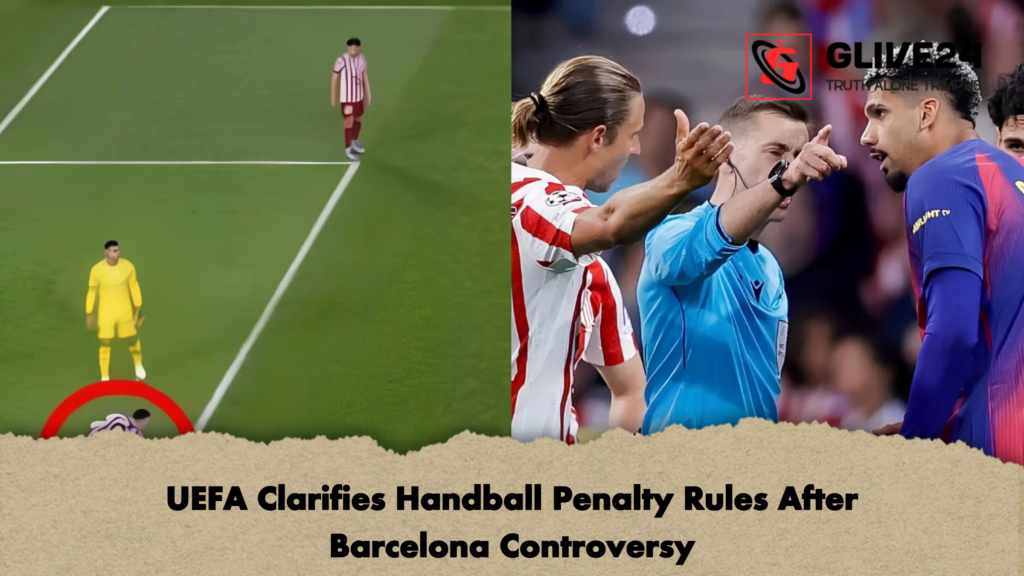
UEFA has issued clearer guidance to referees on handball decisions inside the penalty area, following a controversial incident involving Barcelona in the Champions League earlier this year.
Under the new guidance, if a player deliberately handles the ball inside their own penalty area while the ball is in play, the referee must award a penalty. UEFA has indicated that referees should not rely on subjective interpretations or appeals to so-called ‘common sense’ when assessing such an incident.
The clarification comes around four months after a disputed moment during the first leg of the Champions League quarter-final between Barcelona and Atlético Madrid on 8 April 2026.
The incident occurred after Atlético goalkeeper Juan Musso played the ball from a goal kick towards Marc Pubill. While inside his own penalty area, Pubill appeared to use his hand to stop the ball even though it was already in play. However, Romanian referee István Kovács did not award Barcelona a penalty, and the Video Assistant Referee (VAR) did not recommend an on-field review.
Barcelona subsequently lodged a formal complaint, arguing that the refereeing decision should be acknowledged as an error. However, UEFA’s disciplinary authorities reportedly rejected the complaint, leaving the club without any official recognition that the decision had been incorrect.
The latest guidance has now reignited debate over the incident. While UEFA’s clarification does not amount to a direct reversal of the original decision, its wording appears to support Barcelona’s argument that deliberate handball inside the penalty area, when the ball is in play, should result in a penalty.
The timing of the incident made the decision particularly significant. Barcelona were trailing Atlético 1–0 when the handball occurred. They eventually lost the match 2–0, leaving them with a difficult task in the second leg.
Barcelona were unable to overturn the deficit in the return fixture and ultimately failed to reach the Champions League semi-finals, with Atlético Madrid progressing after winning the tie over two legs.
The episode has also highlighted the continuing importance of consistency in the application of handball laws. Such decisions have long been among the most contentious issues in elite football, with referees often required to assess whether a hand movement was deliberate, whether the player had enough time to react and whether the position of the arm or hand materially affected the play.
UEFA’s latest instruction seeks to reduce ambiguity in at least one specific situation. Where a player intentionally handles the ball inside their own penalty area while play is active, referees are now being told that the appropriate outcome is a penalty rather than an interpretation based on individual judgement or an informal appeal to common sense.
For Barcelona, the clarification offers little practical consolation after their Champions League exit. The club cannot change the result of the quarter-final, but the new guidance has nevertheless given fresh weight to its concerns over the controversial decision that became one of the talking points of the tie.