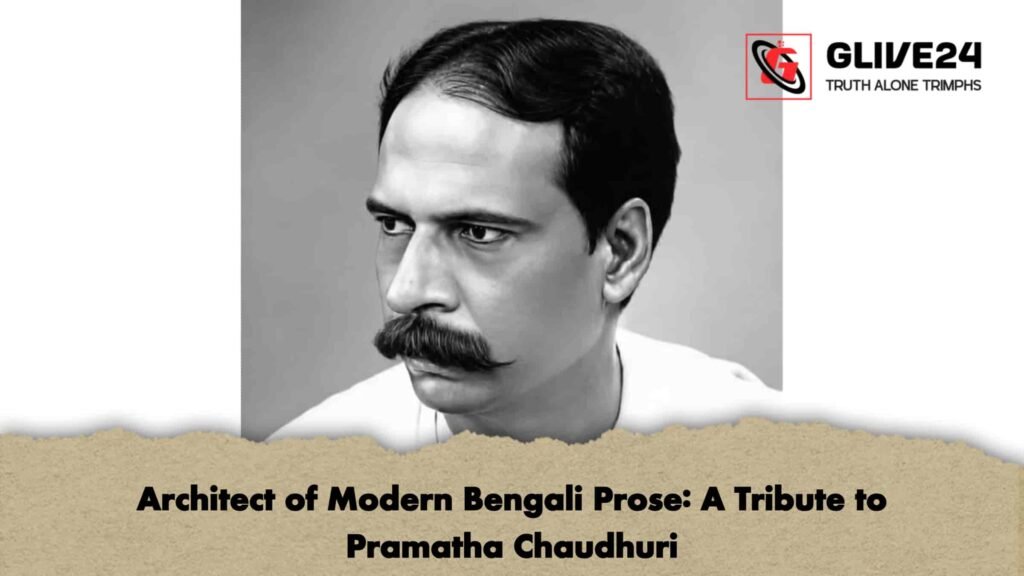
The evolution of modern Bengali prose owes an immense debt to a handful of literary visionaries who dared to redefine its linguistic contours. Standing prominently amongst these architects of language is Pramatha Chaudhuri—an eminent poet, essayist, short-story writer, academic, and editor. Celebrated for his intellectual brilliance, Chaudhuri is best remembered for spearheading the revolution that replaced the rigid, archaic literary style with the vibrant colloquial language (Chalit Bhasha) that defines contemporary Bengali literature.
Under his famed nom de plume, ‘Birbal’, Chaudhuri carved out a distinct niche in Bengali letters. He introduced an unmatched sophistication characterised by incisive wit, unsentimental critique, rationalist thought, and sharp satire. His seminal contributions laid the groundwork for modern satirical prose, elevating critical discourse to an art form.
Formative Years and Educational Rigour
Born on 7 August 1868 in Jessore, Bengal, Chaudhuri belonged to a distinguished family hailing from Haripur village in the Pabna district. His father, Durgadas Chaudhuri, was a progressive and cultured landlord who prioritised learning and intellectual development. From a young age, Chaudhuri displayed exceptional cognitive talent, a keen analytical mind, and a deep appreciation for the arts.
He received his foundational schooling at Calcutta’s renowned Hare School, proceeding subsequently to the prestigious Presidency College and the University of Calcutta for his higher qualifications. Upon completing his legal education, he spent a brief period as a barrister at the Calcutta High Court. He later transitioned into academics as a lecturer at the University Law College in Calcutta, whilst also overseeing administrative duties as manager of the Tagore Estate.
The Sabuj Patra Paradigm Shift and Literary Alliances
Chaudhuri’s life was deeply integrated with the cultural elite of Bengal through his marriage to Indira Devi Chaudhurani, the highly accomplished niece of Nobel laureate Rabindranath Tagore. The pair became a cornerstone of Calcutta’s intellectual circle, fostering vibrant discussions across art, literature, and social reform.
In 1914, Chaudhuri established Sabuj Patra (The Green Leaf), a groundbreaking literary journal that became the crucible for a major linguistic transformation. At a time when formal writing was heavily dominated by Sadhu Bhasha—a heavily Sanskritised and complex register—Chaudhuri used Sabuj Patra to champion Chalit Bhasha, the living, spoken language of the educated urban population. His relentless advocate work successfully demystified literary prose, proving that spoken language possessed the flexibility and precision required for nuanced philosophical, social, and political commentary. In later years, he also edited the prestigious journal Visva-Bharati.
Oeuvre and Lasting Significance
Pramatha Chaudhuri’s bibliography remains a testament to his versatility and intellectual depth. His writing stands out for its clarity, logical coherence, and subtle humor, avoiding melodrama in favour of reasoned argument and refined aesthetics.
His principal published works include:
-
Essay Collections: Tel-Nun-Lakri (Oil, Salt, and Firewood), Birbaler Halkhata (Birbal’s Ledger), Nana Katha (Miscellaneous Thoughts), Amader Shiksha (Our Education), Rayater Katha (On the Peasantry), and Nana Charcha (Varied Discussions).
-
Short Fiction: Char-Yari Katha (Tales of Four Friends), Ahuti (The Offering), and Neellohit.
-
Poetic Works: Sonnet Panchashat (Fifty Sonnets) and Padacharan (Footsteps).
Pramatha Chaudhuri passed away on 2 December 1946, leaving behind a rich legacy that fundamentally altered the course of Bengali letters. On his birth anniversary, tribute is paid to ‘Birbal’—a master writer whose commitment to clarity, logic, and linguistic innovation continues to inspire generations of readers and authors alike.