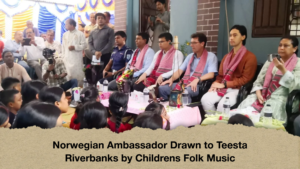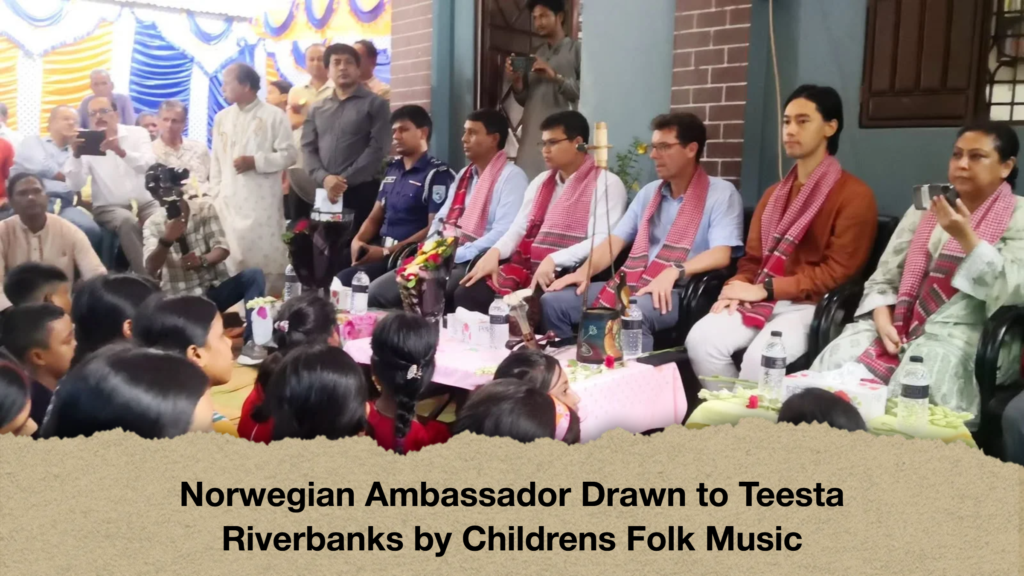
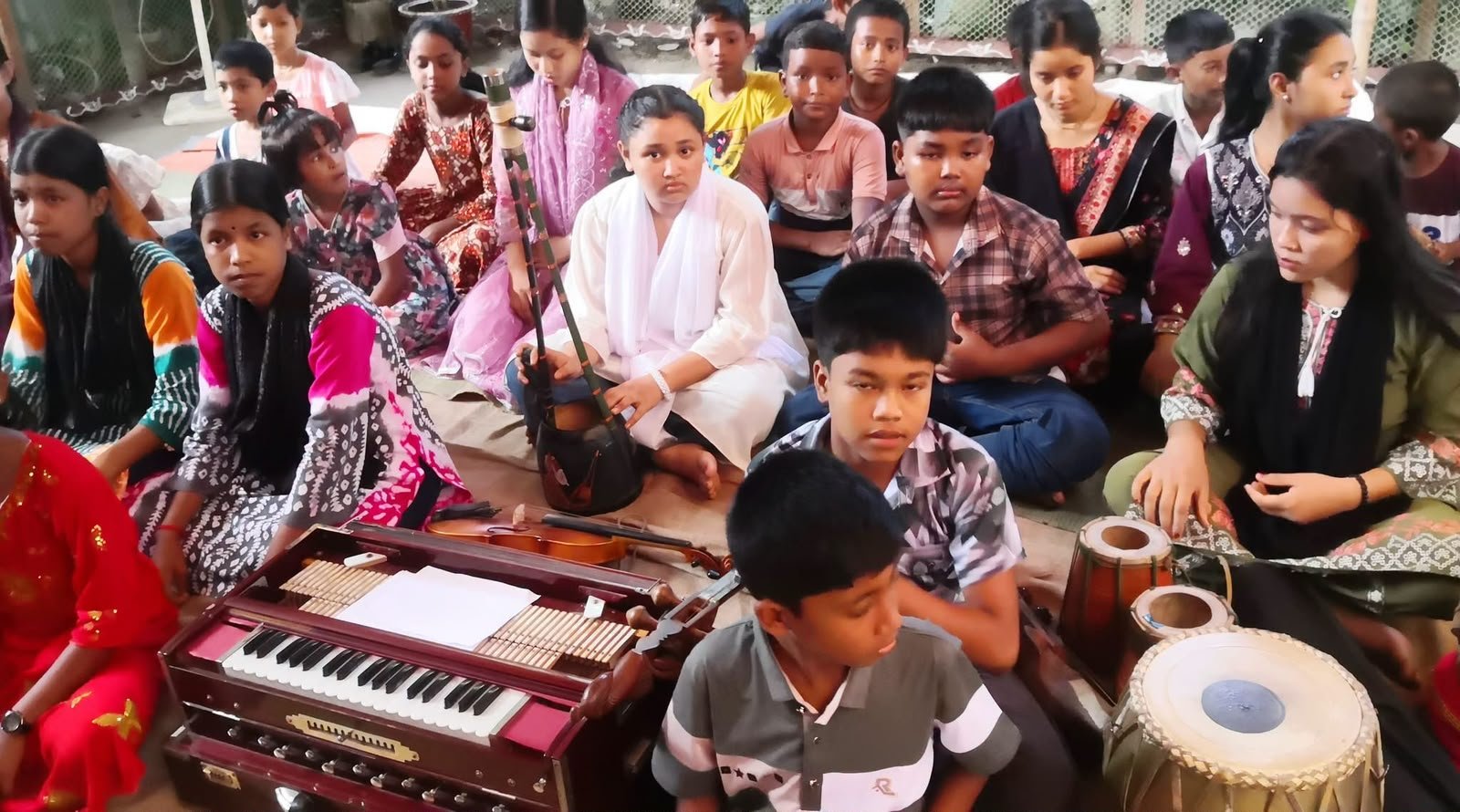
The melodious tunes of Bhawaiya, Lalon, Baul, Murshidi, and Marfati echoed through the remote village of Deodoba along the Teesta riverbank in Lalmonirhat. Children held ektaras and dotaras, while others played flutes and violins. It was into this rich musical gathering on Monday afternoon that Håkon Arald Gulbrandsen, the Norwegian Ambassador to Bangladesh, arrived.
The diplomat visited the village in Aditmari upazila to inspect the initiatives of ‘Mayer Tori’, a cultural and social organisation. During his visit, the ambassador observed children practicing folk music, receiving training on traditional instruments, and engaged with the organisation’s broader community work.
He enjoyed listening to the young performers and watching them play. The Norwegian diplomat was particularly captivated by the harmonious blend of the ektara, dotara, sarinda, violin, and flute.
Reflecting on his visit, Håkon Arald Gulbrandsen emphasised that initiatives of this nature are vital for preserving Bangladesh’s rich cultural heritage. He praised ‘Mayer Tori’ for its decade-long dedication, noting the meaningful role it plays in community development.
The ambassador observed that folk music and cultural traditions do not merely reflect a nation’s past, but serve as a powerful medium for building human connections. Through ‘Mayer Tori’, children from marginalised communities gain access to cultural education, ensuring that local traditions, folk songs, and regional instruments are passed down to future generations
Over 500 Children Trained Across Nine ‘Guru Grihas’
Sujan Kumar Beda, Executive Director of ‘Mayer Tori’, explained that the organisation currently operates nine ‘Guru Grihas’—traditional learning centres—across the Lalmonirhat and Kurigram districts. More than 500 children are currently learning Bengali folk music through these centres.
In addition, around 125 students are undergoing musical training at two dedicated folk instrument centres, while a special monthly masterclass caters to 15 selected pupils.
Members of the organisation noted that each guru teaches children within their own homes. Despite facing financial constraints, most instructors work on a largely voluntary basis.
Through their time, effort, and devotion, local children are learning Lalon, Baul, Murshidi, Marfati, Bhawaiya, and traditional rural songs. They are also mastering indigenous folk instruments, including the violin, ektara, dotara, flute, tabla, khamak, and sarinda.
Modern Recording Studio and Digital Archive Needed
Lipi Debnath, a guru at the Deodoba village ‘Guru Griha’, highlighted that the lack of funding and preservation facilities remains one of their greatest hurdles.
She explained that establishing a modern recording studio would allow performances by both veteran folk artists and young learners to be systematically recorded into a digital archive. This would safeguard unwritten songs and rare melodies from fading into obscurity.
Yousuf Alamgir, an organiser at ‘Mayer Tori’, stated that the initiative centers on nurturing self-purification and a deeper appreciation of life among children through folk music.
He remarked that ‘Mayer Tori’ has persevered for ten years on limited resources, voluntary labour, and passion. Despite lacking major infrastructure or advanced technical equipment, folk music sessions continue uninterrupted across rural courtyards.
According to Alamgir, placing an ektara, dotara, or flute in a child’s hands is more than just a music lesson; it is an active campaign to hand down Bengal’s endangered melodies, sounds, and heritage to the next generation.
The Norwegian Connection Behind ‘Mayer Tori’
The origins of ‘Mayer Tori’ are closely tied to Ms Wera Sæther, a Norwegian author, folk researcher, photographer, and poet.
She first arrived in Bangladesh in 1998. While visiting flood-affected communities in the South Namaz Char area of Kurigram’s Roumari upazila along the Brahmaputra River, she was enchanted by the Marfati and Murshidi songs performed by local women on the river islands.
Her growing passion for Bengali folk music led her to collaborate with local artists and organisers to found ‘Mayer Tori’ in 2016. Demonstrating her deep commitment to the country’s culture, she also translated 53 songs of Lalon Shah into Norwegian and published them in a book.
On Monday, Ambassador Gulbrandsen was accompanied by Aletxanda Falk Biden, Deputy Head of Mission; Shahpar Selim, Programme Officer; Mizanur Rahman, Country Director of Strømme Foundation; and Chandan Kumar Sarkar, Programme Manager.
With children’s singing and the resonance of ektaras and dotaras filling a rural courtyard, the Norwegian ambassador’s visit turned a quiet afternoon on the Teesta riverbank into an extraordinary celebration of international cultural exchange.