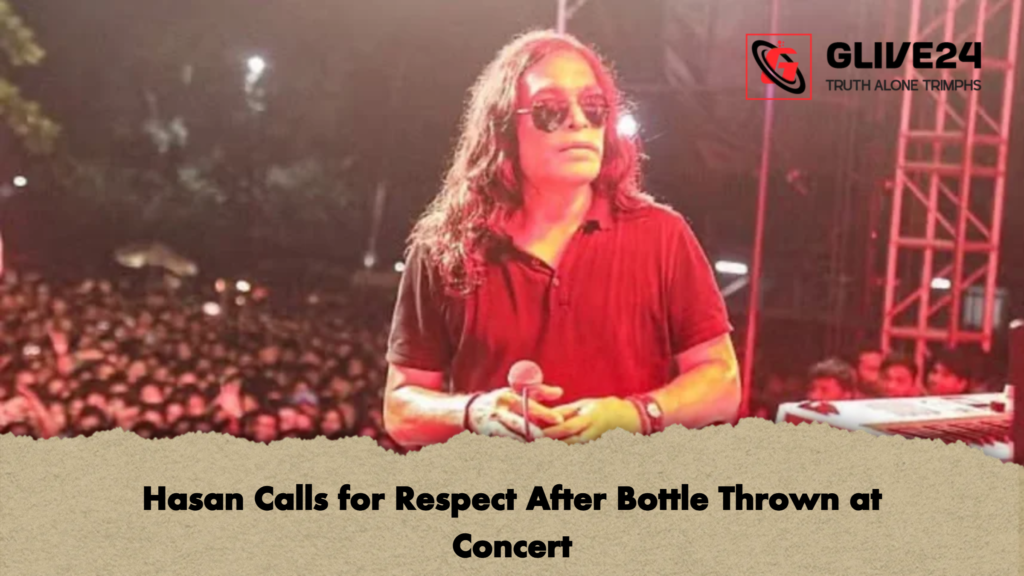
Hasan, lead vocalist of Bangladeshi rock band Ark, has expressed his disappointment after a bottle was thrown at him while he was performing at a concert on Manik Mia Avenue in Dhaka. Despite the unsettling incident, the veteran singer has urged people to respond with forgiveness rather than anger, while calling for greater respect and safety for artists performing on stage.
The incident took place on 5 August during ‘Songs of the Monsoon Revolution’, a concert organised at Manik Mia Avenue to mark July Mass Uprising Day. Hasan was performing when a bottle was thrown from the audience towards him. The incident quickly drew attention on social media, prompting criticism from people in the music and entertainment industries over what was widely regarded as inappropriate behaviour towards a performer.
After returning to Dhaka from Rajshahi, Hasan reflected on the incident in a social media post, drawing on his long career in Bangla band music. He said that his years in the industry had exposed him to many different situations, but having an object thrown at him while performing was something he had not expected.
Hasan said he preferred to believe that the person responsible might not have fully understood the consequences of the act. For that reason, he said he wanted to approach the matter with forgiveness rather than hostility or a desire for retaliation.
His decision to forgive, however, does not mean he considers such behaviour acceptable. Hasan made it clear that no artist should have to face an unsafe or humiliating situation while performing. A concert is built around a relationship between performers and audiences, and that relationship depends heavily on mutual respect.
The singer also spoke about the expectations artists have when they step on stage. Performers dedicate years to developing their craft and appear before audiences to share their music and creative work. In return, they reasonably expect appreciation and respect, rather than behaviour that could compromise their dignity or physical safety.
Hasan urged audiences to exercise restraint even when they dislike a performance or disagree with an artist. Differences of opinion are natural, but expressing dissatisfaction should never cross the line into conduct that threatens a performer’s safety. Concert organisers, too, have a responsibility to create an environment in which artists can perform without fear of disruption or physical harm.
The Ark vocalist also raised concerns about the tendency to judge artists through the lens of political identity. He argued that an artist’s career cannot be reduced to a particular period, event or political climate. A musician does not become an artist for only five or ten years; the identity is shaped by a lifetime of creative work and contribution.
According to Hasan, artists may perform at government, private and political events at different stages of their careers. Taking part in a particular programme or appearing at a particular event should not automatically result in an artist being permanently associated with a particular political identity. He called for greater recognition of an artist’s work, music and overall career rather than judgments based on isolated appearances.
The incident also highlights the broader issue of safety at large public concerts. A successful event requires more than talented performers, good music and a large audience. Adequate security, responsible crowd management and respect for those on stage are equally important. Audiences have a role to play in maintaining that environment, while organisers must take reasonable measures to protect performers and other participants.
Despite the incident in Dhaka, Hasan and Ark continued their musical activities. On 6 August, the day after the Manik Mia Avenue concert, they took part in another concert at Rajshahi University of Engineering and Technology. The subsequent performance demonstrated that the unpleasant experience had not brought Hasan’s stage activities to a halt.
The incident has nevertheless raised a wider question about concert culture: how can the safety and dignity of performers be better protected while preserving a lively relationship between artists and audiences?
Hasan’s response offers an answer rooted in restraint and mutual respect. While choosing forgiveness over confrontation, he has also drawn a clear line against behaviour that puts artists at risk. His hope is that no performer in Bangladesh will have to face a similar experience while standing on stage and doing what they have spent years learning to do—perform.