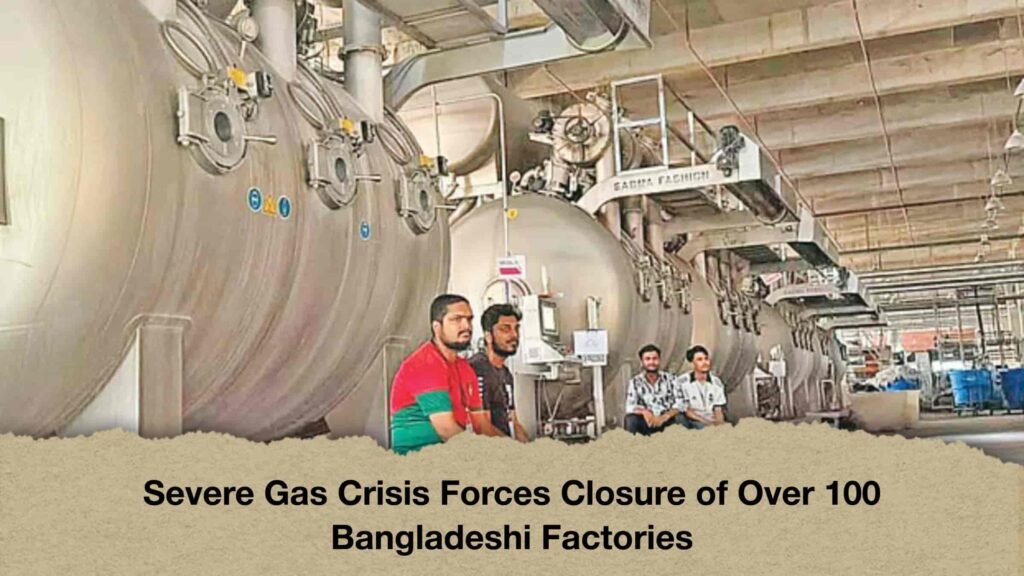
Bangladesh’s industrial sector is facing a severe operational crisis as a protracted shortage of natural gas and electricity has forced the shutdown of more than 100 manufacturing units over the past week. The energy deficit has crippled production across vital sectors, including essential consumer goods, pharmaceuticals, ceramics, steel, and textiles, causing widespread concern among industrial conglomerates and business leaders.
The crisis, which has been intensifying over the past month, reached a critical peak last week due to low gas pressure and acute supply shortfalls. Industrial hubs in Narayanganj, Narsingdi, Gazipur, Savar, Chattogram, Habiganj, Mymensingh, and Khulna have been the hardest hit. Whilst more than 100 factories have halted operations entirely, over 150 others continue to operate far below their installed capacities.
Major Industrial Groups Suffer Heavy Losses
The energy crunch has severely impacted Bangladesh’s prominent industrial conglomerates, particularly those dedicated to processing essential commodities such as sugar, edible oil, flour, and lentils:
-
Meghna Group of Industries (MGI): Operations have completely stopped at 40 of its 57 industrial units, primarily affecting essential consumer goods production. To prevent market depletion, MGI has resorted to supply rationing, releasing only 20 to 25 tonnes daily instead of the usual 50 tonnes.
-
TK Group: The majority of its 28 factories have ceased production. In the surrounding regions of Dhaka, only a single gas-dependent unit remains functional at a limited capacity. Meanwhile, its power-dependent facilities in northern and southern Bangladesh face 8 to 10 power cuts daily.
-
ACI Limited: Production across multiple units—including salt processing in Rupganj, flour and pharmaceuticals in Bandar, and agricultural equipment in Gazipur—has dropped by 30 to 50 per cent, with salt refining suffering the most.
-
City Group: Output at City Edible Oil Limited in Rupganj has plummeted from a daily capacity of 2,500 tonnes to approximately 1,000 tonnes. Technical Director Syed Rafiqur Rahman confirmed an 80 per cent drop in overall production efficiency.
       [National Daily Demand: ~3,800 MMcfd]
                         │
        ┌────────────────┴────────────────┐
        ▼                                 ▼
[Standard Supply Target]        [Recent Supply Dip]
    ~3,000 MMcfd                      1,730 MMcfd
        │                                 │
        ▼                                 ▼
 (Managed Rationing)             (Severe Supply Crisis)
                                          │
                                          ▼
                               [Partial Recovery: 2,440 MMcfd]
                                (Domestic: 1,610 | LNG: 830)
Severe Repercussions Across Diversified Sectors
The ripple effect of the energy disruption extends across multiple critical economic sectors:
-
Pharmaceuticals & Healthcare: Leading manufacturers such as Square Pharmaceuticals have been forced to run their key gas-reliant units in Pabna and Kaliakair on expensive alternative fuels like diesel. Restarting a halted pharmaceutical production line requires 10 to 15 days of recalibration, making continuous operation vital despite mounting costs.
-
Steel & Heavy Industry: BSRM, a premier steel manufacturer, has experienced complete gas cut-offs, forcing a shift to diesel generators. This alternative has elevated production costs while keeping output below half of capacity.
-
Ceramics: RAK Ceramics (Bangladesh) completely shut down operations across its four manufacturing units following the total cessation of gas supply.
-
Textiles & Apparel: In Narsingdi, which supplies nearly 70 per cent of local fabric demand, approximately 90 per cent of gas-dependent facilities are idle, reducing average production to just 10 per cent. In Mymensingh and Chattogram, textilers report significant delivery delays and rising overheads.
-
Frozen Seafood Exports: In the Khulna region, where 80 per cent of the nation’s frozen shrimp and fish exports originate, processing plants are relying heavily on diesel generators to power cold storage units during peak harvest season, incurring substantial financial losses.
Supply Constraints and Wholesale Market Impact
The production slump has directly affected primary distribution channels. At Nitayanganj in Narayanganj—one of the country’s largest wholesale trading hubs—no sugar-laden lorries arrived over a three-day period, triggering a 7 taka per kilogramme increase in wholesale sugar prices.
According to state energy corporation Petrobangla, national gas demand stands at approximately 3,800 million cubic feet per day (MMcfd), with 3,000 MMcfd required to maintain smooth supply. On 14 August 2026, total national supply dropped to a critical low of 1,730 MMcfd. However, a slight recovery was recorded the following day as national supply reached 2,440 MMcfd, bolstered by 1,610 MMcfd from domestic fields and 830 MMcfd from re-gasified Liquefied Natural Gas (RLNG) via Summit and Excelerate Energy terminals.
Business leaders have urged the government to implement immediate relief measures, including the resumption of compressed natural gas (CNG) transportation from the gas-rich Bhola region, to avert prolonged market destabilisation and potential employment losses.