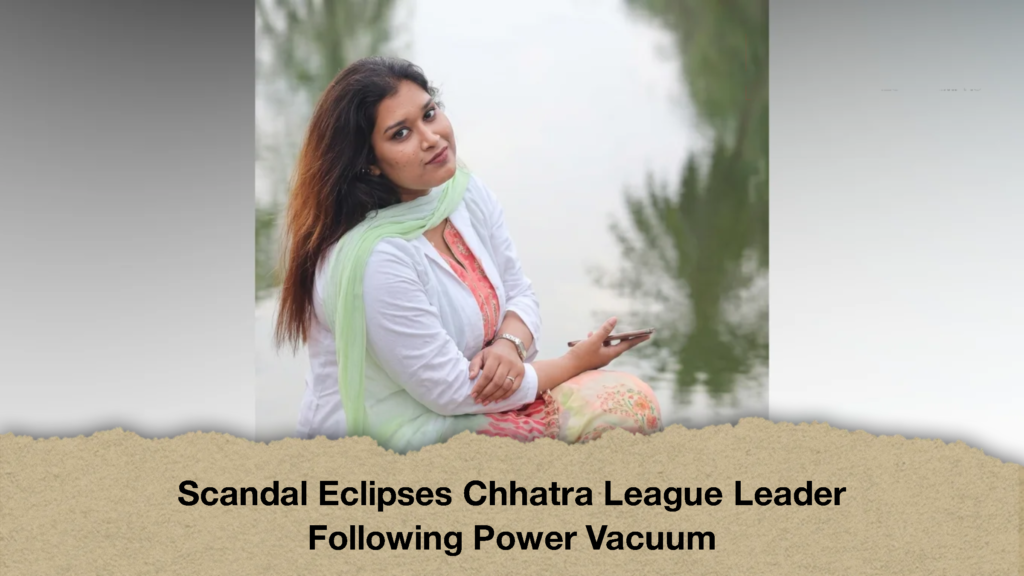
During the sixteen-year administration of the Awami League in Bangladesh, access to state power increasingly concentrated within influential informal networks. In the twilight phase of the regime, several individuals operating outside official administrative hierarchies began exerting outsized control over party machinery and public institutions. Among the most polarising of these figures was Mashtura Mosharraf Oishika, the former president of the Bangladesh Chhatra League (BCL) unit at Faridpur Medical College.
Though her formal portfolio was restricted to student politics within a regional medical campus, Oishika amassed authority that penetrated the highest echelons of the ruling establishment. Her influence stretched well beyond Faridpur, casting a wide shadow over northern districts such as Rangpur and her home district of Dinajpur. Local party organisers assert that executive decisions, committee appointments, and punitive expulsions were frequently dictated at her direction, bypassing standard merit-based procedures and established institutional channels.
Central to Oishika’s rapid rise was her widely reported association with Abdur Rahman, a senior member of the Awami League Presidium and former government minister. Grassroots activists frequently referred to her as his “second wife”—a title that, while lacking confirmation through any public documentation or legal verification, provided her with formidable political capital. This perceived proximity to national leadership allowed her to dictate regional affairs with little resistance from local party stalwarts.
Frictions stemming from this unchecked authority frequently erupted in public view. In one notable incident in Faridpur, Sojib Ahmed, a veteran activist with twelve years of service in the student wing, was abruptly stripped of his post following a heated confrontation. Sojib maintained that the dispute began during a birthday celebration for Abdur Rahman, where he protested against the omission of two former central BCL leaders during the commemorative speeches. He alleged that his unceremonious removal was an act of personal retribution. In response, Oishika denied orchestrating the dismissal over a personal grievance, claiming instead that the senior figures had received proper acknowledgement and that Sojib had behaved aggressively. The district leadership later acknowledged that a confrontation involving medical college affiliates had occurred, though they refrained from directly attributing the disciplinary action to Oishika.
In northern Bangladesh, senior party officials describe a system of invisible administrative control. Members of the Rangpur City Awami League convening committee reported that committee formations were heavily influenced by her recommendations. A commercialised patronage network reportedly emerged, in which aspiring party figures were assessed on personal connections and financial liquidity rather than political service. Dedicated organisers found themselves systematically marginalised by this mechanism, which exploited the minister’s stature for transactional gains.
Following the collapse of the Awami League government on 5 August 2024, Oishika disappeared entirely from the public eye. Both she and Abdur Rahman have remained unavailable to address the compounding allegations.