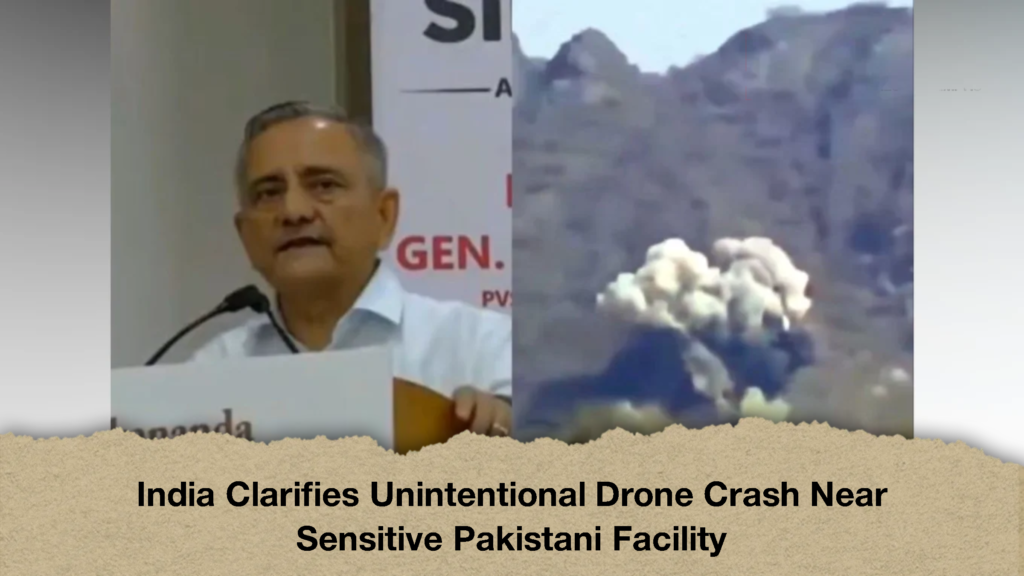
In a major disclosure revealing the intense operational dynamics behind “Operation Sindoor”, former Indian Chief of Defence Staff (CDS) General Anil Chauhan has clarified that an Indian unmanned aerial vehicle accidentally struck the Kirana Hills during past cross-border military engagements with Pakistan. General Chauhan firmly dispelled long-standing speculation that the Indian military had deliberately targeted the sensitive site—known internationally for housing Pakistani nuclear infrastructure—characterising the impact as an inadvertent crash caused entirely by fuel exhaustion.
The aircraft deployed during the operation was an Israeli-designed Harop loitering munition, a specialised autonomous “kamikaze” drone built to track and destroy enemy air defence assets. Operated by Indian forces, the drone was tasked with hunting operational Pakistani radar installations across the Sargodha sector and surrounding areas.
When the munition failed to acquire a valid radar signature within its pre-programmed operational window, it exhausted its fuel supply while loitering in the area, eventually crashing into the nearby mountainous terrain.
“These loitering munitions have a strictly limited flying duration,” General Chauhan explained while detailing the tactical mechanics of the operation. “Typically, they can remain airborne for around two hours. If the system fails to acquire an authorised target within that time frame, it will inevitably descend and strike somewhere before its fuel supply is entirely depleted. That is precisely what occurred—it simply crashed into one of the hills in that sector.”
General Chauhan also revealed previously undisclosed details regarding the Indian Air Force’s (IAF) strike planning at the height of the confrontation. Senior commanders had secured top-level authorisation to launch deep retaliatory airstrikes against Skardu, situated in Pakistan-administered Kashmir.
The planned assault on Skardu was called off at the eleventh hour due to sudden, severe weather deterioration over the high-altitude terrain.
“The Chief of Air Staff had approached me to ask whether we should proceed with strikes on Sargodha,” General Chauhan recalled. “I instructed him to proceed and identify two additional strategic targets. One of the locations selected by the Air Staff was Skardu. We granted full operational clearance, but as weather conditions rapidly worsened over Skardu shortly afterwards, the strike team was forced to adjust plans and divert their attack to Vohari instead.”
The admission provides rare insight into the complex, real-time tactical adjustments made by Indian commanders during high-stakes aerial warfare. While initial reports of explosions near Pakistan’s nuclear storage sites stirred intense diplomatic anxiety, the military leadership maintains that strategic nuclear infrastructure was never targeted, attributing the incident solely to the operational limits of unmanned loitering systems.