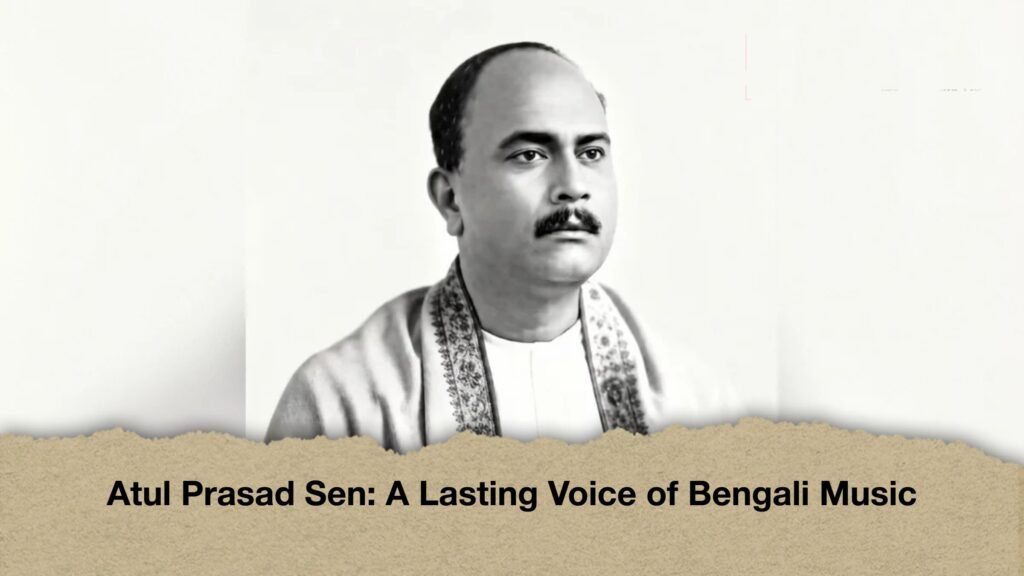
“Moder gorob, moder asha—a mori Bangla bhasha” remains one of the most recognisable expressions of love for the Bengali language. Behind those enduring words was Atul Prasad Sen, a poet, lyricist, composer and singer whose work occupies a distinctive place in the history of Bengali literature and music.
Sen’s songs brought together several strands of Bengali cultural life. Patriotism, devotion, love, separation and an intimate attachment to the mother tongue found expression through his lyrics and melodies. Although his body of work was relatively small in number, its emotional depth and musical character gave it an influence far greater than its size might suggest.
Atul Prasad Sen was born on 20 October 1871 at his maternal grandparents’ home in Dhaka. His ancestral home was in Magar village in the Naria area of present-day Shariatpur. He lost his father at a very young age and was subsequently brought up under the care of his maternal grandfather, Kali Narayan Gupta. It was during these early years that he received his initial exposure to music and devotional songs.
After passing the Entrance Examination in 1890, Sen studied for a period at Presidency College in Calcutta. He later travelled to London for higher education and studied law. He eventually pursued a career in the legal profession, but his interests extended well beyond his professional life. Bengali language, literature and music remained central to his creative identity.
Sen is regarded as one of the important figures who helped shape modern Bengali song. He played a notable role in introducing elements of the thumri tradition into Bengali music and was also among the early Bengali composers to develop the ghazal form in the language. At a time when Rabindranath Tagore’s musical influence was particularly strong, Sen developed a musical idiom of his own rather than simply following the prevailing tradition.
His songs are generally associated with three broad themes: patriotism, devotion and love. Yet the boundaries between these categories were often fluid. Personal sorrow, loneliness and emotional longing frequently found their way into his compositions. As a result, many of his songs carry a strong sense of pathos. In one song, the sadness may emerge through separation; in another, through spiritual yearning; elsewhere, it may appear as an expression of love for the homeland and the Bengali language.
The number of songs attributed to Sen is not particularly large. Around 206 compositions are commonly associated with his repertoire, while roughly 50 to 60 are considered especially well known and widely performed. His significance, however, cannot be measured simply by numbers. His melodies, lyrical sensitivity and distinctive treatment of Bengali music established a separate tradition that came to be recognised as “Atul Prasader gaan”.
His contribution was not confined to music. Sen was also involved in literary and cultural activities among Bengalis living outside Bengal. He was one of the principal figures associated with the establishment of the Prabasi Banga-Sahitya Sammelan, an organisation intended to encourage Bengali literary and cultural activities among communities living away from Bengal. He also served as an editor of its journal, Uttara, and presided over its sessions in Kanpur and Gorakhpur.
Sen also maintained an interest in public affairs. In the early part of his life, he supported the Indian National Congress and later moved towards liberal political thinking. His public identity, however, was shaped less by partisan politics than by his literary, musical and philanthropic activities.
He was known for his generosity and concern for public welfare. A considerable portion of his earnings was devoted to charitable and community causes. He also made arrangements for his home and literary rights to be used for public benefit. Such acts reflected an approach to wealth in which social responsibility took precedence over personal accumulation.
Atul Prasad Sen died on 26 August 1934. He was later buried beside the Brahma Temple at Kaoraid in the present-day Sreepur area of Gazipur.
His death marked the passing of a distinctive voice in Bengali music, but it did not bring an end to his influence. His compositions continued to be performed and remembered because they addressed experiences that remained deeply familiar to Bengali-speaking people: attachment to one’s language, devotion, love, loss and a longing for the homeland.
Among all his works, “Moder gorob, moder asha” has acquired particular cultural significance. Its celebration of Bengali as a source of identity and affection has allowed the song to endure well beyond the period in which it was written.
Atul Prasad Sen’s legacy therefore rests not merely on a collection of songs. It lies in the musical language he helped develop and in the emotional connection he created between Bengali words and melody. His compositions demonstrated that a relatively small body of work can leave a lasting cultural imprint when it combines originality with genuine emotional force.
On his death anniversary, Sen is remembered as one of the important architects of Bengali song—a creator whose melodies gave voice to devotion, longing, patriotism and an enduring love for the mother tongue.
“Moder gorob, moder asha—
A mori Bangla bhasha;
Tomar kole, tomar bole
Kotoi shanti, bhalobasha.”
More than nine decades after his death, those words continue to carry the sentiment that remained at the heart of Atul Prasad Sen’s creative life: Bengali was not simply a language to him, but a profound expression of cultural identity, affection and belonging.