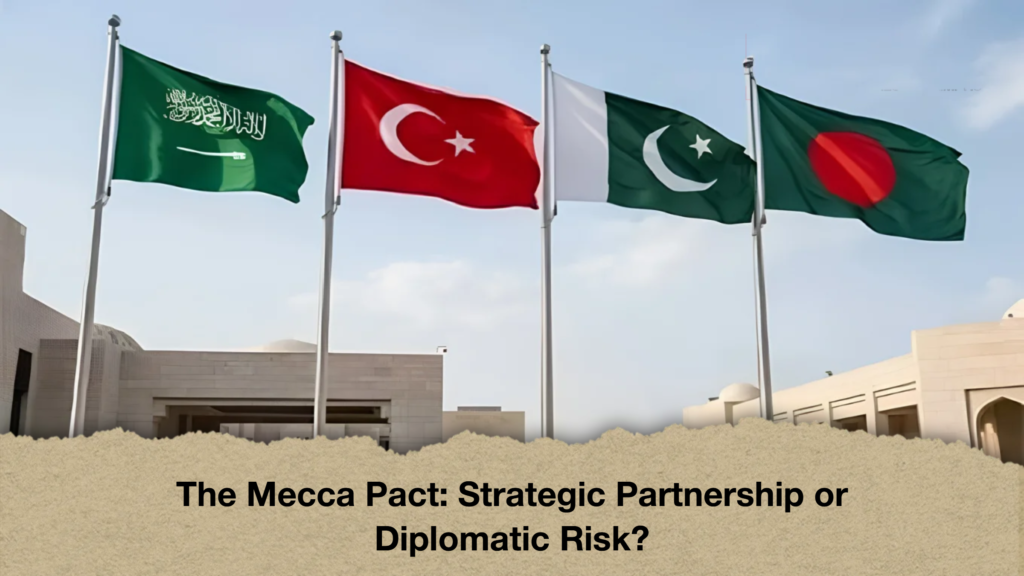
Special Correspondent :The recent defence cooperation agreement between Saudi Arabia, Turkey, and Pakistan, known as the “Mecca Pact,” has presented Bangladesh’s foreign policy with a compelling strategic dilemma. Following reports of a Saudi invitation extended to Bangladesh to join the framework, intense debates have emerged across diplomatic and political circles nationwide. Analysts caution that Bangladesh’s ultimate accession could impact not only its regional security posture, but also its delicate bilateral relations with key partners, most notably India.
According to a report by Reuters, Dhaka remains open to considering participation should a security coalition form among Middle Eastern Islamic nations. Bangladesh’s Minister of State for Foreign Affairs, Humayun Kabir, told reporters that Dhaka views such initiatives positively, adding that the leadership—specifically Prime Minister Tarique Rahman—has been invited to engage with the initiative.
A source within Bangladesh’s Ministry of Foreign Affairs confirmed to Reuters off-the-record that Saudi Arabia extended an invitation to Bangladesh to join the Mecca Pact, though the precise timing of the offer remains undisclosed.
Signed earlier this month in the holy city of Mecca, the tripartite agreement between Saudi Arabia, Turkey, and Pakistan establishes a mutual defence structure modelled closely on NATO’s collective defence principle—where an armed attack against any single member is deemed an attack against all.
While the individual strategic capacities of the signatories vary, their combined potential is formidable: Turkey stands as NATO’s second-largest military force, Pakistan possesses nuclear capabilities, and Saudi Arabia remains a dominant global energy exporter. Emerging amid ongoing Middle Eastern instability, this defence architecture introduces a fresh dynamic to regional geopolitics.
Turkish officials have noted that the pact allows for future expansion to include additional member states. Consequently, Bangladesh’s potential participation transcends simple bilateral or regional considerations, connecting directly to broader global geopolitical calculations.
Since independence, Bangladesh has consistently maintained a non-aligned, balanced foreign policy, refraining from formal military blocs. Dhaka’s diplomatic doctrine focuses on sustaining harmonious political, economic, and strategic ties across a diverse spectrum of partners, including India, China, the United States, the European Union, and the Middle East.
Entering a formal military pact would signal a notable departure from this traditional neutrality. For an economy heavily dependent on RMG (ready-made garment) exports, foreign direct investment, and overseas remittances, the potential economic repercussions of joining a defence bloc require careful evaluation.
The United Kingdom, the European Union, and the United States constitute the primary destinations for Bangladesh’s garment exports, while millions of Bangladeshi expatriates in the Middle East and elsewhere generate vital foreign exchange reserves. Ensuring that security decisions do not adversely affect trade access or overseas labour markets remains a central priority for national planners.
Geopolitical analyst Kallol Kibria suggests that entering a military coalition would recalibrate Dhaka’s strategic equations with major powers—including India, China, Iran, Japan, Kuwait, Oman, Qatar, Russia, the United Arab Emirates, and the United States. While existing ties might not unravel immediately, Bangladesh would inevitably face questions regarding its strategic alignment.
The most sensitive dynamic remains India’s potential reaction. Bilateral relations between Dhaka and New Delhi currently navigate a delicate period. Issues include reports of forced border push-backs by the Indian Border Security Force, alongside Dhaka’s formal request for the extradition of deposed Prime Minister Sheikh Hasina following recent political developments.
With Sheikh Hasina currently residing in India and Dhaka awaiting a final response on the extradition request, Bangladesh’s participation in the Mecca Pact could introduce diplomatic friction.
No official itinerary has been finalized for Prime Minister Tarique Rahman’s prospective visit to India. Meanwhile, following recent public remarks by Sheikh Hasina in New Delhi, Dhaka raised formal objections regarding political activities conducted from foreign soil. With bilateral sensitivity already heightened, joining a security framework that includes Pakistan adds an intricate variable to South Asian diplomacy.
Addressing the Mecca Pact, a spokesperson for India’s Ministry of External Affairs stated that New Delhi is closely monitoring developments in West Asia, though it remains premature to assess the precise impact on India-Bangladesh ties should Dhaka join the bloc.
Professor Asif Shahan of the Department of Development Studies at the University of Dhaka noted that joining a military alliance could introduce risks for Bangladesh’s export-driven economy, which relies heavily on stable commercial and diplomatic access worldwide.
However, he emphasized that foreign perceptions alone should not dictate Bangladesh’s strategic decisions. Sovereign security priorities, core economic interests, and long-term national objectives must remain central to the decision-making process.
The prospect of joining the Mecca Pact presents Bangladesh with a complex balancing act: weighing the advantages of deepened defence cooperation with Saudi Arabia, Turkey, and Pakistan against the imperative to preserve established partnerships and economic interests with India and global powers.
Ultimately, Bangladesh faces a fundamental foreign policy test—determining whether it can forge strategic partnerships without jeopardising its long-standing non-aligned doctrine, commercial stability, and regional relationships.