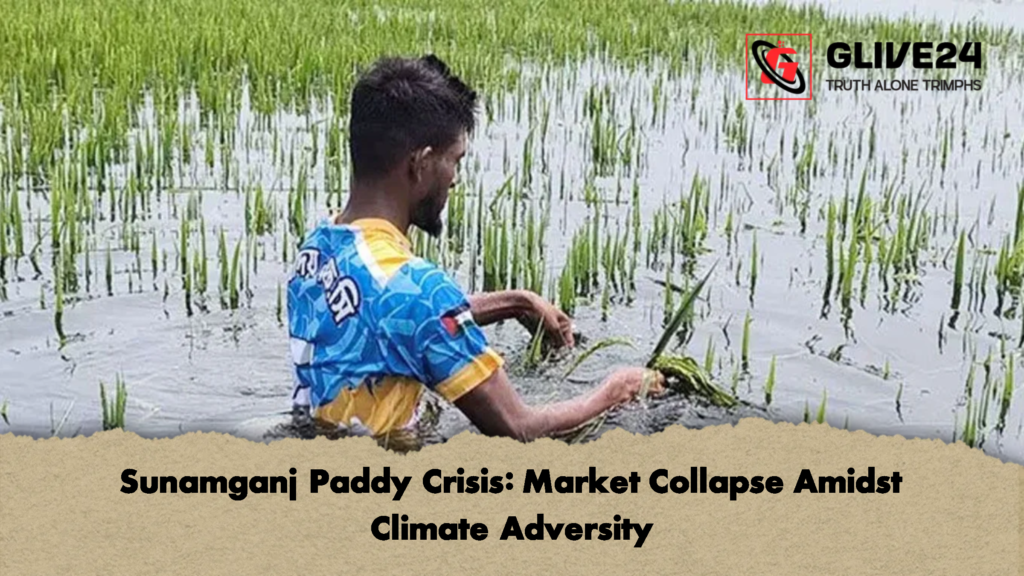
Despite the formal activation of the state’s paddy procurement programme at a regulated rate of 1,440 BDT per maund, marginal farmers across the Sunamganj district are currently enduring a severe financial crisis. A combination of torrential rainfall, upstream flash floods, and a lack of solar exposure has rendered it impossible for small-scale cultivators to dry their harvest. Consequently, many are being forced to sell their produce for as little as 600 to 700 BDT per maund—representing a loss of more than 50% relative to the government-mandated floor price.
Table of Contents
The Impact of Adverse Weather and Flash Floods
The unique agricultural landscape of the Haor region has been devastated by persistent precipitation and the resultant surge of water from upstream hilly terrains. Thousands of hectares of ripened crops have been submerged, forcing a premature and difficult harvest. While many farmers have successfully salvaged portions of their yield, they have immediately encountered a secondary post-harvest crisis: the inability to reduce the moisture content of the grain.
The sustained absence of sunlight over several days has led to dangerously high moisture levels. In many “kholas” (traditional open drying yards), the wet paddy has begun to sprout, a biological process that causes rapid deterioration in colour, nutritional value, and texture. This loss of quality has effectively decimated the marketability of the produce, leaving the peasantry at the mercy of unscrupulous buyers.
Economic Distress and Market Exploitation
The fiscal vulnerability of Haor farmers has reached a critical point. Operating on minimal margins, these marginal cultivators lack the cash reserves required to settle the wages of seasonal labour. To liquidate their debts and pay harvesters, they are compelled to bring unrefined, high-moisture paddy to the local markets immediately.
Local wholesalers and alleged market syndicates have been accused of systematically exploiting this desperation. By citing the poor quality of the wet grain and the additional costs of mechanical drying, these intermediaries are purchasing crops at a fraction of their worth. Farmers report that these predatory prices do not even cover the basic overheads of seeds, fertilisers, and manual labour.
Official Procurement and Policy Disconnect
On Sunday, 3 May 2026, the Food Department inaugurated its procurement drive across the twelve sub-districts (upazilas) of Sunamganj. B.M. Mushfiqur Rahman, an official at the District Food Controller’s Office, confirmed the following targets:
-
Total Collection Target: 21,349 metric tonnes.
-
Official Purchase Price: 1,440 BDT per maund.
-
Method of Acquisition: Direct digital purchase via the “Krishoker App” and manual selection of listed farmers.
While the government intended this price to act as a fiscal cushion against market volatility, a significant policy-practice gap has emerged. The state’s stringent quality protocols mandate that only “fair average quality” (FAQ) paddy—properly dried and winnowed—can be accepted at government silos. Under current climatic conditions, the most affected marginal farmers cannot meet these standards, effectively disqualifying them from the state’s financial safety net.
Demands for Direct Intervention
The farming community in Sunamganj has issued an urgent plea for the government to reform its procurement methodology. Their primary demand is the total exclusion of middlemen from the state supply chain. They argue that without rigorous verification, wealthy traders will continue to purchase cheap, wet paddy from desperate farmers, dry it using private facilities, and then sell it to the government at the premium 1,440 BDT rate, thereby pocketing the profit intended for the cultivators.
Agricultural specialists have proposed several emergency interventions:
-
Mechanical Drying Facilities: The rapid deployment of mobile grain dryers to Haor areas.
-
Moisture Relaxation: Temporarily easing the moisture content requirements for government purchase during natural disasters.
-
Direct Subsidy: Providing immediate cash assistance to help marginal farmers settle labour costs without being forced into distress sales.
Without such targeted measures, the disparity between the official floor price and the actual market reality threatens to trap the Sunamganj agricultural community in a cycle of permanent debt and insolvency.