Zisan Shahriar
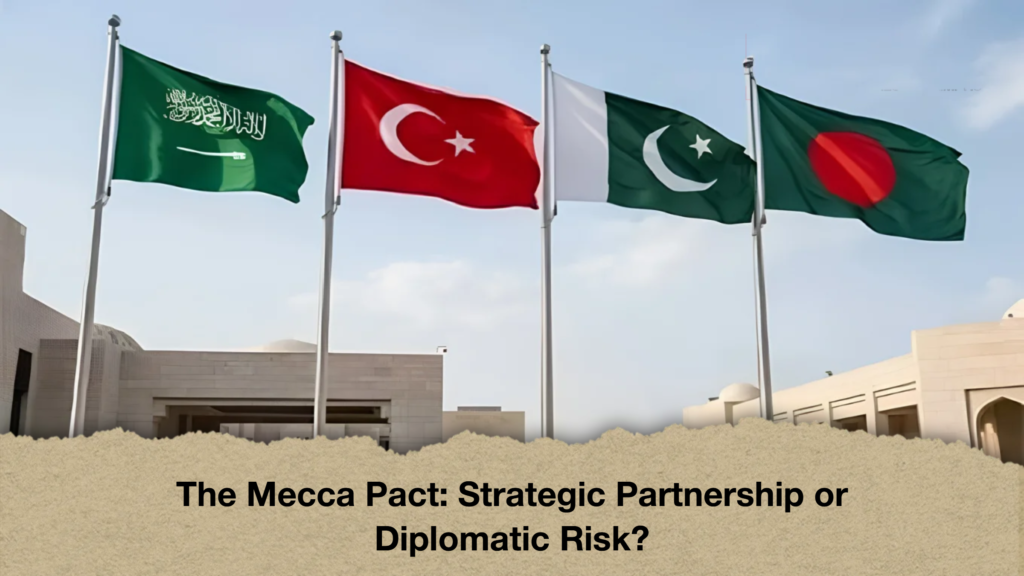
The prospect of Bangladesh joining the Mecca Alliance presents the nation with fresh strategic opportunities alongside significant security and diplomatic risks. Entering a joint defence framework with Saudi Arabia, Turkey, and Pakistan could enhance Bangladesh’s military cooperation and regional influence; however, the core principle—where an attack on one member is deemed an attack on all—introduces the danger of being drawn into external conflicts.
Discussions surrounding the “Mecca Joint Defence Agreement” (MJDA)—signed by Saudi Arabia, Turkey, and Pakistan—have gained heightened attention following an invitation extended by Saudi Crown Prince Mohammed bin Salman to Prime Minister Tarique Rahman for a potential visit to Saudi Arabia.
The joint defence pact was signed in Mecca on August 7. A pivotal clause of the agreement stipulates that an armed attack against any single member state will be treated as an attack against all member states.
While Bangladesh has not formally joined the alliance, official statements indicate a positive outlook toward the initiative. Consequently, Dhaka faces a fundamental decision: what strategic advantages can Bangladesh gain from joining this bloc, and what military and diplomatic liabilities might it incur in return?
Understanding the Mecca Alliance
The Mecca Defence Agreement represents an initiative to establish a collective security architecture among the three founding nations. Due to its mutual defence commitment, many analysts draw parallels with NATO’s collective defence mechanism.
However, the Mecca Alliance has not yet developed NATO-equivalent institutional structures, integrated military commands, or unified defence systems. Instead, its initial framework reflects the distinct security concerns and regional interests of the three founding states.
Saudi Arabia’s security calculus revolves around Iran, the Houthi movement in Yemen, and the security of the Persian Gulf. Turkey’s priorities center on Syria, Iraq, Kurdish issues, and its broader regional influence. Pakistan’s security posture remains primarily focused on India and its western border with Afghanistan.
Thus, despite sharing a single alliance, the security priorities of the three founding members differ substantially—a reality that serves as the most critical consideration for Bangladesh’s potential accession.
Potential Benefits for Bangladesh
The primary argument for joining the alliance lies in the potential expansion of defence cooperation. Accession could deepen Bangladesh’s engagement with Turkey’s defence industry and military technology, Pakistan’s operational experience, and Saudi Arabia’s economic influence.
Bangladesh stands to gain new avenues for military training, defence technology acquisition, intelligence sharing, and joint military exercises. Such collaboration could support the ongoing modernization of the Bangladesh Armed Forces.
Defence ties between Bangladesh and Turkey have expanded significantly in recent years. Turkey has rapidly advanced its capabilities in unmanned aerial vehicles (UAVs), armored vehicles, naval platforms, and modern military hardware. Institutionalizing defence cooperation with Ankara could provide Bangladesh with valuable technological advancements.
Similarly, engagement with Pakistan offers opportunities for military training and expertise exchange. Meanwhile, the significance of Bangladesh’s relationship with Saudi Arabia extends beyond defence to encompass labor markets, remittances, investment, and religious ties.
Saudi Arabia remains one of Bangladesh’s largest overseas employment destinations, hosting a vast Bangladeshi workforce whose remittances contribute significantly to the national economy.
Maintaining close ties with Riyadh carries substantial economic and diplomatic weight. Consequently, the opportunity to deepen this relationship through the Mecca Alliance cannot be disregarded.
Evaluating the Risks
The primary vulnerability stems from the alliance’s mutual defence commitment. Treating an attack on one member as an attack on all implies that a future conflict involving any member state could compel other members to adopt political or military positions.
This requirement poses the central dilemma for Bangladesh.
If Saudi Arabia becomes involved in a military conflict concerning Iran or Yemen, what stance would Bangladesh be required to take? Should Pakistan enter a major military confrontation with India, how would Dhaka navigate its obligations? If Turkey initiates new military operations involving Syria or Kurdish issues, could Bangladesh remain insulated from the fallout?
Clarity on these questions is essential prior to making any binding commitments.
Bangladesh’s security environment differs fundamentally from those of Saudi Arabia, Turkey, and Pakistan. Bangladesh maintains no direct territorial disputes in the Middle East, nor is an India-Pakistan military confrontation Bangladesh’s war to fight.
Assuming liabilities in conflicts disconnected from Bangladesh’s core national interests could generate long-term strategic vulnerabilities for Dhaka.
Relevance of the 1990 Precedent
Bangladesh’s history offers a notable precedent of responding to a Saudi security request. Following Iraq’s invasion of Kuwait in 1990, Bangladesh deployed troops to the Gulf region at the request of Saudi Arabia.
Bangladeshi troops did not engage in direct combat operations. Following the war, they played a significant role in Kuwait’s security and reconstruction—an experience that subsequently enhanced the Bangladesh Armed Forces’ participation in international United Nations peacekeeping operations.
However, caution is warranted when drawing direct comparisons between the 1990 deployment and joining the Mecca Alliance. In 1990, Bangladesh responded to a specific, localized international crisis. In contrast, joining a permanent joint defence alliance creates long-term commitments across diverse future conflicts.
While past security cooperation with Saudi Arabia provides a positive reference point, the formal military obligations of the current proposal require independent evaluation.
Regional Implications: The Indian Perspective
Bangladesh’s potential entry into the Mecca Alliance would carry implications beyond the Middle East, directly affecting South Asia’s security dynamic.
Because Pakistan is a founding member, Bangladesh’s participation in a formal defence framework alongside Pakistan, Saudi Arabia, and Turkey would be viewed by India through a specific security lens.
In the event of renewed military tensions between India and Pakistan, Bangladesh’s formal alliance obligations could heighten concerns in New Delhi. This dynamic could impact bilateral areas including border management, trade, water sharing, transit connectivity, and regional initiatives.
The situation could become more complex if the Mecca Alliance establishes closer alignment with China or other major powers in the future, altering the political weight of the alliance within South Asia’s balance of power.
Nonetheless, categorizing the Mecca Alliance strictly as an anti-India bloc would be premature. The three founding nations retain distinct interests, and the final structural framework of the alliance remains under development.
West Asian Dynamics and Geopolitical Realities
Potential expansion of the alliance represents another critical factor for Bangladesh. Discussions regarding the future inclusion of nations such as Egypt, Iran, Iraq, or Syria would add layers of complexity to the bloc’s operational dynamics.
If Iran were to engage with the framework, its relationship with Saudi Arabia, Turkey’s regional interests, and the internal security environments of Iraq and Syria would introduce additional variables to alliance decision-making.
Furthermore, the Kurdish issue remains a long-standing factor in the security politics of Turkey, Iran, Iraq, and Syria. Consequently, any broader expansion of the alliance could tilt its operational focus toward managing internal security and territorial integrity challenges in those regions.
Defining Bangladesh’s strategic interests within such a framework is vital, particularly as the majority of these regional disputes lie outside Bangladesh’s immediate security scope.
Testing the “Bangladesh First” Policy
The government has consistently emphasized a “Bangladesh First” foreign policy framework. Aligning potential membership in the Mecca Alliance with this principle requires assessing the degree to which Bangladesh’s sovereign security and economic interests would be safeguarded.
Expanding bilateral defence cooperation with individual nations is fundamentally different from joining a collective defence bloc. In bilateral arrangements, Bangladesh retains the flexibility to define the scope and limits of agreements. In contrast, collective defence frameworks introduce mutual security obligations where the crises of other member states directly influence national decision-making.
Before committing to such a framework, several key parameters require clarification:
-
Whether Bangladesh would be expected to participate in the internal conflicts of member states.
-
What role Bangladesh would take in military operations conducted outside a United Nations mandate.
-
The extent of Bangladesh’s obligations if a member state enters a conflict with a third party.
Without clear definitions on these points, Bangladesh risks narrowing its strategic and diplomatic autonomy.
Strategic Options: Full Membership vs. Balanced Cooperation
Bangladesh faces two potential pathways:
-
Full Accession: Becoming a complete member of the Mecca Alliance and committing to its mutual defence framework.
-
Enhanced Bilateral Cooperation: Expanding defence, technological, and strategic ties with Saudi Arabia, Turkey, and Pakistan without committing to binding military clauses that could risk entanglement in external wars.
The second option offers greater strategic flexibility. It allows Dhaka to leverage advances in defence technology, military training, and strategic dialogue while retaining the discretion to remain neutral in external conflicts when required by national interest.
The optimal choice will ultimately depend on the finalized charter of the MJDA, the specific terms offered to Bangladesh, and the precise nature of the military commitments required.
A Measured Approach
The Mecca Alliance offers tangible strategic prospects for Bangladesh. Enhanced defence technologies, advanced training, Saudi investment potential, Turkey’s defence manufacturing integration, and security cooperation with Pakistan could strengthen national defense capabilities.
Simultaneously, membership carries the risk of assuming foreign security liabilities, facing pressure to take sides in regional conflicts, and complicating bilateral relations with India.
Evaluating the alliance solely as a “defence bloc of Muslim nations” oversimplifies its geopolitical realities. It represents a security framework composed of nations with distinct regional security concerns, conflicts, and strategic priorities.
The central calculation for Bangladesh remains evaluating how much genuine security the alliance provides relative to the strategic autonomy it may require Bangladesh to surrender.
If the Mecca Alliance enhances Bangladesh’s defence capabilities and economic opportunities while preserving its independent foreign policy, it represents a strategic opportunity. Conversely, if alliance terms create scenarios where another nation’s conflict becomes Bangladesh’s obligation, that opportunity could become a significant strategic vulnerability.
Ultimately, whether the Mecca Alliance serves as a strategic opportunity or a trap of conflict depends on one fundamental factor: whether Bangladesh engages on terms that safeguard its sovereignty, or accepts responsibility for the security liabilities of others.
Author: Zisan Shahriar