Bangladesh’s worsening energy shortage is emerging as a serious threat to industrial production, investment and business competitiveness, with factories across the country reportedly suffering production losses of around Tk 2,387 crore every day.
The crisis, once largely associated with large industrial plants, has now spread across a much wider section of the economy. Pharmaceutical manufacturers, textile and dyeing units, ceramic producers, sugar refineries, small and medium-sized enterprises and service-sector businesses are all facing disruptions linked to inadequate and unreliable energy supplies.
The figures were presented in a keynote paper at a roundtable discussion titled ‘Bangladesh’s Power and Energy Challenges: Ensuring Reliable Infrastructure for a Better Business Environment’, held on Sunday at the conference room of the Metropolitan Chamber of Commerce and Industry (MCCI) in Gulshan, Dhaka.
The event was jointly organised by Policy Exchange Bangladesh and MCCI, with support from the Australian Government’s Department of Foreign Affairs and Trade. MCCI president Kamran T. Rahman chaired the discussion, while Fazlul Hoque, administrator of the Federation of Bangladesh Chambers of Commerce and Industry, attended as the chief guest.
Dr M Masrur Reaz, chairman and chief executive officer of Policy Exchange Bangladesh, moderated the session. The keynote paper was presented by Hasib Hasan, senior associate at Policy Exchange.
Manufacturing growth slows
According to the paper, growth in Bangladesh’s manufacturing sector fell to 2.86 per cent in the 2025-26 financial year, compared with 3.71 per cent in the previous financial year.
The decline comes as industrial producers contend with inadequate gas supplies, unreliable electricity and higher costs for alternative fuels. Interruptions to energy supplies can force factories to reduce operating hours or halt production, while repeated disruptions also make it harder for businesses to maintain production schedules and meet delivery commitments.
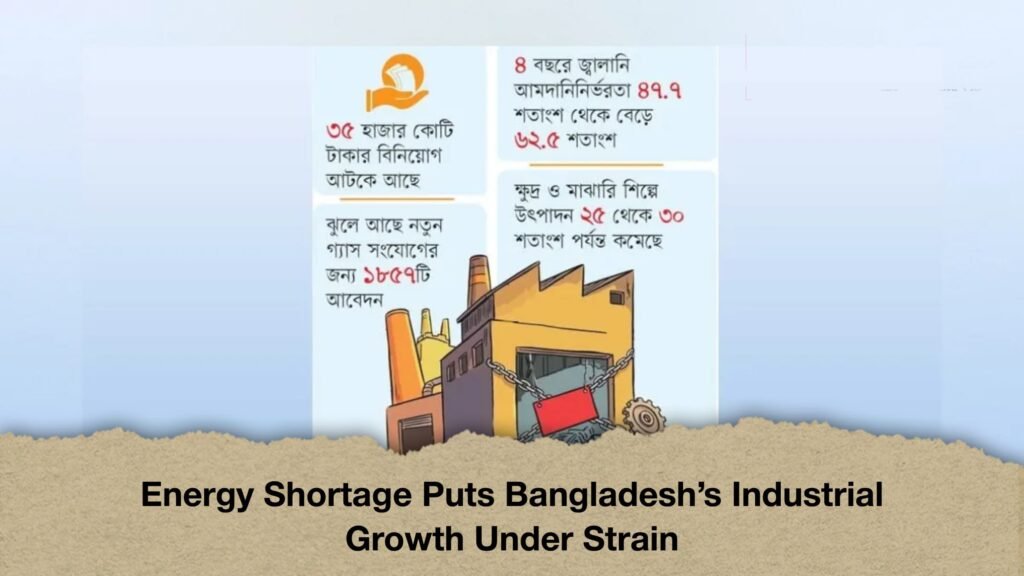
The paper also highlighted Bangladesh’s growing dependence on imported energy. Over the past four years, the country’s reliance on imported energy has increased from 47.7 per cent to 62.5 per cent.
This growing dependence leaves the economy more exposed to fluctuations in international energy prices and supply conditions. Any disruption in global markets can therefore have a direct impact on domestic production costs and business operations.
Industrial hubs bear the brunt
The impact has been particularly severe in several major industrial areas.
In Narsingdi, more than 300 factories are reportedly closed. The district has around 3,000 textile and dyeing mills, which supply roughly 70 per cent of the country’s local fabric demand. Some factories have resorted to using wood to operate boilers because of the shortage of gas.
Gazipur is also facing a significant supply gap. Industrial consumers in the district require between 590 million and 600 million cubic feet of gas a day, but receive only around 250-270 million cubic feet. Supply is therefore meeting roughly 45 per cent of demand. Between 18 and 22 per cent of factories in the area have reportedly been forced to suspend operations.
The situation in Narayanganj is similarly difficult. Of approximately 1,850 factories in the district, around 900 are reportedly closed, leaving nearly 49 per cent of the industrial base outside production.
In Mymensingh, 99 of the 293 industrial units depend on gas. Average production in the area has fallen by around 50 per cent, according to the presentation.
Habiganj has suffered another major disruption. A total of 171 factories have been affected by the complete suspension of gas supplies, while daily production losses in the district are estimated at more than Tk 1,000 crore.
Chattogram has also seen industrial capacity fall by around 25 per cent. At the national level, production in the knitwear and dyeing industries has declined by between 30 and 50 per cent.
Small businesses also feeling the pressure
The effects of the energy crisis are no longer confined to large manufacturers. Production among small and medium-sized enterprises has fallen by an estimated 25 to 30 per cent.
For smaller businesses, interruptions in gas or electricity supplies can be particularly disruptive because many have limited capacity to switch to alternative sources of energy. Those that do turn to alternative fuels face additional operating costs, placing further pressure on already constrained businesses.
The consequences are also being felt by export-oriented manufacturers. Lower gas pressure can interrupt production, while the use of more expensive alternative fuels raises manufacturing costs. At the same time, unpredictable supplies make it harder for exporters to plan production and meet agreed delivery schedules.
Tk 35,000 crore investment remains stalled
The shortage is also affecting future industrial investment. According to the keynote paper, 1,857 applications for new gas connections remain pending, involving around Tk 35,000 crore in industrial investment.
The delays mean that the energy problem is affecting not only existing factories but also proposed industrial projects. Investors require a reasonable degree of certainty over energy availability before committing significant capital to new facilities or expansion.
Persistent uncertainty can therefore influence the timing of investment decisions and the pace at which new production capacity comes into operation.
Businesses seek predictable energy supplies
Business leaders at the roundtable said unreliable gas and electricity supplies were directly damaging the competitiveness of Bangladeshi industries.
They called for export-oriented industries and major industrial zones to receive priority in energy allocation. They also urged the authorities to publish advance and credible load-shedding schedules so that factories can plan production, staffing and machinery use around expected interruptions.
Shawkat Aziz Russell, president of the Bangladesh Textile Mills Association, said the present crisis reflected weaknesses in long-term planning and energy procurement. He called for an industrial energy policy and immediate measures to protect manufacturing and export-oriented sectors.
Mohammad Iqbal Chowdhury, director and chief executive officer of LafargeHolcim, stressed the need for a credible and predictable long-term energy plan to protect existing industrial investment. He called for a clear 10- to 20-year energy strategy that takes industrial competitiveness and sustainable development into account.
Moinul Islam, president of the Bangladesh Ceramic Manufacturers and Exporters Association, said gas was not simply a source of energy for the ceramic industry but an important component of the production process. Continued uncertainty over supplies, he said, could threaten production, employment and investment.
Professor Dr Ijaz Hossain, chairman of ESTex Foundation, said the energy crisis should be viewed as a wider economic and planning challenge rather than simply a supply problem. He stressed the need for attention to energy pricing, allocation, renewable energy, efficiency and a realistic energy mix.
Calls for long-term energy security
The roundtable recommended strengthening energy security while making gas and electricity supplies more reliable. Participants also called for greater domestic energy exploration, faster adoption of renewable energy and stronger coordination between the public and private sectors.
Predictability was a recurring concern during the discussion. For industrial businesses, knowing when energy will be available and what it will cost is essential for production planning, investment decisions and maintaining competitiveness.
The recommendations therefore covered both immediate and longer-term measures. These included protecting existing investment, restoring confidence among potential investors, improving the reliability of energy supplies, ensuring greater predictability in energy pricing and expanding domestic energy exploration.
With daily industrial production losses estimated at Tk 2,387 crore and around Tk 35,000 crore in investment linked to pending gas connections, the energy shortage is putting significant pressure on Bangladesh’s industrial base. The discussions highlighted the need for immediate steps to ease supply constraints alongside a long-term strategy capable of providing businesses with a stable and predictable energy environment.