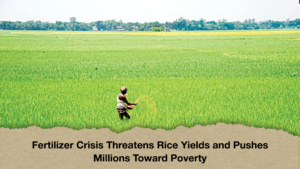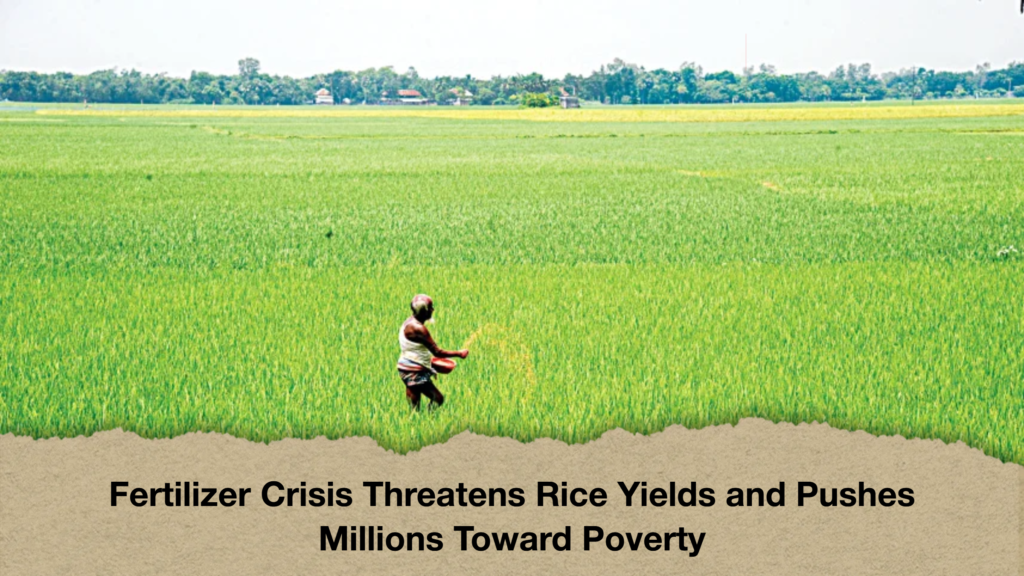
Rising global fertiliser prices and domestic distribution bottlenecks threaten to reduce rice yields during critical agricultural seasons in Bangladesh, potentially driving 1.4 million people into poverty if the cost of staple rice increases by just 10 percent, according to a recent World Bank assessment.
The warning underscores the delicate balance sustaining the country’s food security. Agriculture employs nearly forty-five percent of the national labour force, with rice cultivation accounting for roughly seventy-five percent of the country’s total annual fertiliser requirement of approximately 6.6 million tonnes. More than eighty-five percent of these agricultural inputs are met through imports, leaving domestic crop production highly vulnerable to external supply chain disruptions and geopolitical tensions in the Middle East. Global market pressures, compounded by US policy toward Iran and lingering domestic gas shortages that have idled three of Bangladesh’s seven state-run fertiliser factories, have amplified the reliance on foreign shipments.
Recent World Bank projections indicate that international fertiliser costs could surge by up to thirty percent this year, following a twelve percent increase during the opening quarter. To cushion the blow for smallholders, the international financial institution disbursed a 300 million US dollar loan under an emergency food security project. This funding is specifically earmarked to ensure that three million marginal and small-scale farmers secure timely access to chemical fertilisers for the current Aman and upcoming Boro crop cycles. These two major agricultural periods account for over ninety percent of the nation’s total paddy output and require more than 4.3 million tonnes of fertiliser combined.
Despite government assurances that national buffer stocks remain secure at roughly 1.4 million tonnes—down from 1.8 million tonnes at the start of the fiscal year—ground realities reflect growing tension in rural districts. Farmers in several northern regions have recently resorted to blocking highways and raiding local dealer warehouses after failing to secure required quotas. Agricultural economists point out that the core issue lies within domestic supply chains and local distribution networks rather than absolute national stock levels. With the Aman crop currently entering a vital growth phase, experts warn that any prolonged delay in fertilizer application could impair grain development and lead to substantial yield contractions ahead of the Boro harvest in April.
In response to the mounting pressure, the government formed a high-level cabinet committee headed by Social Welfare Minister A.Z.M. Zahid Hossain to review nationwide fertiliser distribution, monitoring mechanisms, and dealer appointments. Meanwhile, government officials have maintained that sufficient reserves exist and warned that strict administrative penalties will be enforced against any local retailers or syndicates attempting to manufacture artificial shortages or inflate prices for profit. Protecting agricultural productivity remains vital, as two-thirds of the country’s lowest-income households depend directly on farming for their livelihoods and sustenance.