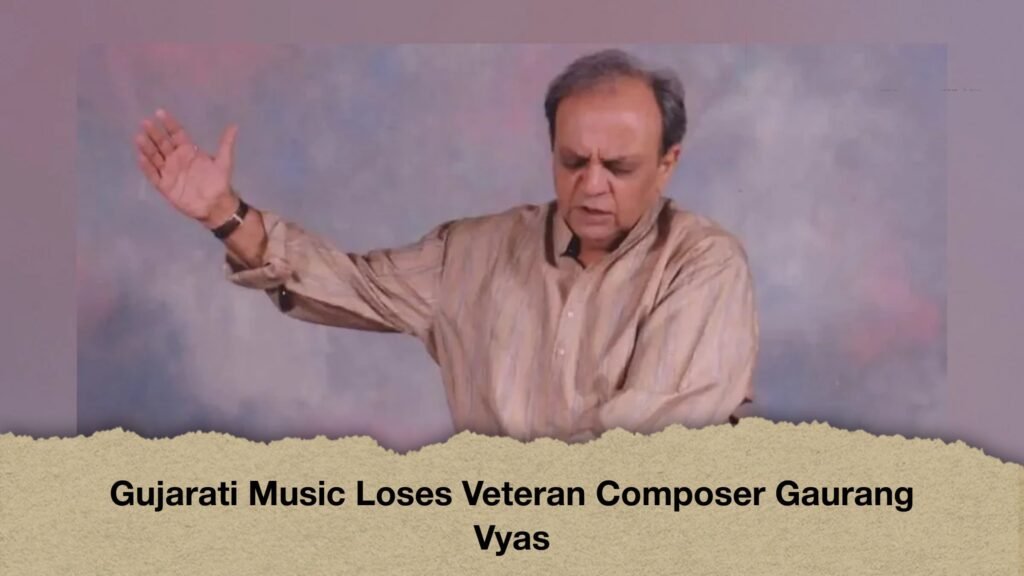
Gujarat’s music fraternity is mourning the death of veteran composer, singer and music arranger Gaurang Vyas, who died in Ahmedabad on the night of 2 September at the age of 87. Over a career spanning several decades, Vyas made a significant contribution to Gujarati cinema, folk music, devotional music and traditional musical forms. His death was also mourned by Indian Prime Minister Narendra Modi.
Vyas was the son of acclaimed composer and Padma Shri recipient Avinash Vyas, one of the important figures in Gujarati music. Although he grew up in a family deeply connected with music, Gaurang Vyas established a distinct identity through his own work and creative approach.
His association with music began at a remarkably young age. At just five, he started learning the harmonium and played the devotional song ‘Vaishnav Jan To’. That early interest eventually developed into a professional career, although music was not initially his chosen profession.
Vyas began his working life in engineering and was employed by an established organisation. His growing attachment to music, however, eventually led him to leave his job and pursue music as a full-time profession.
His entry into Gujarati cinema came through his father. He worked as Avinash Vyas’s assistant on the film ‘Jesal Toral’, gaining valuable experience in film music. He later established himself as an independent music director with ‘Lakho Phulani’. The film also gave him an opportunity to work with legendary playback singer Kishore Kumar on a Gujarati song.
Across his long career, Vyas was associated with more than 100 films. His work extended beyond cinema, covering folk and devotional music as well as traditional Gujarati musical forms. His name was linked with several notable productions, including Ketan Mehta’s ‘Bhavni Bhavai’. Other significant works associated with him included ‘Maniyaro’, ‘Nasibni Balihari’, ‘Parki Thapan’, ‘Liludi Dharti’ and ‘Maiyarman Mandu Nathi Lagtu’.
A notable part of Vyas’s career was his collaboration with some of India’s best-known singers. He worked with Lata Mangeshkar, Asha Bhosle, Kishore Kumar, Manna Dey, Mahendra Kapoor, Suman Kalyanpur, Bhupinder Singh and Praful Dave. Among his recognised compositions were ‘Maniyaro Te Halu Halu Thai Re Viyo’ and ‘Hu Tu Tu Tu, Jami Ramatni Rutu’.
Vyas also made a substantial contribution outside the film industry. He released a number of albums rooted in devotional and folk traditions. His notable releases included ‘Jalaramni Jhopdi’, ‘Bhajan Anmol’, ‘Ganga Satina Bhajano’, ‘Kahat Kabir’, ‘Jalaram Bapanu Halardu’, ‘Prachin Prabhatiyan’ and ‘Non-Stop Dandiya-Raas’.
His contribution to music received recognition through several honours during his career. He received around 11 state-level awards for best music direction. In 2022, Gujarat Chief Minister Bhupendra Patel presented him with a lifetime achievement honour in recognition of his contribution to music. In 2024, the Gujarat State Sangeet Akademi and Gujarat Tourism Department also recognised his work.
Following his death, Prime Minister Narendra Modi paid tribute to the veteran musician on social media, sharing a photograph with him. Modi noted that Vyas had carried forward the rich musical legacy of his father, Avinash Vyas, while creating an identity of his own in Gujarati music. The Prime Minister also expressed his condolences to Vyas’s family and his many admirers.
Gaurang Vyas’s career reflected the breadth of Gujarati musical culture, from cinema and popular songs to folk traditions and devotional compositions. His journey from engineering to professional music was followed by decades of creative work and collaborations with some of India’s most celebrated singers.
His death marks the passing of a musician whose career was closely connected with the development and preservation of Gujarati music across generations. The body of work he leaves behind, particularly his contributions to film, folk and devotional music, remains an important part of his artistic legacy.