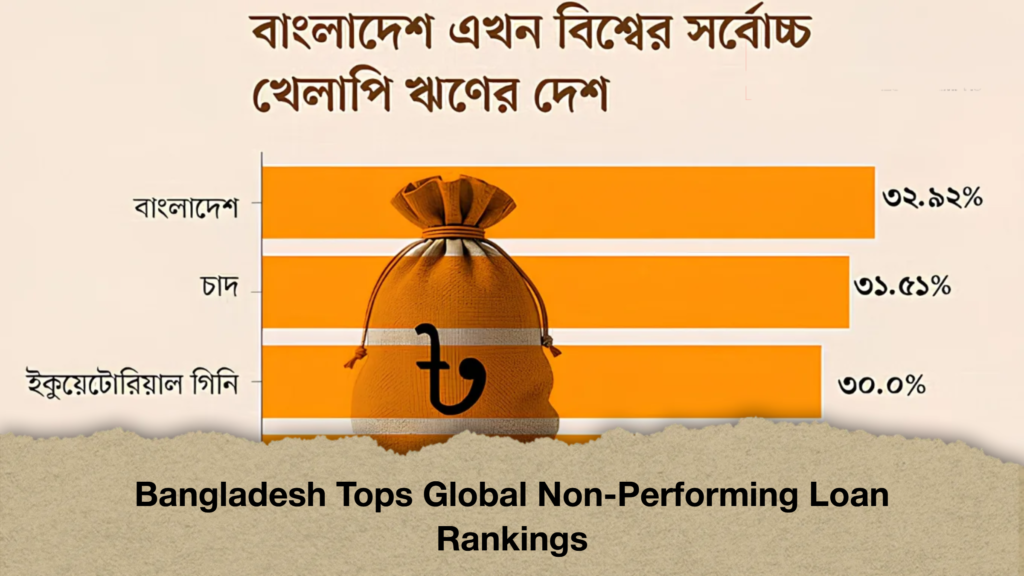
Bangladesh has emerged as the country with the highest non-performing loan ratio among countries with the latest available comparable data, with nearly one-third of bank lending classified as non-performing. The scale of the problem has placed growing pressure on the country’s banking sector and exposed weaknesses that had accumulated over several years.
According to Bangladesh Bank data, non-performing loans in the country’s banking sector reached Tk 606,555 crore at the end of June 2026. That represented 32.78 per cent of total outstanding loans. In practical terms, almost Tk 33 out of every Tk 100 lent by banks was classified as non-performing.
The figure was Tk 588,704 crore at the end of March, meaning non-performing loans increased by Tk 17,851 crore in just three months. The amount had previously reached a record Tk 644,515 crore in September 2025 before declining temporarily.
The latest international comparison places Bangladesh ahead of Chad, Equatorial Guinea, Algeria and Ghana. The comparison, however, is based on the latest available figures for each country, meaning the reporting periods are not identical.
Chad and Equatorial Guinea follow
Chad has the second-highest ratio among the countries in the comparison, at 31.51 per cent. Its latest available figure dates from December 2023, according to the International Monetary Fund’s Financial Soundness Indicators database. Chad has not subsequently provided newer data for that particular indicator.
Equatorial Guinea ranks third, with a non-performing loan ratio of 30 per cent. Data from the African Development Bank show that the ratio stood at 32.5 per cent in 2023, indicating some improvement despite the figure remaining exceptionally high.
Algeria recorded a non-performing loan ratio of 20.05 per cent at the end of December 2025, placing it fourth in the comparison. Ghana ranked fifth, with a ratio of 18.11 per cent during the first quarter of 2026. Ghana’s figure had been 20.6 per cent in 2023.
The gap between Bangladesh and the countries ranked fourth and fifth illustrates the severity of the deterioration in Bangladesh’s banking sector.
Why Bangladesh’s figure has risen so sharply
The current level of non-performing loans did not emerge entirely from new defaults over the past two years. A substantial portion reflects the recognition of loans that had remained under pressure for much longer.
For years, troubled loans were sometimes kept outside the official non-performing category through repeated rescheduling, preferential treatment and changes in accounting treatment. Following political changes, reviews of banks’ assets and audits by domestic and international institutions have brought a larger number of irregular, fraudulent and undisclosed loans to light.
As a result, loans that had previously been presented as regular are now being recognised according to their actual condition.
The problem is particularly severe among five banks that have been brought into a merger process. More than 80 per cent of the loans issued by these banks are reportedly non-performing. Several other state-owned and private banks are also facing non-performing loan ratios exceeding 50 per cent.
Allegations of politically influenced lending, weak supervision, fraudulent and undisclosed loans, economic weakness and energy shortages have all contributed to the deterioration in asset quality.
Ukraine has taken a very different path
Bangladesh’s rise to the top of the ranking becomes clearer when compared with Ukraine, which previously had one of the world’s highest non-performing loan ratios.
Ukraine’s ratio stood at 37.4 per cent in 2023 and rose to nearly 39 per cent after the economic disruption caused by Russia’s invasion. Since 2024, however, the country has made significant progress through loan recovery, restructuring and an increase in comparatively better-quality lending.
According to Ukraine’s central bank, total bank lending increased by 133.7 billion hryvnia, or 10.3 per cent, during the first six months of 2025. Over the same period, the non-performing loan ratio fell to 27 per cent.
A major change came at the end of 2025, when PrivatBank and several other state-owned banks wrote off substantial amounts of old non-performing loans. The sector-wide ratio fell from 23.91 per cent on 1 December 2025 to 13.92 per cent on 1 January 2026.
A write-off, however, does not mean that the debt has been forgiven. The loans had already been fully provisioned for, meaning banks had recognised the expected losses in their accounts. After the write-off, the loans were removed from the main balance sheet and transferred to off-balance-sheet records, while banks retained the right to pursue recovery.
PrivatBank, for instance, has continued legal efforts to recover outstanding funds not only in Ukraine but also through proceedings in jurisdictions including London, Cyprus and Israel.
Ukraine’s improvement has continued. Central bank data show that its non-performing loan ratio fell further to 12.5 per cent on 1 July 2026, its lowest level in almost 17 years. The country has therefore moved well outside the top five in the global comparison.
Bangladesh and Ukraine show contrasting trends
The experiences of the two countries highlight two very different approaches to dealing with distressed lending.
Ukraine has combined loan recovery, restructuring, improved lending quality and the removal of fully provisioned old loans from banks’ balance sheets. Bangladesh, by contrast, has seen a large volume of previously concealed or reclassified distressed lending enter the official non-performing category.
In June 2024, Bangladesh’s officially reported non-performing loans stood at Tk 211,391 crore. Within two years, the figure had climbed beyond Tk 600,000 crore. This does not necessarily mean that more than Tk 395,000 crore of entirely new bad loans were created during that period. A significant part of the increase reflects the recognition of long-standing problems that had previously been kept out of the non-performing category.
That distinction is crucial when assessing the health of the banking sector. A sudden rise in reported bad loans can partly indicate that banks are becoming more transparent about existing weaknesses rather than that all of the deterioration has occurred recently.
Steps being taken to address the crisis
Bangladesh Bank has moved to strengthen loan classification and provisioning requirements and align them more closely with international standards. Asset-quality reviews are being conducted at weaker banks, changes have been made to the boards of several institutions, and greater emphasis is being placed on risk-based supervision.
These measures can initially push the reported non-performing loan ratio higher because previously under-classified loans are brought into the correct category. The longer-term objective, however, is to establish a more accurate picture of banks’ financial health.
There is also a difficult balance between restructuring distressed loans and ensuring that repeated concessions do not simply postpone recognition of losses. Rescheduling or writing off loans can reduce the headline figure on paper, but neither measure automatically recovers the money owed to banks.
The IMF has also indicated that stricter classification rules and asset-quality assessments could reveal additional non-performing loans as Bangladesh continues to strengthen its banking-sector framework.
Recovery requires more than lower headline figures
Experts argue that reducing the ratio sustainably will require stronger action against deliberate defaulters, effective recovery of bank assets, quicker resolution of financial disputes and greater protection of lending decisions from political influence.
Banks also need stronger credit assessment before loans are approved and closer monitoring after funds are disbursed. Preventing new bad loans is just as important as recovering existing ones.
The challenge is particularly significant because a banking system burdened with a high level of non-performing assets has less capacity to provide productive credit to businesses and households. Weak asset quality can also erode banks’ profitability and capital positions, making it harder for them to support economic activity.
Bangladesh’s position at the top of the global comparison is therefore not simply a statistical distinction. It reflects years of accumulated weaknesses in lending, governance, supervision and recovery.
Bringing the ratio down sustainably will depend on whether the country can recover genuinely recoverable loans, deal firmly with deliberate defaults, strengthen bank governance and prevent politically influenced or poorly assessed lending from creating another wave of distressed assets. Simply reducing the reported figure through repeated rescheduling or accounting measures would risk masking the underlying problem rather than resolving it.