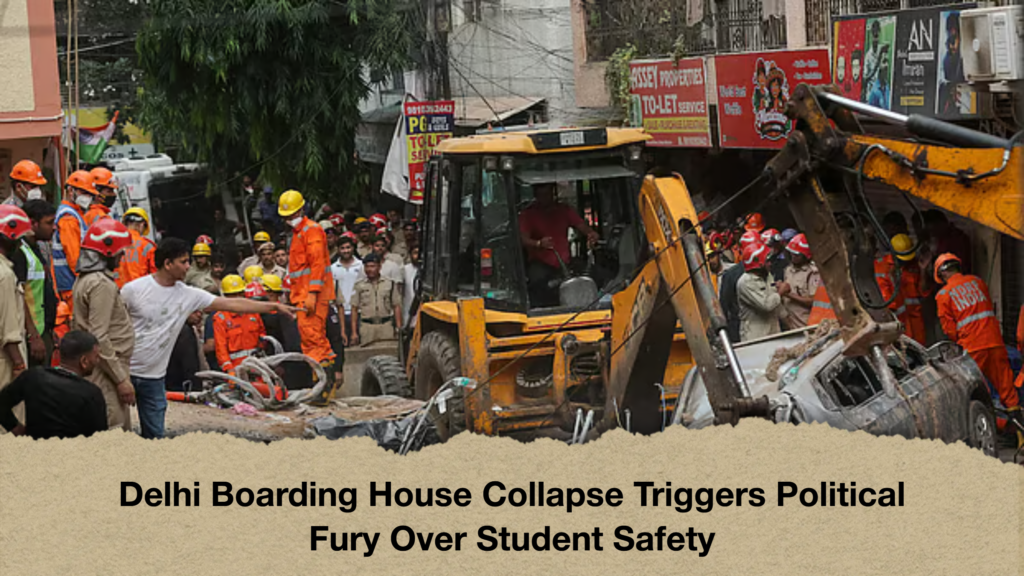
A tragic building collapse in the capital’s Satya Niketan area has escalated into a fierce political row over infrastructure failures and state priorities. Six students lost their lives and eleven others suffered severe injuries when a six-storey boarding house, operating as a paying guest accommodation in Chanakyapuri, suddenly crumbled on Sunday. Emergency personnel worked through Monday to clear tons of debris, searching for any additional victims who might remain trapped beneath the wreckage. The incident has raised urgent questions regarding structural safety standards for student lodgings in major urban centres.
In the wake of the disaster, opposition figures from the Cockroach Janata Party (CJP) directed sharp criticism towards the Prime Minister and the Union Home Minister. CJP leader Abhijit Dipke posted a scathing critique on X, arguing that the administration prioritises political rhetoric over safeguarding basic educational infrastructure. Dipke cited recent remarks made by the Prime Minister at Shri Ram College of Commerce, where the leader spoke about “intellectual Naxals” (Dimagi Naxals) and likened his phrasing to a homeopathic remedy that temporarily heightens symptoms before bringing relief. Dipke questioned how long students must pay the ultimate price for administrative neglect, noting that safety hazards are no longer confined to neglected tribal regions but have reached the national capital.
CJP joint conveners Sourav Das and Ashutosh Ranka echoed these sentiments, accusing the government of attempting to distract the public from systemic shortfalls in education and employment by attaching derogatory labels to questioning youths. Dipke further challenged the Prime Minister to return to Delhi University to explain how such a devastating collapse could occur under the watch of urban regulators.
The controversy deepened as details emerged regarding the Union Home Minister’s schedule during the incident. At the time of the collapse, the minister was attending the inauguration of a party office in Goa, though he truncated his engagement upon receiving news of the tragedy. Dipke seized on the contrast, questioning why lavish political headquarters are constructed rapidly across states while students are forced into unsafe, hazardous lodgings.
Beyond immediate accountability, the CJP renewed its demand for financial reallocation toward educational infrastructure. CJP leaders have actively inspected public school conditions across various states—reportedly encountering physical obstruction and assaults during their visits—and advocate using unspent capital from the PM CARES Fund to rebuild dilapidated facilities. According to financial figures for 2024–25, the fund holds 8,452 crore Indian Rupees, an amount Dipke contends could completely overhaul government schools nationwide.
As political debate intensifies, official investigations into the Satya Niketan collapse remain paramount. Authorities are currently determining whether the building complied with residential structural codes, if safety regulations were breached, and why the structure was permitted to operate as student housing in its compromised state. The tragedy underscores a growing public demand for mandatory safety audits across all private messes, paying guest accommodations, and hostels catering to students.