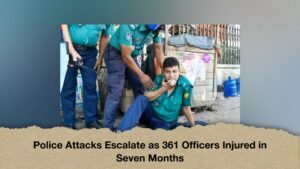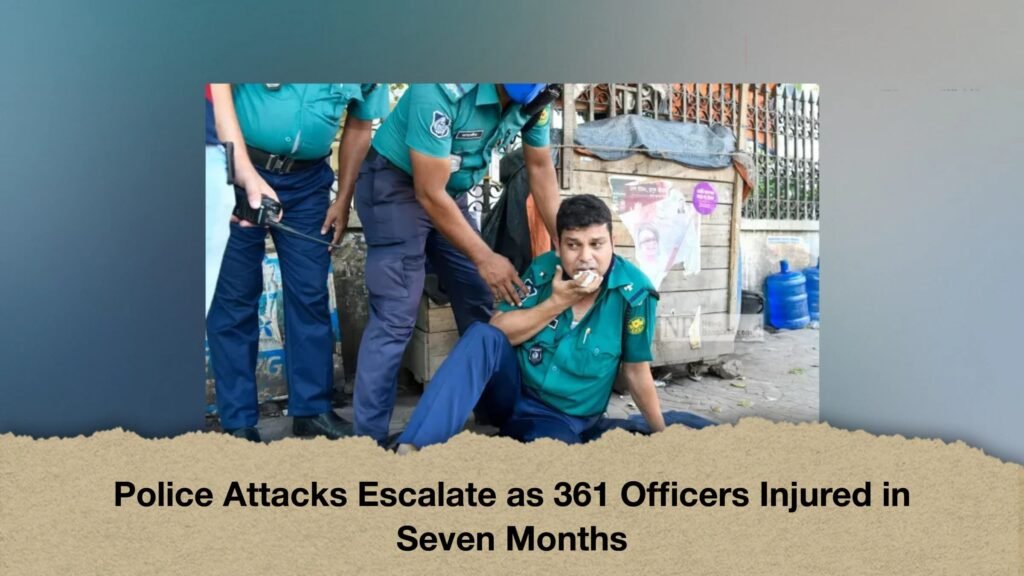
At least 361 police personnel were injured in separate attacks across Bangladesh during the first seven months of this year, according to figures from the Police Headquarters. The incidents, reported between January and July, occurred while officers were carrying out routine law-enforcement duties, including arrests, anti-drug operations, searches and attempts to apprehend suspected criminals.
Dhaka recorded the highest number of such incidents. Police personnel have faced attacks from alleged criminals, muggers, extremist elements and groups attempting to obstruct arrests. In several cases, officers were reportedly assaulted while escorting suspects, with some incidents ending in the suspects being forcibly released from police custody.
The latest serious incident occurred in Savar, on the outskirts of the capital, where Special Branch Sub-Inspector Altaf Hossain was killed after being repeatedly attacked by alleged criminals.
According to Police Headquarters data, 82 police personnel were injured in January and February combined. A further 63 were injured in March, 66 in April, 55 in May, 51 in June and 42 in July. The seven-month total therefore stands at 361.
The previous year also saw a significant number of attacks. A total of 601 police personnel were injured while performing their duties. Monthly figures were 38 in January, 37 in February, 96 in March, 52 in April, 62 in May, 44 in June, 39 in July, 51 in August, 43 in September, 69 in October, 41 in November and 41 in December.
Concerns over police morale
The killing of Sub-Inspector Altaf Hossain in Savar prompted condemnation from both the Bangladesh Police Association and the Bangladesh Police Service Association.
Police Association president Inspector Kamrul Islam Talukder said attacks on uniformed officers were being carried out in an organised manner by elements seeking to undermine police morale and obstruct officers from performing their professional duties.
He said those attacking police personnel would be brought under the law and face the highest applicable punishment. He also stressed that police work was ultimately intended to protect the public and called on citizens to assist officers when they encountered resistance while carrying out their duties.
The repeated attacks have raised questions about the risks faced by officers working on the ground, particularly during operations involving organised criminals and suspects who may attempt to resist arrest.
Muggers and extremist elements among attackers
Reports cited in the original account indicate that attacks on police increased during 2025-26 following the changed political circumstances of 2024. Dhaka has reportedly experienced the largest concentration of incidents, involving both street criminals and extremist elements.
On 21 February this year, a police checkpoint in the Kutubkhali Pocket Gate area of Jatrabari was attacked. During the incident, a police constable on duty was stabbed by a group of youths, who also detonated a cocktail before fleeing. Police subsequently recovered five cocktails and a bag containing explosive devices from the scene. An investigation by the Dhaka Metropolitan Police’s Counter Terrorism unit reportedly found links to militants associated with Neo-JMB.
In May, a team from Dhanmondi Police Station came under attack while attempting to apprehend muggers in Mohammadpur. Police opened fire during the incident, and one suspected mugger was shot. Earlier, Pallabi Police Station’s officer-in-charge Nazrul Islam and two other police officers had also been injured in an attack.
Another officer, Siddiqur Rahman of the Department of Narcotics Control, was shot in March while conducting an anti-drug operation near the Sayedabad railway line in Jatrabari.
In Rayerbazar, Mohammadpur, four police personnel, including three sub-inspectors, were seriously injured when a group described as a teenage gang attacked officers conducting an anti-drug operation. The injured officers were identified as Afzalur Rashid, Jasimuddin, Khorshed Alam and Sohel.
Attacks reported beyond Dhaka
The problem is not confined to the capital. Police officers have also been attacked while conducting operations in several districts.
In Chattogram, officers attempting to arrest listed criminal Wakil Hossain Boga at the Wireless More area came under attack. At least six police personnel, including Khulshi Police Station’s officer-in-charge Abdur Rahim, were injured after attackers threw bricks and stones and detonated cocktails.
Police officers were also injured by gunfire during an operation to arrest another listed criminal in Chattogram.
In Laukathi of Patuakhali Sadar upazila, police personnel attempting to control a clash between two groups faced an attack. Officer Shahidul Islam suffered serious injuries after allegedly being struck with a machete and beaten with an iron rod.
Reports also indicate that attacks on police have occurred in Munshiganj, Faridpur, Jashore, Moulvibazar and other parts of the country. In some cases, groups attacking officers have managed to free suspects from police custody.
Suspects being snatched from police custody
One of the more serious aspects of the recent incidents has been the forcible release of arrested suspects.
On the night of 2 September, police were taking Asir Mia, a suspect in several cases, in handcuffs through the Damodardipi area of Shantiganj upazila in Sunamganj when relatives and associates allegedly attacked the officers and became involved in a physical struggle. The group managed to take Asir Mia away.
After escaping, Asir Mia reportedly appeared live on Facebook while still wearing handcuffs. The following day, on 3 September, a joint operation by Sunamganj District Detective Police and Sadar Police led to his re-arrest at a restaurant in the town.
A similar incident occurred in Narsingdi in July. Police had arrested Selim Munshi, who was wanted in three cases, including a murder case, and were taking him to the police station when 40 to 50 local people allegedly attacked the officers with sticks and bricks. The group managed to free the suspect, and police personnel were injured in the incident.
Earlier in the year, similar incidents involving attacks on police and the forcible release of handcuffed suspects were reported in Mymensingh and Bagerhat.
Experts warn of wider law-and-order consequences
The continuing attacks have prompted concern among legal and criminology experts. Senior Supreme Court lawyer Nasir Uddin Samrat said repeated assaults on police could make it increasingly difficult to maintain public order. He argued that police leadership needed to take effective measures to control the situation and ensure officers could perform their duties.
According to him, attacks involving political activists, muggers, absconding suspects and drug traders are particularly concerning. He stressed the need for public cooperation with law-enforcement agencies in maintaining peace and security.
Dhaka University criminology department chairman Assistant Professor Rezaul Karim Sohag linked the recurrence of such offences to weaknesses in ensuring punishment for criminals. He said the principal purpose of punishment was to deter crime, but when offenders repeatedly evade effective legal consequences, similar offences can recur.
He also warned that persistent attacks on police could weaken public confidence in law enforcement. At the same time, offenders may gain greater confidence if they believe they can resist arrest or return to criminal activity after securing bail despite facing multiple cases.
Rezaul Karim Sohag argued that anyone accused of an offence should be dealt with through due legal process and, where guilt is established, punished under the law. Failure to ensure accountability, he said, could further weaken confidence in the justice system and encourage people to take the law into their own hands.
Former Inspector General of Police Baharul Alam also attributed the attacks partly to what he described as a culture of impunity. He argued that police must be allowed to carry out their responsibilities within the law and questioned how law and order could be maintained if officers themselves were unable to perform their duties safely.
He also referred to an earlier incident in Narsingdi in which an additional superintendent of police was assaulted during his tenure as inspector general, saying he had been unable to ensure justice in that case.
Police seek to rebuild confidence
Police officials acknowledge that the risks faced during operations can affect the willingness of officers to undertake difficult assignments.
Additional Superintendent of Police Ziaul Haque said officers may have to think carefully before going on operations if attempts to arrest drug suspects or other criminals repeatedly result in attacks. He stressed that arresting criminals and bringing them before the law is a core responsibility of the police and that the wider public ultimately benefits when such operations succeed.
He also emphasised that police and ordinary citizens should not be viewed as opposing sides. Public cooperation, he said, is necessary for effective law enforcement.
Additional Deputy Inspector General Shihab Kaiser Khan similarly said police work would become extremely difficult without public support. Referring to the Savar incident, he noted that Sub-Inspector Altaf Hossain had identified himself as a police officer before being attacked and killed. His son, who came to his father’s aid, was also left critically injured, according to the account.
Police officials say the force is attempting to regain its footing following the changed circumstances of recent years. Officers and personnel at field level are being encouraged to carry out their duties, while efforts are continuing to manage attacks encountered during law-enforcement operations.
Home Minister Salahuddin Ahmed said last month that efforts were being made simultaneously to modernise the law-enforcement agencies, improve personnel morale and encourage officers to serve the public. Speaking at an event outside the BNP central office in Naya Paltan on 26 August, he said the condition and morale of police and other law-enforcement personnel had improved over the previous six months.
The government has also pledged to develop Bangladesh Police into a more public-friendly and effective force, alongside changes to the legal framework of law-enforcement agencies and measures aimed at strengthening accountability and transparency.
The figures from the first seven months of the year underline the scale of the challenge. With 361 police personnel already injured in attacks, the issue extends beyond the safety of individual officers. It also raises broader questions about the ability of law-enforcement agencies to carry out arrests, conduct operations and maintain public order when resistance to police action becomes violent.