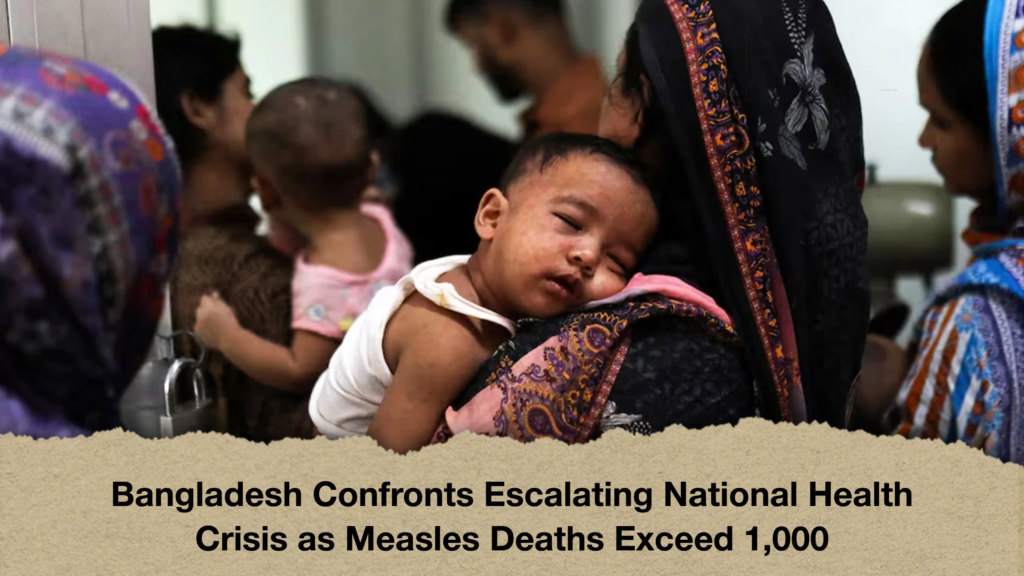
A catastrophic collapse in routine childhood immunisations has thrust Bangladesh to the centre of the world’s most severe measles epidemic. Official public health records confirm that, as of 9 September, the national death toll from confirmed and suspected measles cases reached 1,002. Total recorded infections have climbed to 187,484, reflecting a public health emergency of historic proportions.
Data from the US Centers for Disease Control and Prevention (CDC) places Bangladesh at the top of its global tracking list for active measles transmission. During the first six months of 2026 alone, the nation registered 57,561 cases—the highest total reported by any single country globally over that period.
Figures released by the Directorate General of Health Services reveal that out of the 1,002 fatalities, 100 were laboratory-confirmed cases of measles. The remaining 902 deaths involve individuals who succumbed after exhibiting clinical symptoms matching the disease. Laboratory testing has formally confirmed 19,904 cases nationwide, while a staggering 167,580 suspect cases remain under official monitoring.
The impact on the national healthcare infrastructure has been severe. Hospital admissions for measles or related symptoms reached 147,393 by early September. Although 141,819 patients were treated and subsequently discharged, 5,574 individuals remained hospitalized in critical condition. The strain on medical facilities has been further exacerbated by a concurrent surge in dengue fever, leaving pediatric units across the country severely stretched.
Systemic disruptions in 2024 and 2025 laid the groundwork for the current outbreak. Prolonged political instability severely compromised routine health services, severed supply chains for vital biological products, and halted field-level administration of the measles-rubella (MR) vaccine. Analysis by the World Health Organization (WHO) revealed that by April, active transmission had spread to 58 out of the country’s 64 districts. Young children bear the brunt of the epidemic; roughly 79 per cent of all recorded cases involve children under five years old, with unvaccinated infants under two facing the highest mortality risk.
In response, Bangladeshi health authorities, working Alongside WHO and UNICEF, conducted an emergency mass vaccination campaign. By late June, workers administered MR vaccines to over 18.4 million children, surpassing initial target metrics. Nevertheless, transmission rates remain elevated. Public health experts emphasize that mass reactive campaigns cannot fully compensate for deep, historical gaps in baseline immunity. Unimmunized cohorts from previous years remain vulnerable, and disparities between administrative coverage statistics and actual community-level immunity persist in several high-risk regions.
Measles is an exceptionally contagious airborne disease transmitted via respiratory droplets. While early clinical manifestations include fever, cough, rhinitis, and conjunctivitis, severe complications such as pneumonia, acute respiratory distress, and encephalitis frequently develop in vulnerable hosts—particularly malnourished infants.
Bangladesh had previously made substantial strides toward eliminating vaccine-preventable diseases. This ongoing outbreak underscores how rapidly hard-won public health achievements can erode when routine immunisation protocols falter. Containing the present epidemic will require sustained efforts to trace unvaccinated children, secure reliable vaccine supply chains, and reinforce routine healthcare operations across every district.