“We are all kings, in this kingdom of our king—”
Sukumar Ray
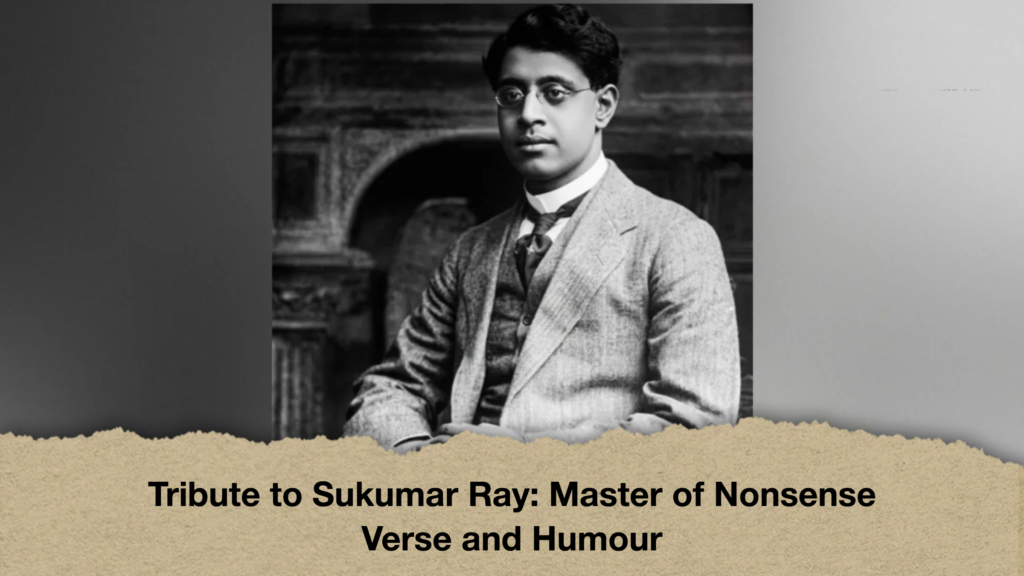
Certain luminaries grace the literary horizon for a brief moment, yet their brilliance continues to guide generations. Sukumar Ray remains one of the most remarkable talents in Bengali literature. Though his life was cut tragically short, he bestowed upon children’s literature a unique universe—one where whimsical nonsense exists alongside reason, reality intertwines with pure imagination, and subtle wisdom lies beneath lighthearted humour.
Born on 30 October 1887 into a prominent Brahmo family in Kolkata, Ray traced his ancestral lineage to Masua village in Kishoreganj. His father, Upendrakishore Ray Chowdhury, was an acclaimed author, artist, musician, and pioneer in printing technology. Growing up in an environment rich in science, arts, and literature shaped Sukumar’s versatile intellect. After graduating with a BSc (Honours) in Physics and Chemistry from Presidency College, Kolkata, in 1906, he travelled to England in 1911 to study advanced printing techniques and photography. Upon returning, he introduced modern photo-engraving and printing innovations to the Indian publishing industry.
During Ray’s tenure in England, his father established a premier printing press in Kolkata and launched Sandesh, a monthly children’s magazine. Following Upendrakishore’s passing shortly after Sukumar’s return in 1913, the young writer assumed the editorial leadership of Sandesh. This marked the beginning of a golden era in Bengali juvenile literature. Ray crafted an extraordinary literary domain filled with whimsical logic, bizarre creatures, playful wordplay, and unforgettable characters like Pagla Dashu.
Ray’s definitive contribution to Bengali letters was elevating nonsense verse to a recognized art form. His nonsense was far from mindless absurdity; it contained razor-sharp social satire, clever linguistic mechanics, and astute observations of human nature. Masterpieces such as Abol Tabol, HaJaBaRaLa, Pagla Dashu, and Chalachittachanchari stand as timeless treasures. Through surreal situations and inverted logic, he subtly exposed societal hypocrisy and the absurdities of conventional authority.
A true polymath, Ray was a poet, satirist, playwright, essayist, photographer, and technologist. His legacy extended naturally to his son, the world-renowned filmmaker Satyajit Ray, who went on to elevate Indian cinema to global acclaim.
Tragedy struck when Sukumar Ray contracted severe leishmaniasis, known locally as kala-azar. He succumbed to the illness on 10 September 1923 at the age of 35. Though his life ended prematurely, his literary legacy remains unaffected by the passage of time. Over a century after his death, the rhythmic cadence of Abol Tabol and the surreal world of HaJaBaRaLa continue to enchant readers across generations.