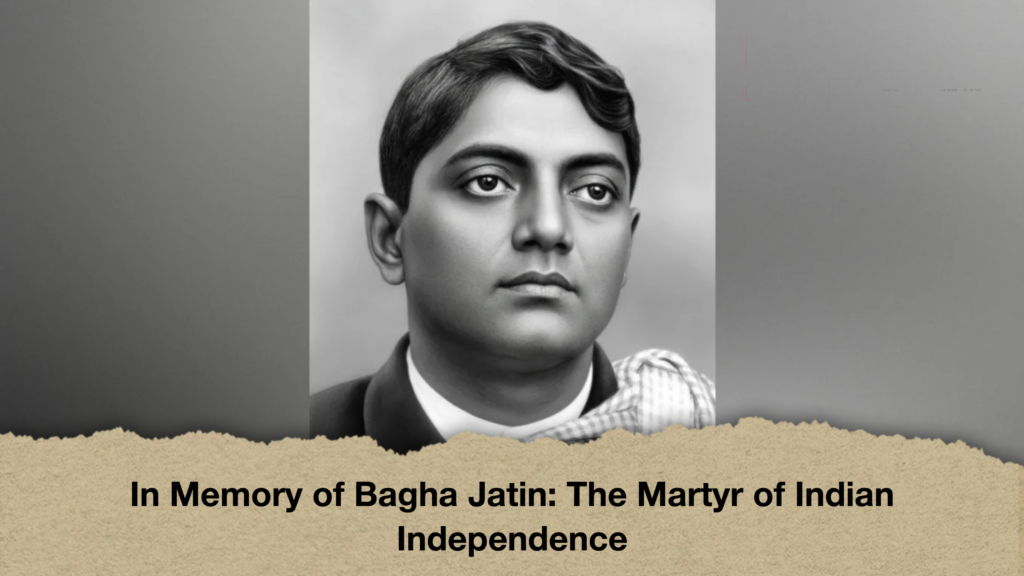
In the annals of India’s anti-British independence movement, few figures command as much respect and awe as Jatindranath Mukherjee, universally remembered as Bagha Jatin. A commander of extraordinary grit, he stood as one of the primary architects of the armed revolutionary movement and a key leader of the Jugantar party.
Born on 7 December 1879 in Kaya village, situated in the Kumarkhali region of Kushtia, Jatindranath was raised by his parents, Umeshchandra Mukherjee and Sharat Shashi Devi. From an early age, he displayed exceptional physical strength, resolute determination, and a fierce intolerance for injustice.
His legendary moniker, “Bagha Jatin” (Jatin the Tiger), was earned in 1906 following a harrowing encounter in his native region. Armed with only a dagger, Jatindranath fought off and killed a Royal Bengal tiger in a duel. This extraordinary display of bravery earned him the epithet “Bagha”, a title that remained permanently attached to his identity throughout his life.
Yet, his defining struggle was waged against the British colonial empire. Recognising that isolated, scattered acts of resistance could never dismantle British rule, Jatin set out to unify revolutionary factions across the subcontinent. Under his charismatic leadership, the Jugantar group transformed into a tightly knit, widespread organisation capable of coordinated action.
During the First World War, Jatin elevated his strategy to an international level. Capitalising on global geopolitics, he forged contacts with German representatives to secure arms, ammunition, and financial backing for an all-India military uprising—a clandestine strategy known historically as the “German Plot”.
According to the plan, a German ship carrying a vast consignment of weaponry was scheduled to land along the coast of Balasore in Odisha. However, British intelligence intercepted details of the shipment, prompting widespread raids, arrests, and an intensive manhunt for the revolutionary leaders.
On 9 September 1915, British forces tracked Jatin and four of his closest comrades—Chittapriya Ray Chaudhuri, Manoranjan Sengupta, Niren Dasgupta, and Jyotish Chandra Pal—to Chashakhand near the banks of the Buribalam River in Balasore.
Vastly outnumbered and equipped only with pistols against heavy police firepower, the revolutionaries refused to surrender. They staged a heroic last stand from behind a hillock on the riverbank. Jatin sustained severe bullet wounds during the prolonged gun battle and was moved under armed guard to Balasore Hospital.
The following day, 10 September 1915, Jatindranath Mukherjee succumbed to his injuries at the age of 35. His tragic demise ended a remarkable chapter in the armed struggle, but his sacrifice galvanised future generations of freedom fighters across South Asia, cementing his legacy as a titan of the anti-colonial resistance.