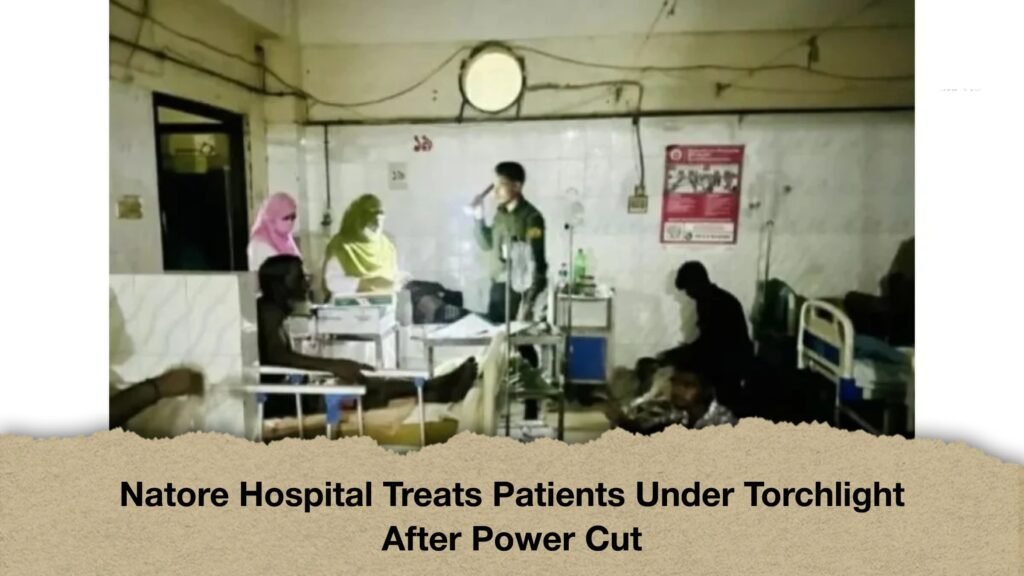
Medical services at Singra Upazila Health Complex in Natore were disrupted for around 13 hours after a transformer failure cut the facility’s electricity supply, forcing doctors and nurses to treat patients using torchlights and mobile phone lights.
The power went out at around noon on Saturday, 12 September, and had still not returned by 1am. The 50-bed hospital remained without a normal electricity supply throughout the period, creating serious difficulties for patients, their relatives and medical staff.
Hospital authorities said the outage was caused by a faulty transformer connected to the facility’s electricity line. During the day, doctors and nurses were able to continue providing treatment despite the disruption, largely because there was sufficient natural light. Conditions became much more difficult after sunset, when proper lighting was required for routine treatment and emergency care.
From the evening onwards, members of the Ansar security force were seen holding torches to help medical staff attend to patients. Nurses used the available light while administering medicines, saline and injections. In some cases, mobile phone lights were also used to provide basic medical assistance.
The prolonged outage was particularly challenging because the hospital had patients of different ages, including children and elderly people. A doctor working in the emergency department said medical staff had been struggling to provide services after the electricity failure continued for hours.
The doctor said mobile phone lights had to be used to provide necessary care. The outage also disrupted the hospital’s online ticketing system, meaning tickets could not be issued online for patients arriving for admission or seeking treatment at the emergency department.
The doctor called for a reliable and uninterrupted electricity supply at hospitals, describing it as essential for reducing difficulties faced by both patients and healthcare workers.
Patients and their relatives said a generator was switched on in the evening, but it could not run for long because of a shortage of fuel. Once the generator stopped, patients had to rely on their own mobile phones for lighting while taking medicines and carrying out other essential activities.
The lack of electricity was especially difficult for children and elderly patients. Patients suffering from high blood pressure also faced additional discomfort in the heat.
Relatives of patients admitted to the hospital, including Humayun Kabir, Asit Sarkar and Abdur Rashid, were among at least seven people who described the situation. They said patients were receiving treatment for respiratory problems, diarrhoea and high blood pressure.
According to the relatives, the prolonged electricity failure created difficulties in providing gas to a patient suffering from breathing problems at the appropriate time. They also said patients with high blood pressure were struggling in the heat. The relatives blamed what they described as negligence by the rural electricity authorities for the prolonged disruption.
Singra Upazila Health and Family Planning Officer Dr Mujahidul Islam said the hospital had kept its generator running after the electricity supply was interrupted. However, it had to be switched off at intervals. He acknowledged that patients were suffering because of the power failure.
The electricity authorities, meanwhile, said repair work had already begun. Siddiqur Rahman, deputy general manager of the Singra zonal office of Natore Palli Bidyut Samity-1, said workers started repairing the fault after receiving information that the transformer serving the hospital’s electrical line had failed.
He described the problem as complicated and said it could take until around 9am on Sunday for the electricity supply to return to normal. He urged patients and their relatives to remain patient while the repair work was carried out.
The prolonged outage exposed the difficulties faced by a healthcare facility when its main electricity supply fails for an extended period. Apart from lighting, electricity is needed for a range of routine hospital operations and equipment. In emergency situations, even basic tasks such as administering injections, managing saline and attending to patients can become considerably more difficult when adequate lighting is unavailable.
For the patients at Singra Upazila Health Complex, the 13-hour disruption therefore meant dealing with an additional layer of hardship while already seeking medical care. The incident also underlined the need for dependable power arrangements at healthcare facilities, particularly where emergency patients and vulnerable groups require continuous attention.