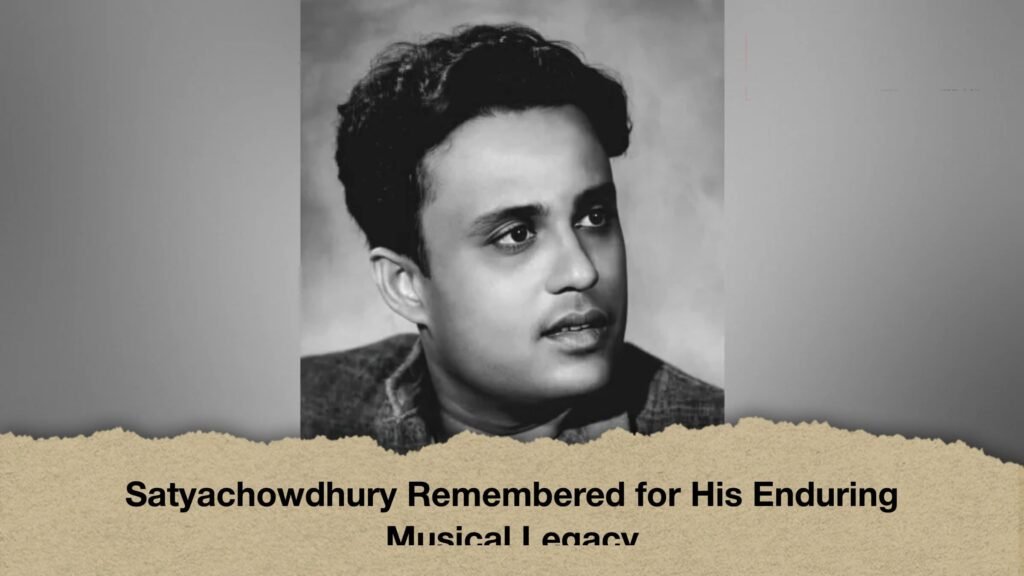
Certain voices in Bengali music refuse to fade with time. Long after an artiste’s active years have passed, their songs can continue to evoke memories and emotions among listeners from entirely different generations. Legendary singer, composer and music director Satyachowdhury was one such figure. His deep, resonant voice and expressive style made him a distinctive presence in Bengali music.
The song “Prithibi amare chay, rekho na bendhe amay” remains closely associated with his musical identity. Its evocative melody and words express a longing for freedom, a love of life and a desire to remain connected with the wider world. In Satyachowdhury’s rendition, those emotions acquired a strong and memorable vocal character, helping the song retain its place in the memories of Bengali music lovers.
Satyachowdhury was born on 17 September 1918 in Kolkata into a distinguished family with a keen interest in music. His formal name was Satyaranjan Chowdhury, while his family’s ancestral home was in Rajshahi. Growing up in a musical environment, he developed an early interest in melody and singing. With dedication, practice and his own artistic ability, he gradually established himself in the Bengali music world.
One of the most significant influences on his musical life was his association with Kazi Nazrul Islam, the celebrated Bengali poet, composer and cultural figure. Satyachowdhury had the opportunity to receive direct musical training from Nazrul. The experience became an important part of his development as a singer, while Nazrul’s affection and guidance remained a memorable aspect of his career.
Satyachowdhury became particularly recognised during the 1940s for his performances of patriotic songs, Shyama Sangeet and romantic compositions. His powerful voice brought a strong sense of patriotism and self-respect to patriotic songs. In devotional music, his delivery conveyed reverence and surrender. His romantic performances, meanwhile, revealed a gentler side, expressing tenderness, longing and affection.
His ability to adjust his vocal expression according to the character of a composition was one of the qualities that distinguished him. He did not rely solely on vocal strength or melodic precision. He sought to communicate the feeling contained within the lyrics, allowing the words and music to work together in a way that could connect directly with listeners.
His close association with Nazrul is also reflected in a notable recording episode from 1942. Before Nazrul became seriously ill, three singers recorded songs under his supervision. Satyachowdhury was one of them, alongside Jaganmoy Mitra and Pratibha Ghosh. The episode represents a particularly significant link between the singer and Nazrul during an important period in the poet’s life.
Satyachowdhury’s contribution to the cultural sphere was not limited to singing. He also demonstrated his abilities as a composer and music director. He was involved in acting and later served as an announcer for Akashvani, the broadcasting service associated with All India Radio. His involvement in several branches of the cultural world reflected a career that extended beyond conventional boundaries.
His voice itself was central to his artistic identity. It had a natural depth and a commanding quality, yet his performances were also marked by emotional sensitivity. Whether he was singing about patriotism, devotion or love, he placed considerable emphasis on conveying the sentiment behind the composition. As a result, his songs could feel less like formal performances and more like direct expressions of human emotion.
Satyachowdhury died on 5 December 1993. His passing brought an end to the life of an artiste whose career had spanned singing, composition, music direction, acting and broadcasting. Yet his departure did not end the presence of his music. The recordings and songs associated with him continue to preserve the memory of his distinctive voice.
The enduring appeal of “Prithibi amare chay, rekho na bendhe amay” offers one example of that legacy. The song’s theme of freedom and its celebration of life remain relatable beyond the period in which it was performed. Satyachowdhury’s interpretation gave those ideas a particularly recognisable musical form.
His career also reflects a period when Bengali music was closely connected with radio, recorded performances and a wider cultural movement involving poetry, composition and stage performance. His association with Nazrul places him within that rich artistic environment, while his own work across different mediums demonstrates the breadth of his contribution.
Today, Satyachowdhury is remembered not simply for a single song but for a distinctive body of work and a multifaceted cultural career. His journey from a music-loving family in Kolkata to recognition as a singer, composer, music director, actor and radio announcer forms an enduring chapter in Bengali musical history.
On his birth anniversary, the memory of the veteran artiste returns through the songs that carried his voice. Decades after his death, his music continues to connect listeners with an earlier era of Bengali culture. His artistic legacy remains preserved in those melodies, performances and memories, ensuring that Satyachowdhury continues to be remembered as a distinctive voice in Bengali music.