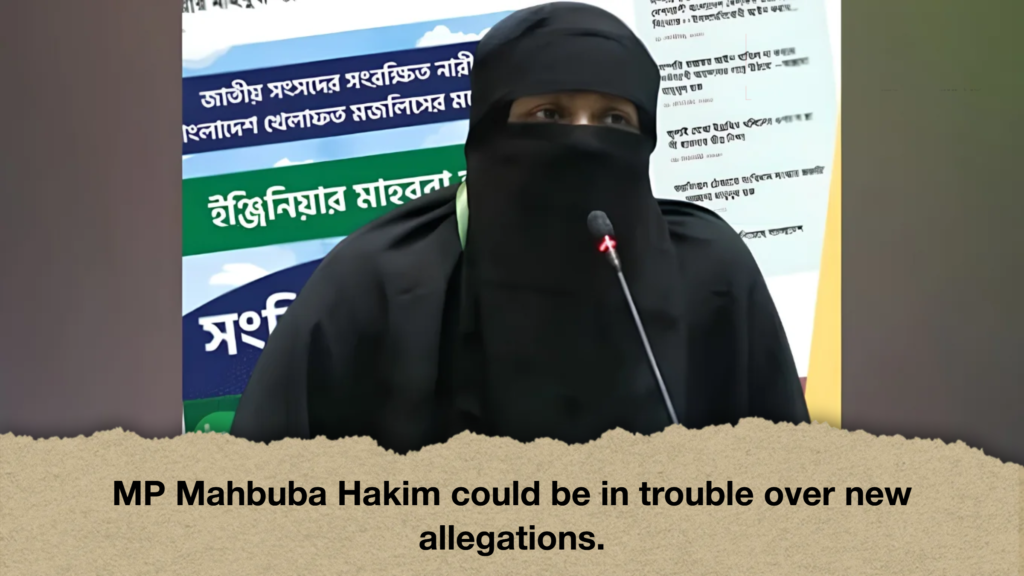
Mahbuba Hakim, the niece of Bangladesh Khelafat Majlis chief Mamunul Haque and a current member of parliament from a reserved women’s seat, has come under scrutiny over information about her educational qualifications submitted to the Election Commission.
The issue surfaced after her affidavit, submitted to the Election Commission, listed her highest educational qualifications as “LLM, Barrister-at-Law”. However, publicly available information and statements attributed to Hakim indicate that she completed a Bachelor of Science degree in Textile Engineering from Bangladesh University of Textiles (BUTEX).
Hakim has also said that she does not hold any higher educational qualification in law.
The discrepancy has prompted questions about how the information was included in the affidavit and whether the relevant documents were properly verified during the nomination process. An affidavit submitted to the Election Commission forms part of the official information provided by a candidate, making accuracy in such documents an important matter during the electoral process.
Hakim’s educational background has previously been associated with textile engineering. According to the information available about her academic career, she studied at BUTEX and completed her undergraduate degree in the field. Her own account also identifies textile engineering as her area of higher education.
The appearance of an LLM and Barrister-at-Law qualification in the affidavit therefore stands in contrast to that account.
Hakim has reportedly explained that the information was included inadvertently during the preparation of nomination-related documents. According to her account, the paperwork was prepared with assistance from party officials and the disputed educational information may have been inserted because of an error while preparing or copying information into the relevant documents.
She has also indicated that her actual educational certificate was submitted as part of the documentation. Her explanation is that she did not intentionally claim to possess a law degree or a Barrister-at-Law qualification.
The matter has now drawn attention to the Election Commission because any formal complaint concerning the information could lead to a review of the relevant documents.
Election Commissioner Abdur Rahmanel Masud told the media on Tuesday, 22 September, that if anyone submits a complaint regarding Mahbuba Hakim, the matter will be examined in accordance with the law.
His remarks indicate that the commission would consider the issue if it receives a formal complaint. Such a review could involve examining the affidavit, supporting educational documents and other relevant records before determining whether any further action is warranted.
At this stage, however, the existence of an inconsistency in the affidavit does not by itself establish that the information was deliberately falsified. The key questions are how the disputed qualification came to be recorded, what documents were submitted with the nomination papers and whether the discrepancy was identified during the relevant verification process.
The distinction is significant because an allegation and a proven violation are not the same thing. Any legal or electoral consequence would depend on the facts established through the appropriate review and the provisions of the law applicable to the case.
For now, the Election Commission has not announced any final decision regarding Mahbuba Hakim’s parliamentary position. The commissioner’s statement makes clear that the matter can be considered if a formal complaint is lodged.
The issue is therefore likely to remain under scrutiny, particularly because the affidavit contains qualifications that appear inconsistent with Hakim’s publicly stated educational background. Whether the discrepancy was the result of an administrative error or something requiring further legal consideration can only be established through examination of the relevant records.