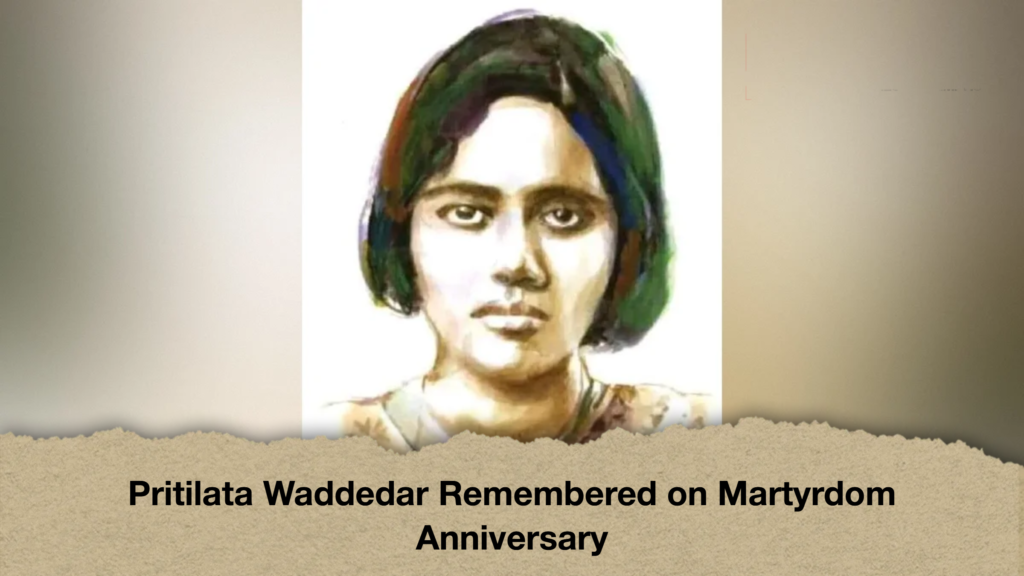
23 September marks the martyrdom anniversary of Pritilata Waddedar, one of the most prominent women revolutionaries of Bengal’s anti-colonial struggle. She died on this day in 1932 at the age of just 21, leaving behind a legacy of courage and sacrifice that continues to occupy a significant place in the history of the independence movement.
Born in Chattogram in 1911, Pritilata was a gifted student. She passed her matriculation examination with distinction from Dr Khastagir Government Girls’ High School before moving to Dhaka for higher education at Eden College. In 1929, she performed well in the Intermediate examination under the Dhaka Board. She later studied philosophy at Bethune College in Kolkata and completed her graduation.
Her political consciousness developed during her student years, when opposition to British colonial rule was spreading among sections of young people. At a time when women’s direct involvement in armed revolutionary activities was relatively uncommon, Pritilata gradually became associated with nationalist and women’s organisations and moved towards underground revolutionary activities.
After returning to Chattogram, she worked as the headmistress of Nandan Kanan Aparnacharan Girls’ School. Teaching offered her a relatively secure professional life, but her growing commitment to the anti-colonial movement eventually drew her towards the revolutionary struggle.
Pritilata subsequently became associated with the revolutionary organisation led by Surya Sen, popularly known as Masterda Surya Sen. She was involved in activities connected with the revolutionary network, including plans targeting colonial communication facilities. Her association with the movement also brought her under increasing surveillance by British authorities, forcing her at one stage to remain underground to avoid arrest.
Attack on the Pahartali European Club
The defining episode of Pritilata’s revolutionary career came on the night of 23 September 1932, when Surya Sen entrusted her with leading an attack on the Pahartali European Club in Chattogram.
The club had come to be regarded by revolutionaries as a symbol of the racial discrimination associated with colonial rule. It was also linked to the notorious sign reported at the time as reading, “Dogs and Indians not allowed”, which became a powerful representation of the racial hierarchy imposed under British rule.
On that night, Pritilata led a group of revolutionaries while dressed in male attire. The attackers launched their assault on the club, but the operation soon met resistance from the colonial authorities. During the confrontation, Pritilata was shot and became surrounded.
Facing the possibility of arrest and fearing that interrogation could expose information about her fellow revolutionaries, she took potassium cyanide that she had carried with her and died at the scene. She was only 21.
Her death sent a strong message through the revolutionary circles of Bengal. At a time when women were often expected to remain distant from armed political struggle, Pritilata’s participation demonstrated the extent to which women could become directly involved in the anti-colonial movement. Her decision to accept the ultimate personal cost of that involvement subsequently became an enduring part of her historical image.
Pritilata’s life also reflected the intersection of education, political awareness and resistance during a turbulent period in Bengal’s history. Her journey from an accomplished student and schoolteacher to an underground revolutionary illustrates how the experience of colonial rule shaped the political choices of a section of the younger generation.
Her story is remembered not simply for the circumstances of her death, but also for the determination with which she entered a movement dominated largely by men. Her actions challenged contemporary expectations about the role of women in political resistance and helped establish her as one of the best-known female figures of Bengal’s revolutionary era.
On the anniversary of her martyrdom, Pritilata Waddedar is remembered as a young revolutionary whose name became closely associated with courage, resistance and sacrifice during the struggle against British colonial rule. More than nine decades after her death, her life remains part of the historical memory of Bengal’s anti-colonial movement.
At 21, she gave up a life filled with possibilities for a cause she believed in. Her story continues to remind later generations o