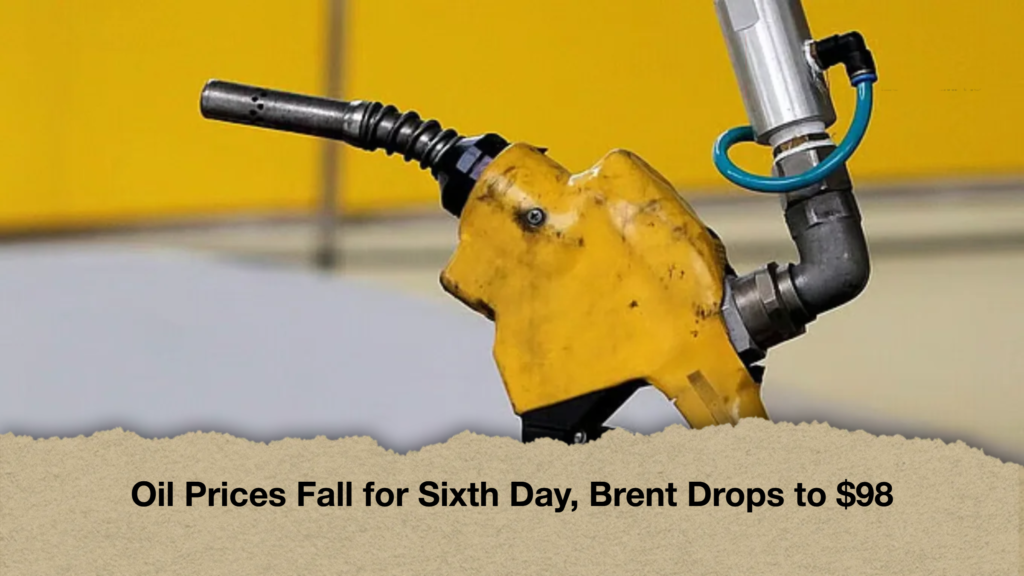
Global crude oil prices continued their decline on Wednesday, extending a losing streak to six consecutive days as signs of easing geopolitical tensions and improving supply prospects weighed on the market.
Brent crude fell 0.8 per cent in Asian trading to $98.43 a barrel. If the decline continues through the day, it would mark the longest sustained fall in oil prices since August last year. US West Texas Intermediate (WTI) crude also slipped below $90 a barrel, having lost more than 10 per cent over the past five sessions.
The latest decline comes amid diplomatic developments surrounding the conflict between Iran and the United States. Washington and Tehran have held their first talks since June, raising hopes in financial markets that the immediate risks to regional energy supplies could ease. At the same time, preparations are under way for Chinese President Xi Jinping’s planned three-day visit to Washington, adding another major geopolitical development to an already uncertain global environment.
Supply concerns have also eased to some extent. Saudi Arabia said on Tuesday that preparations were under way to restart its East-West oil pipeline. The country is also preparing to resume crude oil exports from its Red Sea coast. Any restoration of transport and export capacity could reduce pressure on international supplies and make traders less concerned about shortages.
The fall in energy prices has also helped support financial markets. US equities reached fresh highs this week, with the Nasdaq 100 setting a new record on Tuesday amid continued optimism surrounding artificial intelligence and technology companies. Lower oil prices can ease concerns about corporate costs and inflation, although markets remain highly sensitive to developments in the Middle East.
Xi’s expected visit to Washington is another factor being closely watched by investors. Analysts expect the meeting to maintain the existing, if uneasy, understanding between the world’s two largest economies, while expectations of a major breakthrough remain limited.
Kenny Ng, a strategist at Everbright Securities International, said the outcome of the summit could have significant implications for US-China economic and trade relations, competition in the technology sector and the broader geopolitical outlook. He also cautioned investors against following the recent market rally blindly, arguing that the outcome of the high-level meeting could provide greater clarity on the policy direction of both countries.
Lower oil prices have also altered expectations about US monetary policy. Grace Tam, deputy chief investment officer for Asia at BNP Paribas Wealth Management, said the decline in energy costs had reduced the likelihood of a Federal Reserve rate increase in October to 53 per cent.
However, the oil market remains vulnerable to a renewed escalation in the conflict. Investors have yet to become convinced that crude prices can remain lower for an extended period unless the confrontation between Iran and the United States is resolved. A sudden deterioration in the situation could quickly reverse the recent decline.
Analysts also expect China’s oil demand to remain relatively restrained during the final three months of the year. Lower Chinese purchases have reduced some of the pressure on global crude markets, while Beijing has been drawing on strategic reserves. As a result, a sharp increase in Chinese imports is not currently regarded as the principal threat to oil prices.
Instead, a further expansion of attacks on crude oil production and export infrastructure in the Middle East is seen as a more immediate risk. Damage to facilities, pipelines or other transport links could disrupt supplies and send prices higher even after the recent decline.
The global bond market was broadly stable on Wednesday. The yield on the US 10-year Treasury rose by 0.01 percentage point to 4.96 per cent. Higher energy prices had previously fuelled concerns about inflation around the world, contributing to higher bond yields in several major markets.
Chicago Federal Reserve President Austan Goolsbee also issued a warning this week about the outlook for US inflation. He said that if the recent increase in inflation was caused by something more persistent than a temporary shock from higher oil prices, the Federal Reserve might need to respond quickly and forcefully.
What Does the Oil Price Mean in Bangladeshi Taka?
One barrel of crude oil contains roughly 159 litres. At a price of $98.43 a barrel, the international price of crude works out at approximately 62 US cents per litre. Assuming an exchange rate of Tk123 to the dollar, that is equivalent to roughly Tk76 per litre.
That figure, however, represents only the international price of unrefined crude oil. It is not the final price paid by consumers in Bangladesh. Transport, insurance, port handling, refining, storage and distribution costs are added along the supply chain. Government duties and taxes also form part of the overall cost.
Bangladesh’s limited domestic refining capacity is another important consideration. The country can refine roughly 1.5 million tonnes of crude oil a year, while its annual oil imports are around 7 million tonnes. A substantial volume of refined petroleum products therefore has to be imported to meet domestic demand.
As a result, a fall in international crude prices does not automatically translate into an equivalent reduction in domestic fuel prices. Import costs, exchange rates, refining expenses, transportation, taxes and duties, as well as the cost of refined petroleum products, all influence the final price in Bangladesh.
The latest decline in global oil prices therefore offers some relief to energy markets, but its longer-term impact will depend heavily on whether the geopolitical situation remains stable and whether crude supply routes in the Middle East continue to operate without major disruption.