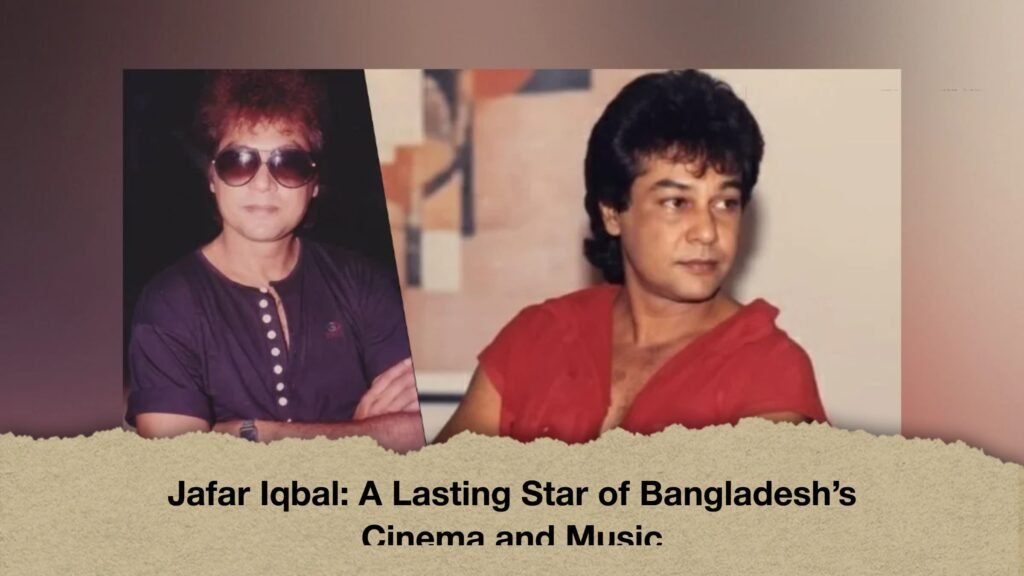
Jafar Iqbal occupies a distinctive place in the history of Bangladesh’s popular entertainment. He began his career in music, but later emerged as one of the most recognisable leading men of the country’s cinema. During the 1970s and 1980s, his romantic screen image, contemporary style and confident personality made him especially popular among young audiences. His career brought together two creative worlds that rarely overlap so closely: music and acting.
Born in Gulshan, Dhaka, in 1950, Jafar Iqbal came from a family with strong musical connections. His elder brother, Anwar Parvez, was a noted composer and music director, while his younger sister, Shahnaz Rahmatullah, became a celebrated singer. Music was therefore a natural part of his upbringing. From an early age, he developed a keen interest in singing and performance.
In 1966, Jafar Iqbal made his debut as a singer after forming the band Rambling Stones. He was also a skilled guitarist, an ability that became an important part of his early musical identity. At a time when the country’s band music scene was still developing, his involvement in a group helped introduce him to a younger generation of music listeners.
His musical career also brought him closer to the film industry. Through his association with composer Alauddin Ali, he became involved in the production of background music for films. This experience gave him an opportunity to work within the wider world of cinema before establishing himself as an actor. Gradually, the singer and guitarist began to make his way towards the silver screen.
Jafar Iqbal entered acting before Bangladesh’s independence. In 1970, he appeared as a leading actor in the film Apon Por. His career was then interrupted by the Liberation War in 1971, in which he actively participated. After independence, he returned to the film industry and resumed his acting career.
His popularity expanded significantly after his role in the 1975 film Mastan. He went on to appear in a wide range of roles, demonstrating that his appeal was not limited to the conventional romantic hero. At different points in his career, he portrayed romantic young men, rebellious and impulsive characters, and people facing emotional hardship and difficult circumstances.
His acting style was closely tied to his screen presence. Jafar Iqbal had a distinctive manner of appearing before the camera, while his dialogue delivery and personal style contributed to the individuality of his performances. For audiences of the period, particularly younger viewers, he represented a modern form of cinematic stardom.
Music, meanwhile, remained an important part of his public identity. Several songs associated with his films became popular, including ‘Hoy Jodi Bodnam Hok Aro’, ‘Sukhe Theko O Amar Nandini’ and ‘Tumi Amar Jibon’. His continued connection with music meant that audiences could experience him not only as an actor but also as a singer.
Fashion was another significant element of his appeal. Throughout the 1970s and 1980s, his clothes, hairstyle and overall appearance attracted considerable attention among young people. He developed an image that combined the traditional appeal of a leading man with a more contemporary sense of style. His appearance on and off screen helped reinforce his status as one of the era’s fashionable stars.
Jafar Iqbal is credited with acting in around 150 films as a leading actor over the course of his career. His professional journey was notable not simply for its length but also for its breadth. Few performers of his generation moved so visibly between popular music and mainstream cinema while maintaining a strong identity in both.
His career also coincided with a significant period in the development of Bangladesh’s entertainment culture. The 1970s and 1980s saw film songs, cinema and changing fashion trends play an important role in shaping popular tastes. Jafar Iqbal became closely associated with that cultural period through his work as a performer.
Jafar Iqbal is no longer alive, but his contribution remains part of the country’s cinematic and musical memory. His songs continue to recall a particular era, while his films preserve the image of a leading man whose career extended beyond acting.
From the music stage to the silver screen, Jafar Iqbal built a career across two different forms of entertainment. His combination of singing, acting, guitar playing and distinctive personal style gave him a place of his own in Bangladesh’s cultural history. For many audiences, his name remains closely connected with the music, romance and cinematic style of the 1970s and 1980s.