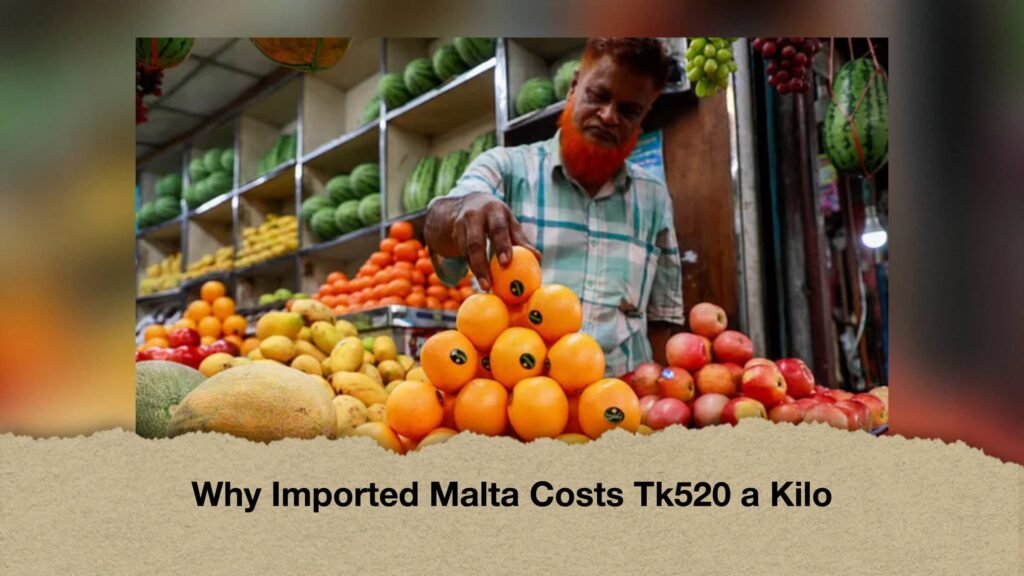
Yellow Malta sold in Bangladesh is largely imported from South Africa and Egypt, where the fruit is being brought in at a maximum price of around 70 US cents per kilogram. In Bangladeshi currency, that amounts to roughly Tk87. Yet consumers in Chattogram are currently paying between Tk480 and Tk520 per kilogram — more than five times the import price.
An analysis of the fruit’s journey from import to retail shows that a substantial portion of the price increase occurs before the Malta even reaches the domestic market. The combined tax burden on fresh oranges and Malta-type fruit stands at 121.78%. Transport, port charges, storage and other expenses are then added at different stages of the supply chain.
More recently, reduced supplies and increased demand amid a rise in dengue cases have pushed wholesale and retail prices even higher.
Taxes add around Tk107 per kilogram
According to Bangladesh Customs, the total tax burden on imported fresh oranges and Malta-type fruit is 121.78%. This includes import duty, regulatory duty, supplementary duty, value-added tax and advance income tax.
Data from Chattogram Customs House show that the average import value of Malta is currently around Tk87 per kilogram. Taxes and duties add approximately Tk107, taking the cost to around Tk193–194 per kilogram by the time the fruit is cleared from the port.
Malta is transported in refrigerated or frozen containers. Importers and traders say another Tk10–15 per kilogram is added through transportation from the port to warehouses, container-related expenses and other associated costs. On that basis, the direct cost rises to around Tk204–209 per kilogram.
Importers, however, say the actual cost can be considerably higher once wastage, port expenses and container-related costs are taken into account. According to them, the effective cost may reach Tk230–240 per kilogram.
Imports have fallen sharply
The higher tax burden has coincided with a sustained decline in Malta imports, according to National Board of Revenue data.
In the 2021–22 financial year, Bangladesh imported around 294,000 tonnes of Malta. The figure fell to 220,000 tonnes in 2022–23 after the tax burden increased. Imports declined further to 173,000 tonnes in 2023–24, followed by 168,000 tonnes in 2024–25 and 153,000 tonnes in 2025–26.
This means imports have fallen to almost half their level over a period of four years. The downward trend has continued into the current financial year, with only around 21,000 tonnes imported during the first three months.
Supply shortages push up wholesale prices
After being cleared at the port, imported Malta is sent to wholesale markets in Chattogram and Dhaka before reaching retailers. Prices can change significantly at each stage depending on supply, demand and operating costs.
Traders at Chattogram’s Falmandi said Malta was being sold wholesale at Tk220–230 per kilogram around three weeks ago. Prices subsequently climbed rapidly. At one point, a 15-kilogram carton was being sold for Tk6,000–7,500, equivalent to approximately Tk400–500 per kilogram at wholesale level.
By Wednesday, retailers in different parts of Chattogram were selling the fruit for Tk480–520 per kilogram.
Fruit trader Md Babul of Railway Men’s Super Market said many importers suffered losses between June and August, prompting a reduction in subsequent imports. When September demand exceeded available supplies, prices rose sharply.
He said new consignments were now arriving and prices had started to ease. If supplies increase further in the coming week, retail prices could decline further, he added.
Mohammad Qutub Uddin, proprietor of Malta importer HR Corporation, said taxes, port charges and container transportation costs had all increased. He also claimed that retailers were in some cases charging up to Tk100 more per kilogram than importer or wholesale prices.
Fruit taxes have risen in recent years
Imported fruit did not always carry such a high overall tax burden. In the 2021–22 financial year, the combined tax burden on Malta and several other fruits was around 89%.
In May 2022, amid a shortage of US dollars, the government imposed a 20% regulatory duty on fruit and various other products as part of measures to discourage imports.
The overall tax burden subsequently increased further. At one stage in the 2024–25 financial year, it reached 136.20%, before being reduced. The current combined burden on several fruits, including oranges, Malta, apples and grapes, is 121.78%.
As a result, even if the international price of Malta remains unchanged, taxes alone can more than double its cost before it enters the domestic market.
Dengue adds to demand for Malta
The latest price surge has also coincided with a rise in dengue cases in Bangladesh. According to the Directorate General of Health Services, 79,620 people had been admitted to hospitals with dengue by 30 September this year, while 245 had died. Both cases and deaths rose sharply during September.
Fruit traders said demand for Malta and oranges tends to increase among families caring for people suffering from fever and dengue. With supplies already limited, the additional demand has contributed to further price increases.
For families buying fruit for sick relatives, Malta can therefore represent a significant expense. An imported fruit costing around Tk87 per kilogram at the initial stage can carry approximately Tk107 in taxes and duties before port clearance. Transportation, wastage, trading costs, margins and changes in supply and demand then add to the final price.
The National Directorate of Consumer Rights Protection has also taken action over the market situation. Mohammad Foyez Ullah, deputy director of the Chattogram office, said the issue had come to the authorities’ attention and that market drives had already been conducted.
On Wednesday, three businesses at Falmandi were fined a combined Tk13,000. He said such drives would continue.