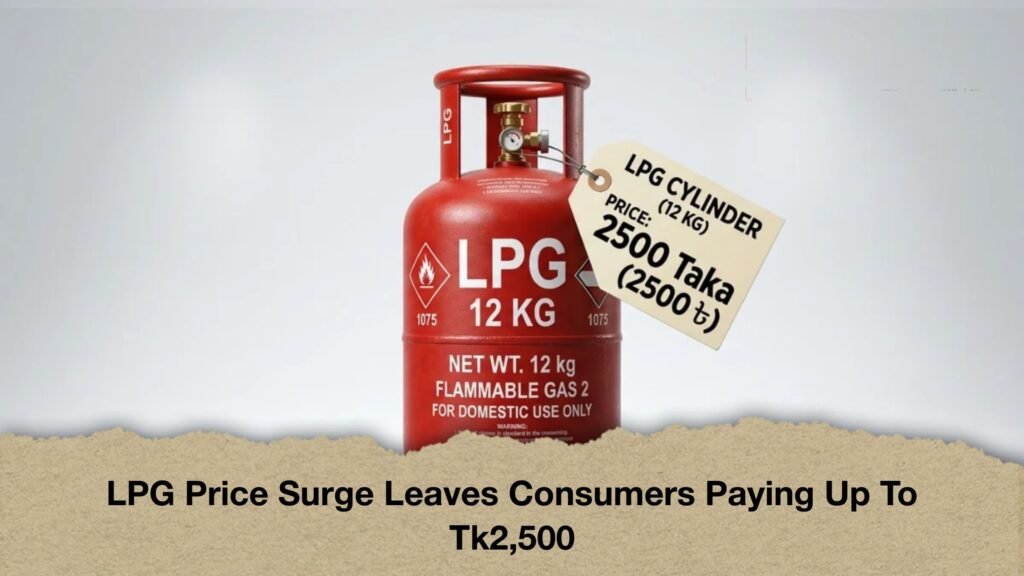
Bangladesh’s liquefied petroleum gas (LPG) market is facing growing price pressure, with consumers in some areas reportedly paying as much as Tk2,500 for a 12kg cylinder—far above the official September price of Tk1,585.
The sharp gap between the regulated rate and the retail market price has fuelled complaints from households and small businesses, while concerns have also emerged over the availability of cylinders. In some places, consumers say they have been unable to secure LPG even after agreeing to pay substantially more than the government-fixed price.
The Bangladesh Energy Regulatory Commission (BERC) set the retail price of a 12kg LPG cylinder at Tk1,585 for September, cutting the previous rate of Tk1,598 by Tk13. The revised price took effect on 2 September and included VAT. BERC’s calculation was based on international LPG prices, freight costs, traders’ premiums and the prevailing exchange rate.
Despite the reduction in the official rate, market prices moved in the opposite direction. Reports from different parts of the country indicate that 12kg cylinders have been selling for around Tk2,000 or more, while some consumers have reported prices reaching Tk2,500. That means buyers in the most expensive cases are paying roughly Tk915 above the regulated rate.
For households that rely on LPG for cooking, the sudden increase represents a significant additional expense. The impact is also being felt by small restaurants, food shops and other businesses that depend on LPG as a regular cooking fuel.
Supply shortage or market disruption?
The central issue is whether the price surge is being driven by an actual shortage, higher import costs, distribution problems or the withholding of supplies at some points in the market.
Retailers and distributors have pointed towards tighter supplies and higher procurement costs. Their argument is that if they have to purchase cylinders at elevated prices from distributors, selling them at the BERC-fixed rate would result in losses.
Industry representatives have also cited international market disruptions, higher freight costs and difficulties in securing new LPG cargoes. Reports indicate that some importers have faced higher premiums when trying to obtain fresh supplies, while disruptions along key shipping routes have added to transportation costs. Some operators have therefore reduced market releases while waiting for the next regulated price adjustment to reflect the higher costs.
Yet LPG operators have maintained that Bangladesh does not face an overall shortage.
At a meeting with Power, Energy and Mineral Resources Minister Iqbal Hassan Mahmood on 28 September, LPG operators said the country’s stock and supply position remained satisfactory. Data from the National Board of Revenue showed that Bangladesh imported 157,760 tonnes of LPG in August and another 118,742 tonnes between 1 and 22 September.
The figures have added another layer to the controversy. While import and stock data suggest that supplies are broadly available at the national level, consumers in several areas are reporting difficulty obtaining cylinders at the regulated price.
Government orders investigation
Against this backdrop, the government has moved to investigate the reasons behind the retail price escalation.
On 30 September, the energy minister instructed deputy commissioners to examine complaints that LPG was being withheld from the market or sold above the price fixed by BERC. District administrations were asked to submit reports with supporting evidence explaining why shortages were being reported despite apparently adequate national supplies and why consumers were being charged more than the regulated rate.
The minister said there was no nationwide shortage of LPG but acknowledged that artificial shortages could be occurring in particular areas. He also warned that action would be taken against those found creating artificial scarcity or charging prices above the official rate. Where genuine shortages are identified, the government has said it will take steps to increase supplies.
The investigation could therefore help distinguish between two different problems: a genuine disruption in the LPG distribution chain and localised practices that may be pushing prices beyond the regulated level.
Heavy dependence on imported LPG
Bangladesh’s dependence on imported LPG makes the domestic market particularly sensitive to international prices, shipping conditions and currency movements. The BERC reviews LPG prices each month using international benchmarks and other costs associated with bringing the product into the country.
For September, Saudi Aramco’s contract prices were set at US$625 per tonne for propane and US$660 for butane. Using the 35:65 propane-to-butane mix applied in the pricing calculation, BERC arrived at a weighted average Saudi Contract Price of US$647.75 per tonne. The regulator also factored in freight charges, traders’ premiums and an average exchange rate of Tk123.30 per US dollar.
The latest market turmoil has therefore exposed a wider tension within Bangladesh’s LPG pricing system. Importers and distributors face changing international costs, while consumers are expected to pay according to a regulated monthly price.
For now, the immediate concern for consumers is the wide gap between those two figures. A cylinder officially priced at Tk1,585 is reportedly changing hands for Tk2,000, Tk2,300 or even Tk2,500 in some areas.
Whether the situation reflects temporary supply and import difficulties, distribution bottlenecks or artificial restrictions at the local level is now the subject of government scrutiny. The findings of the district-level investigations, alongside the next BERC price adjustment, are expected to provide a clearer picture of what is driving the unusually high retail prices.