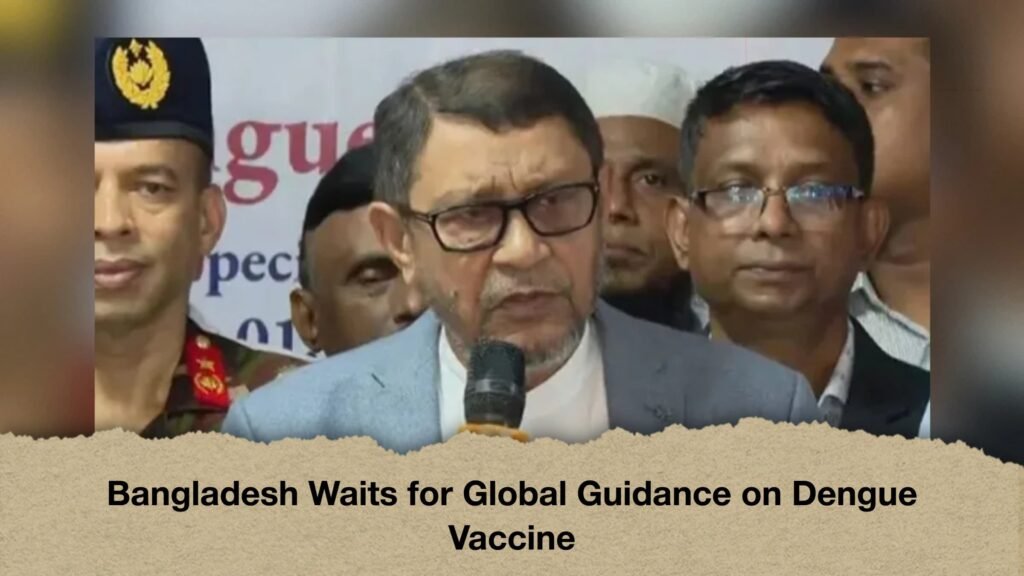
Bangladesh is not currently considering the introduction of a dengue vaccine, Health Minister Sardar Md Sakhawat Hossain has said, indicating that the government will wait for guidance from major international health and immunisation organisations before taking a decision.
The minister said the government would consider vaccination if organisations including the World Health Organisation (WHO), UNICEF and Gavi provide approval or recommendations supporting its use.
His comments come as dengue continues to pose a significant public-health challenge in Bangladesh. The government’s position suggests that, despite the growing burden of the disease, it does not intend to introduce a vaccine programme immediately without first assessing international guidance and the available scientific evidence.
Dengue is a mosquito-borne viral disease caused by four related virus serotypes. Infection with one serotype provides only partial and temporary protection against the other three, while subsequent infections can carry a higher risk of severe dengue. The disease is transmitted mainly by Aedes mosquitoes, which commonly breed in and around human settlements.
There is currently one dengue vaccine available for prevention. WHO recommends Qdenga, also known as TAK-003, for children aged six to 16 in settings where dengue transmission is intense. The recommended course consists of two doses administered three months apart. WHO says vaccination should be considered as part of a broader dengue-control strategy rather than as a replacement for mosquito control, proper clinical management and community engagement.
Qdenga received WHO prequalification in May 2024. The vaccine is a live-attenuated, tetravalent vaccine developed by Takeda and contains weakened versions of dengue virus serotypes 1, 2, 3 and 4. WHO’s recommendation is targeted at particular age groups and epidemiological settings rather than being a blanket recommendation for all populations in dengue-affected countries.
Safety monitoring has also been an important part of the international discussion surrounding the vaccine. WHO’s Global Advisory Committee on Vaccine Safety reviewed reports of hypersensitivity reactions, including anaphylaxis, following the introduction of Qdenga in Brazil. The committee stressed that countries introducing the vaccine should have appropriate systems, resources and training to identify and manage serious allergic reactions following immunisation.
WHO also places specific restrictions on the use of TAK-003. It does not currently recommend programme use among children under six because of lower efficacy in that age group. The vaccine should also not be administered to pregnant or breastfeeding women, or to certain people with impaired immune function.
For Bangladesh, these considerations are particularly relevant because dengue transmission has become a recurring seasonal health concern, placing pressure on hospitals and healthcare workers during periods of high incidence. The disease has also spread beyond its traditional concentration in major urban areas, making prevention and surveillance more complicated.
Recent figures illustrate the scale of the current challenge. According to a Reuters report published on 1 October, Bangladesh recorded 148 dengue deaths in September, making it the deadliest month of the year so far. Since January, at least 79,620 patients had been hospitalised with dengue and 245 people had died. Health experts cited in the report warned that rainfall and changing weather conditions could prolong the dengue season into October.
The availability of a vaccine does not remove the need for mosquito-control measures. WHO recommends reducing exposure to Aedes mosquitoes, eliminating stagnant water where they can breed and maintaining community-level efforts to reduce mosquito populations. Early diagnosis and appropriate treatment are also essential, particularly because severe dengue can develop after an initially uncomplicated illness.
Against this backdrop, the health minister’s remarks indicate that Bangladesh will not rush into a national dengue vaccination programme. The government is instead waiting for international approval and guidance from organisations such as WHO, UNICEF and Gavi before considering whether vaccination should form part of the country’s future dengue-control strategy.
For the time being, dengue prevention in Bangladesh will continue to depend heavily on mosquito-control measures, public awareness, surveillance and timely medical care, while the question of introducing a vaccine remains under consideration for the future.