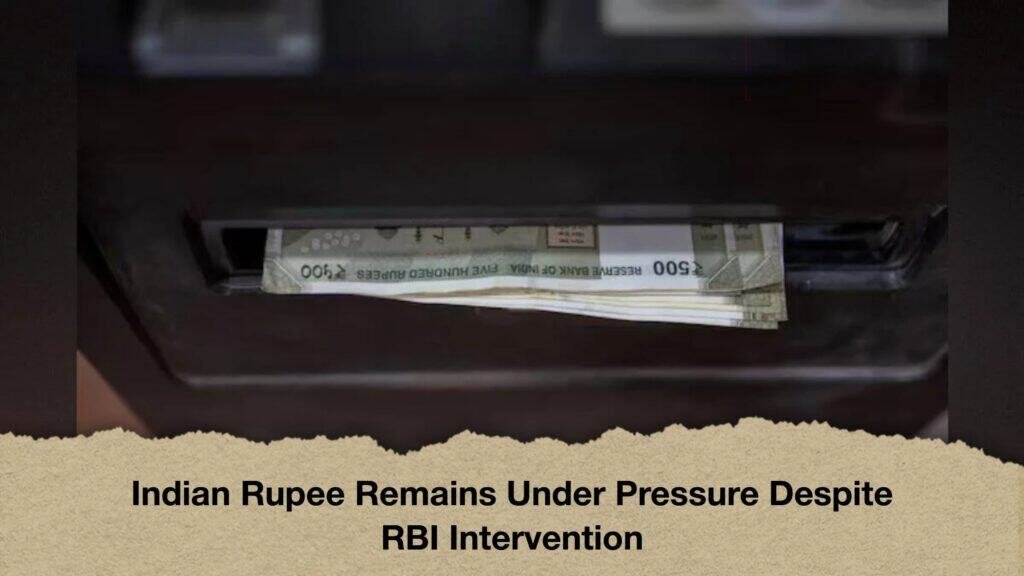
India’s rupee remained close to its record low against the US dollar on Friday, 9 October, as foreign investment outflows, elevated crude oil prices and persistent demand for the American currency continued to weigh on the exchange rate. Intervention by the Reserve Bank of India (RBI) helped contain the currency’s losses, but the broader pressures showed little sign of easing.
The rupee closed at 96.73 against the dollar, approaching its all-time low of 96.96 recorded in May 2026. The latest performance highlights the challenges facing Indian policymakers as they attempt to maintain currency stability amid uncertain global financial conditions and rising import costs.
A weaker US dollar and falling US Treasury yields offered some relief to Asian currencies. However, these developments were insufficient to reverse the rupee’s decline. Foreign investors continued to withdraw funds from Indian financial markets, while importers and businesses seeking protection against exchange-rate fluctuations added to demand for dollars.
A sustained depreciation of the rupee could have wider economic consequences, increasing the cost of imported goods, adding to inflationary pressures and raising the repayment burden on companies with foreign-currency liabilities.
RBI Steps In to Limit Further Losses
The RBI has intervened in the foreign exchange market to limit further depreciation. Traders said state-owned banks had sold dollars, probably on behalf of the central bank, helping to contain the rupee’s losses.
Central banks can use foreign exchange reserves to supply dollars when demand rises sharply. By increasing the availability of the American currency, such interventions can help moderate excessive volatility and prevent abrupt exchange-rate movements.
However, intervention does not necessarily reverse a sustained downward trend. When demand for dollars remains high because of investment withdrawals, import payments or expectations of further depreciation, the pressure can persist despite central bank action.
India’s substantial foreign exchange reserves give the RBI considerable resources to manage periods of market instability. Nevertheless, policymakers must balance the need to support the rupee against the importance of preserving reserves for other external payment requirements.
The latest intervention appears to have helped limit immediate losses, but the currency’s continued proximity to its historic low suggests that the underlying market pressures remain significant.
Interest-Rate Increase Fails to Boost the Rupee
The rupee has remained weak despite the RBI’s first interest-rate increase in nearly four years. The limited response highlights how capital movements and international economic conditions can outweigh the effects of domestic monetary policy.
Higher interest rates can make a country’s financial assets more attractive by improving potential returns for investors. This may encourage foreign capital inflows and support demand for the domestic currency. The impact, however, depends on investors’ expectations, global interest rates and the broader economic outlook.
In India’s case, persistent foreign portfolio investment outflows have continued to weigh on the rupee. When overseas investors sell Indian shares or other financial assets and convert the proceeds into dollars, demand for the American currency can rise, putting additional pressure on the Indian currency.
Importers and businesses are also contributing to dollar demand as they seek protection against further depreciation. Currency hedging allows companies to reduce uncertainty over future foreign exchange payments, although increased demand for such protection can influence market activity.
Meanwhile, lower US Treasury yields and a softer dollar have provided modest support to several Asian currencies. These developments have not been enough to offset the pressures affecting the rupee.
Rising Oil Prices Add to Economic Strain
Higher crude oil prices remain a major concern for India, one of the world’s largest oil importers. The country’s reliance on overseas energy supplies means that rising international prices can increase its import bill and intensify demand for foreign currency.
Brent crude rose by around 4 per cent on Thursday, reaching nearly $106 a barrel, before retreating following comments by US President Donald Trump concerning developments involving Iran.
Oil prices are particularly important for the rupee because Indian importers generally require dollars to settle payments for crude oil and other internationally traded energy products. When prices rise, India must spend more foreign currency to purchase the same volume of oil.
A larger import bill can put additional pressure on the country’s external balances, particularly if export earnings and other foreign currency inflows fail to offset the higher costs.
The effects can extend beyond the foreign exchange market. Higher energy prices may increase transport, manufacturing and distribution costs, which can eventually feed into consumer prices. If the rupee weakens at the same time, imported goods and raw materials may become even more expensive in local currency terms.
This combination presents a difficult challenge for Indian policymakers, as rising import costs can add to inflationary pressures while making currency stabilisation more complicated.
Foreign Exchange Reserves Fall from September Peak
India’s foreign exchange reserves stood at $734.6 billion on 2 October, approximately $50 billion below their record high in September. Figures cited by Reuters showed that reserves had declined for four consecutive weeks.
Foreign exchange reserves serve as an important financial safeguard. They help countries meet external payment obligations and give central banks the capacity to respond to currency-market volatility. They can also support investor confidence during periods of financial uncertainty.
A decline in reserves does not automatically indicate a crisis. Reserve levels can fluctuate because of valuation changes, foreign exchange operations and other factors. However, a sustained reduction alongside continued pressure on the domestic currency may attract greater scrutiny from investors and market analysts.
India’s reserves remain substantial, providing the RBI with resources to manage exchange-rate volatility. The extent to which those resources can limit further depreciation will depend on the scale and duration of dollar demand, as well as the central bank’s approach to market intervention.
Maintaining confidence in the rupee will also require attention to the wider economic conditions affecting capital flows, import costs and external payments.
Analysts Expect the Rupee to Remain Weak
Analysts surveyed by Reuters expect the rupee to remain close to record-low levels over the next three to six months. Their outlook reflects continuing uncertainty over foreign investment flows, energy prices and international financial conditions.
Japan’s MUFG has forecast that the dollar could reach 97.50 rupees by September 2027. The projection suggests the possibility of further depreciation, although it remains a forecast rather than a certainty.
The exchange rate could follow a different path if crude oil prices decline, foreign investment inflows improve or global financial conditions become more favourable for emerging-market currencies. Conversely, renewed increases in energy costs or further capital withdrawals could intensify the pressure.
The consequences of a weaker rupee will vary across the Indian economy. Import-dependent businesses may face higher costs for machinery, raw materials and energy. Companies with dollar-denominated loans or other foreign-currency liabilities could also see the rupee cost of repayments rise, even if the amount owed in dollars remains unchanged.
Exporters may benefit from receiving more rupees when converting their dollar earnings. However, the advantage depends on their reliance on imported inputs, pricing arrangements and conditions in overseas markets. Currency depreciation therefore does not benefit all businesses equally.
Households could also feel the effects if higher import costs feed into the prices of fuel, consumer goods and products manufactured using foreign-sourced materials.
Oil Prices and Capital Flows Will Shape the Outlook
The rupee’s near-term direction will depend on several interconnected factors, including international crude oil prices, foreign investment movements, the strength of the US dollar and the RBI’s response to market volatility.
Central bank intervention can help smooth abrupt exchange-rate movements and limit excessive short-term depreciation. Sustained stability, however, will depend partly on whether the underlying demand for dollars begins to ease.
For now, the rupee’s position near its historic low illustrates the difficulty of defending a currency when external pressures remain strong. Although India retains a sizeable reserve buffer, continued uncertainty over oil prices and foreign investment could keep the exchange rate under pressure in the coming months.