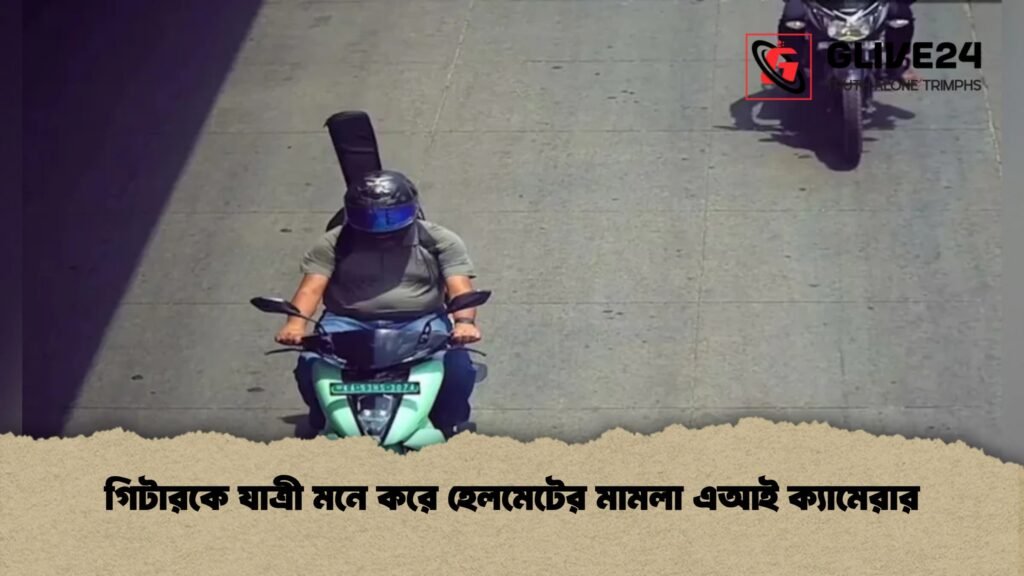
An artificial intelligence-powered traffic camera in Bengaluru has reportedly mistaken a guitar strapped to the back of a scooter rider for a second passenger, leading to a 500-rupee electronic traffic challan for an alleged helmet violation.
The unusual incident took place in the Hebbal area of Bengaluru, where local resident Souvik Dutta was travelling on an electric scooter on 15 September with a guitar strapped to his back. According to reports in the Indian media, Dutta was riding alone. However, a roadside AI-enabled traffic camera apparently interpreted the guitar as another person sitting on the scooter.
The automated system subsequently identified the supposed rear passenger as not wearing a helmet. Based on that detection, a traffic challan carrying a fine of 500 rupees was generated against the scooter. The notification reportedly reached Dutta’s wife the following day.
Dutta was left surprised by the notice because there had been no passenger on the scooter. He later took the matter to social media, where he shared an image of the challan and tagged the traffic police on X, formerly known as Twitter.
In his post, Dutta explained that he had been travelling alone on his wife’s two-wheeler while carrying a guitar on his back. He questioned how an AI-based traffic monitoring system could interpret the musical instrument as a passenger and issue a penalty for an alleged helmet violation. He also requested that the challan be cancelled.
The post quickly attracted attention on social media, with users discussing the reliability of automated traffic enforcement systems. The incident has also raised questions about how AI-powered cameras distinguish between people and objects in real-world traffic conditions.
AI-based traffic monitoring is designed to help authorities identify suspected violations automatically by analysing images captured on roads. Such systems can assist traffic management by processing large volumes of visual information without requiring officers to manually inspect every vehicle. But when an automated system misidentifies an object, the resulting penalty can affect a person who has not actually committed the alleged offence.
The Bengaluru incident illustrates that automated detection still requires mechanisms for human review, particularly when a motorist disputes a digitally generated challan. A system may flag an apparent violation, but verifying the circumstances can be necessary before an incorrect penalty is allowed to stand.
The matter also came to the attention of Bengaluru traffic police. Authorities reportedly contacted Dutta and initiated steps to examine what had happened. They also directed that the disputed challan be reviewed.
The incident has since become an unusual example of the challenges associated with AI-assisted traffic enforcement. What appeared to the camera to be a helmetless passenger was, in reality, a guitar being carried by a lone rider. The case has consequently drawn attention to both the growing use of automated traffic surveillance and the need for effective procedures to correct errors when such systems produce an incorrect identification.