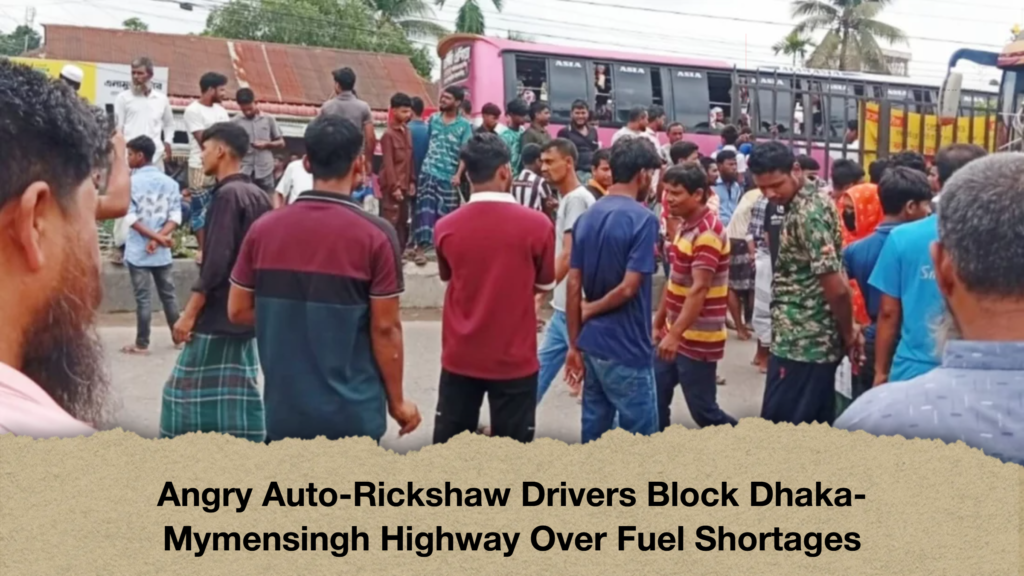
Protesting drivers of compressed natural gas (CNG) auto-rickshaws temporarily blocked the Dhaka-Mymensingh highway in Trishal on Wednesday morning, demanding an uninterrupted fuel supply to sustain their daily livelihoods.
The demonstration began around 10:30 am on 2 September, when driver groups parked their vehicles across the Kakchor Road intersection along the highway. The blockade effectively paralyzed northbound and southbound transport along the eastern lane of the vital regional artery for nearly half an hour, trapping buses, lorries, and private cars in a sudden tailback that left commuters stranded under challenging conditions.
Drivers at the protest voiced deep frustration regarding the acute low pressure and persistent supply shortages experienced at refuelling stations throughout Trishal Upazila. Operators explained that after queuing for hours at local pumps, their vehicles received only nominal amounts of gas. A single refuelling session yields barely enough compressed natural gas to complete one or two short passenger runs before the fuel runs out, forcing them back into line and drastically curtailing their operational output.
This ongoing fuel crisis directly hits the earnings of low-income transport workers. Long delays at refuelling points reduce the number of trips a driver can complete in a single shift, causing daily takings to plummet while operating overheads remain fixed. Protesting operators called on municipal and energy authorities to ensure consistent gas pressure at local filling stations so they can run standard commercial services without facing daily losses.
Upon receiving reports of the disruption, local police dispatched officers to clear the highway. Sub-Inspector Taleb of Trishal Police Station confirmed that traffic was brought to a standstill for a short period before he, alongside Traffic Inspector Saiful Islam, arrived to liaise with the striking drivers. Officers persuaded the group to clear the roadway, successfully re-opening the passage around 11:00 am and allowing trapped vehicles to resume their journey.
The brief roadblock underscores a broader, systemic issue concerning gas supply stability across Bangladesh’s peri-urban public transport sector. In regions like Mymensingh, CNG auto-rickshaws provide an essential transit link for hundreds of thousands of daily commuters. When pipeline pressure drops below operational thresholds, the entire localized transport ecosystem grinds to a halt. Although the police managed to disperse the blockade without further incident, local transport operators warn that without a permanent fix to gas distribution channels, driver unrest on major national highways could resurface.