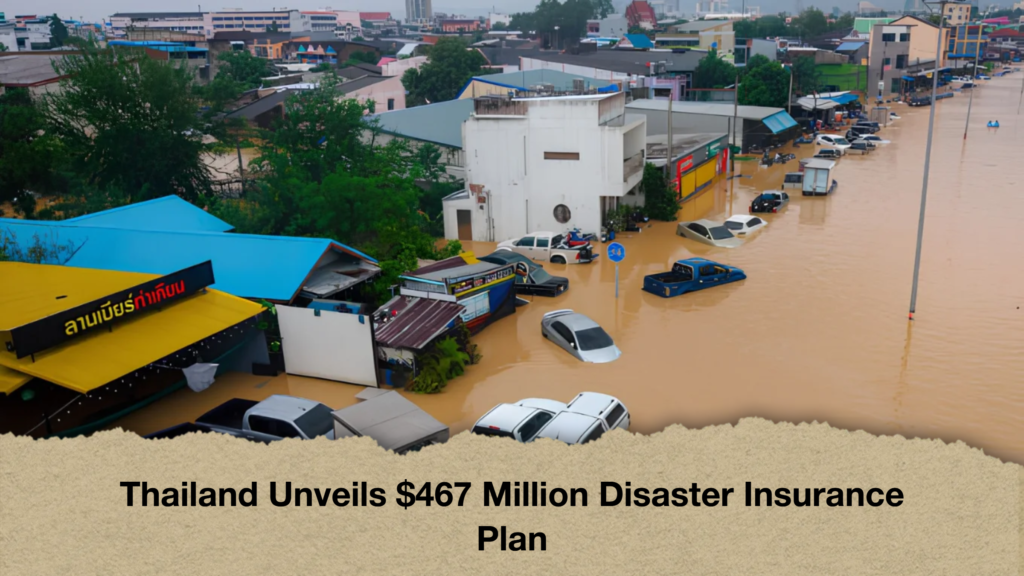
Thailand has approved a government-funded disaster insurance scheme designed to protect around 30 million households in high-risk areas while transferring part of the financial burden of major catastrophes to private insurers.
The government approved an annual allocation of 15.5 billion baht, equivalent to about US$467 million, for the scheme, Prime Minister Anutin Charnvirakul said on Tuesday. The programme will provide insurance protection against floods, storms and earthquakes, three of the major natural hazards facing communities across the country.
The proposed arrangement is intended to reduce the pressure on public finances as the cost of responding to natural disasters continues to rise. Government estimates show that Thailand currently spends at least 30 billion baht each year compensating households for disaster-related losses. Under the new framework, total annual insurance coverage could reach about 75 billion baht, with private insurance companies expected to shoulder liabilities beyond the portion directly supported by the state.
That structure would change how Thailand finances disaster recovery. Rather than relying almost entirely on government compensation after a major event, the state would provide an initial layer of protection while insurers would assume responsibility for additional payouts within the agreed insurance framework. The approach could help limit the financial exposure of taxpayers when severe disasters cause widespread damage.
For affected households, the scheme is intended to provide relatively rapid initial assistance. Government spokeswoman Rachada Dhnadirek said families suffering flood damage would receive an initial payment of 10,000 baht, while those affected by storms or earthquakes would receive 5,000 baht. Payments are expected to be made within 15 days, allowing households to meet some immediate costs following a disaster.
Compensation would be subject to a ceiling of 100,000 baht per household for each disaster. In cases where a person dies as a result of a disaster, the proposed compensation would be 2 million baht.
| Key measure | Proposed figure |
|---|---|
| Annual government allocation | 15.5 billion baht |
| Approximate US dollar value | US$467 million |
| Households covered | About 30 million |
| Estimated total annual coverage | About 75 billion baht |
| Current annual government compensation | At least 30 billion baht |
| Initial flood payment | 10,000 baht |
| Initial storm payment | 5,000 baht |
| Initial earthquake payment | 5,000 baht |
| Target payment period | Within 15 days |
| Maximum household compensation per disaster | 100,000 baht |
| Compensation for a disaster-related death | 2 million baht |
The move comes against a wider backdrop of growing disaster-related financial risks across Asia. Rapid urbanisation has placed more people and economic activity in areas exposed to flooding and other hazards, while increasingly severe weather events are adding to the potential scale of losses. A significant proportion of those losses remains uninsured, leaving governments to absorb much of the cost when disasters strike.
Recent events in Thailand have highlighted those pressures. Flooding in the northern region last month killed three people and affected roughly 25,000 residents. In November, severe floods in the south affected more than one million people, including communities in Hat Yai, an important commercial and tourism centre.
For the government, expanding the role of insurers could provide a way to spread disaster risk across a wider financial system. For insurers, however, the arrangement would involve taking on potentially substantial liabilities when large-scale disasters exceed the limits of direct government support.
The programme will be developed jointly by the Department of Disaster Prevention and Mitigation, the Finance Ministry, the Office of Insurance Commission and the Thai General Insurance Association. Their work will determine how the scheme is structured and how government support and private-sector obligations are coordinated.
If implemented as planned, the initiative would represent a significant shift in Thailand’s approach to disaster compensation. It combines state-backed protection for households with greater participation from the private insurance sector, aiming to provide faster assistance after disasters while reducing the extent to which taxpayers must bear the full cost of increasingly expensive catastrophes.