When Netflix announced its ambitious strategy to adapt a selection of short stories by Satyajit Ray—originally published in the beloved children’s magazine Sandesh—the news provoked both genuine excitement and inevitable scepticism. For devoted purists, such projects raise an uncomfortable but necessary question: will the cinematic translation honour the maestro’s legacy, or merely dilute his distinct narrative voice for contemporary streaming consumption? By the time the four-part anthology series, titled Ray, premiered globally on 25 June 2021, curiosity had largely replaced initial apprehension, leaving audiences to evaluate the offering on its own artistic merits.
The series opens with “Forget Me Not”, an adaptation of Bipin Chowdhury’r Smritibhrom, helmed by director Srijit Mukherji. Mukherji drastically transplants the original modest narrative into a slick, modern corporate landscape, tracking a cut-throat entrepreneur named Ipsit Rama Nair, portrayed by Ali Fazal. The director introduces new characters, employs an unreliable narrator, and experiments with gender reversals to modernise the plot. Despite glossy visual production values and committed performances across the board, the episode struggles to capture the authentic spirit of the source material. Ray’s original tale relied on subtle humour and psychological irony, whereas this adaptation pivots into a heavy-handed, sombre revenge thriller. A failure to engage with the layered symbolism of the original leaves the narrative tonally misplaced and emotionally hollow.
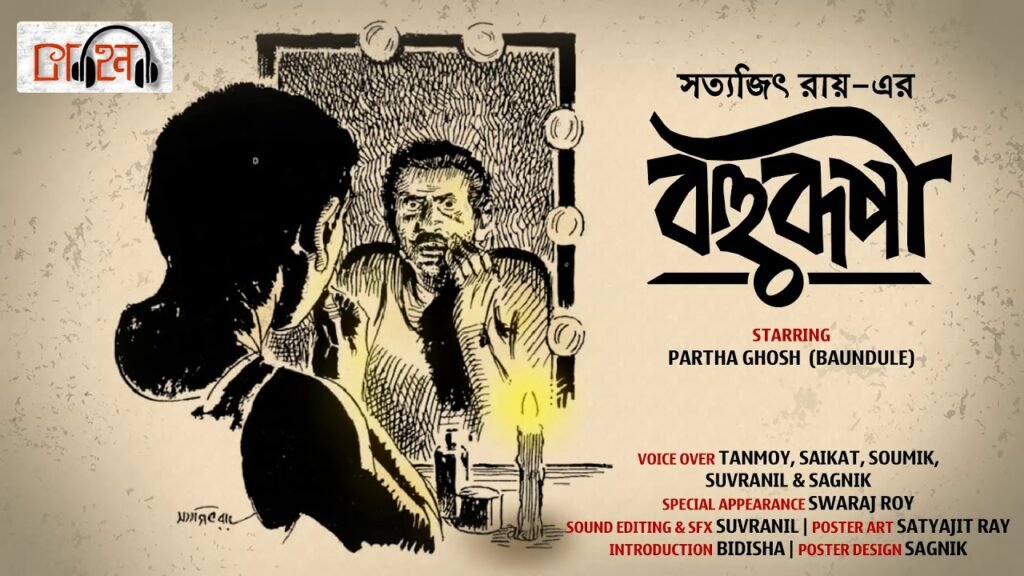
Mukherji remains in the director’s chair for the second instalment, “Bahrupiya”, which draws heavily from the celebrated story Bahurupi. Here, his directorial shortcomings are far less pronounced. Kay Kay Menon delivers a compelling masterclass as Indrashish Shah, a lonely and troubled makeup artist who, perpetually mistreated by society, seeks vengeance by mastering the art of prosthetics. Although the execution occasionally falls short of crafting a truly character-driven piece, Ray’s robust original plot structure maintains a steady, engaging momentum. Bolstered by strong supporting performances—particularly from Rajesh Sharma and Bidita Bag—the episode successfully builds tension towards a satisfying final twist, even if it never completely transcends expectations.
The third episode, “Hungama Hai Kyon Barpa”, directed by Abhishek Chaubey, adapts Barin Bhowmick-er Byaram. This segment brings together the formidable talents of Manoj Bajpayee and Gajraj Rao, a casting choice that instantly heightens viewer anticipation. Bajpayee plays Musafir Ali, a popular musician harbouring a dark secret, while Rao shines as a wrestler-turned-sports journalist. Their dynamic on-screen chemistry is an absolute delight, particularly during the extended train journey that forms the narrative spine of the episode. Unfortunately, the screenplay falters slightly by trying too hard to emulate Ray’s signature eccentricity rather than allowing the story to breathe organically. The pacing suffers in the final act; the episode arguably reaches its natural, most potent conclusion around the 43-minute mark before stretching unnecessarily.
The anthology wraps up with “Spotlight”, directed by Vasan Bala and loosely inspired by Ray’s satirical short story of the same name. Bala’s flamboyant, neon-soaked visual style promised an intriguing marriage with Ray’s sharp wit, yet the final product is chaotic and largely incoherent. Harshvardhan Kapoor struggles to anchor the narrative as Vikram Arora, a creatively frustrated actor facing a profound existential crisis. The underlying satire is ultimately drowned out by excessive stylistic indulgence. Apart from an impressive production design, a memorable soundtrack, and a spirited turn by Radhika Madan as the godlike cult figure ‘Didi’, the episode leaves little lasting impact.
Ultimately, the Ray anthology offers a highly uneven collection of modern reimaginings. While it successfully introduces the literary genius of Satyajit Ray to a new global audience, the series frequently battles to balance contemporary cinematic flair with the nuanced, quiet brilliance that defined the auteur’s original works.