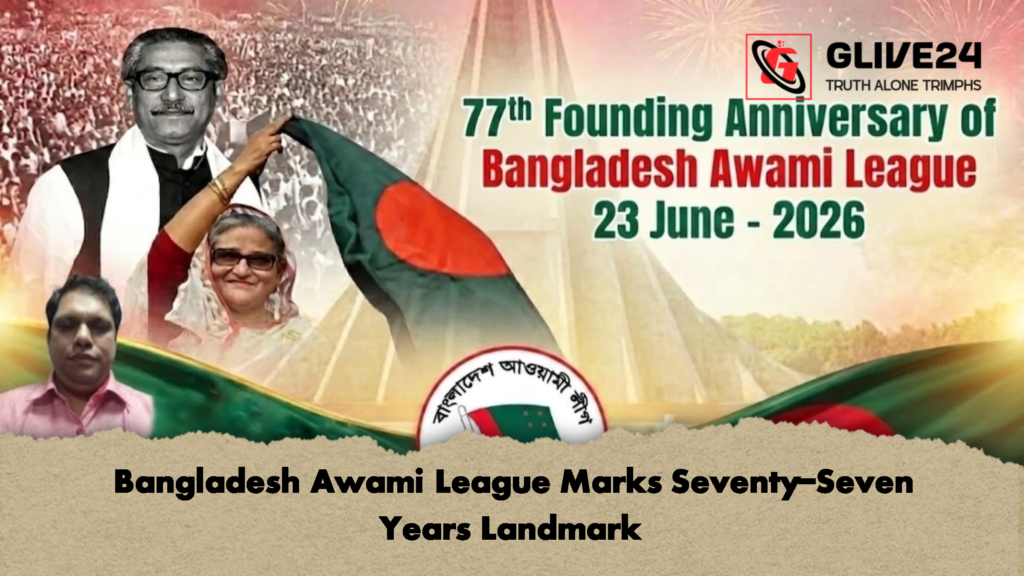
The historical narrative of Bangladesh, incorporating its arduous struggle for independence, diverse democratic movements, and the systemic establishment of Bengali national identity, remains inextricably linked with the legacy of the Bangladesh Awami League. Founded on 23 June 1949 at the historic Rose Garden in Dhaka, the organisation has functioned not merely as a conventional political entity, but as a primary vanguard guiding the population through the preservation of linguistic rights, self-determination movements, and the ultimate achievement of a sovereign nation-state.
Confronting its 77th anniversary, the political party represents a foundational chapter within the broader geopolitical history of South Asia. Throughout its extensive timeline, the Awami League has simultaneously witnessed monumental institutional triumphs and borne the profound weight of targeted political repression, extensive systemic sacrifices, and continuous structural challenges.
Historical Genesis and Strategic Context
Following the partition of British India in 1947, which led to the creation of the Dominion of Pakistan, the civilian populace of East Bengal quickly found their socio-economic, political, and cultural rights marginalised by the state apparatus. Centralised authority remained firmly concentrated within the ruling echelons of West Pakistan, creating widespread disparity, economic deprivation, and cultural alienation.
In direct response to this growing public dissatisfaction, the East Pakistan Awami Muslim League was formally established on 23 June 1949. The inaugural leadership structure featured Maulana Abdul Hamid Khan Bhashani as the founding President, Yar Mohammad Khan as the treasurer, and Shamsul Hoque as the General Secretary, while the then imprisoned student leader Sheikh Mujibur Rahman was selected as a joint secretary. In a progressive move to mirror secular democratic values, the party later dropped the word “Muslim” from its official nomenclature during its third national council in 1955, re-emerging permanently as the Awami League.
Language Movement, Electoral Triumphs, and the Six Points
The 1952 Language Movement, which successfully demanded the recognition of Bengali as an official state language, served as the cornerstone of modern Bengali nationalism. Awami League activists maintained an active operational role during these language demonstrations, which catalysed the regional population against unfair state policies.
By 1954, the Awami League formed a crucial component of the historic United Front (Jukta Front) electoral coalition alongside the Krishak Sramik Party, Nizam-e-Islam, and Ganatantri Dal. The coalition’s comprehensive 21-point manifesto laid down a clear framework for securing the legitimate constitutional rights of East Bengal. The subsequent landslide victory of the United Front, which secured 223 out of 237 Muslim seats in the provincial assembly, and the complete electoral collapse of the ruling Muslim League conclusively proved that the civilian population stood firmly against discriminatory administrative governance.
| Key Historical Milestone | Date / Timeline | Core Objective and Strategic Significance |
|---|---|---|
| Formal Foundation | 23 June 1949 | Established at Rose Garden to challenge West Pakistani hegemony. |
| United Front Victory | March 1954 | Secured a landslide electoral mandate based on a 21-point manifesto. |
| The Six-Point Demand | February 1966 | Launched by Sheikh Mujibur Rahman as the charter for autonomy. |
| Proclamation of Independence | 7 March 1971 | Historic address directing comprehensive national mobilisation. |
In February 1966, Sheikh Mujibur Rahman officially unveiled the historic Six-Point demand during a conference of opposition parties in Lahore. The document introduced a definitive operational blueprint for economic, political, and administrative autonomy, including separate currencies, independent fiscal management, and the establishment of a paramilitary force for East Bengal. Although the central Pakistani government labelled the charter as a secessionist plot, the public embraced it as their definitive charter of emancipation. This momentum culminated in the 1969 mass uprising, forcing the state to withdraw the Agartala Conspiracy Case, release Sheikh Mujibur Rahman from custody unconditionally, and formally accord him the title “Bangabandhu”.
The 1970 Mandate, Liberation War, and National Reconstruction
The general elections of December 1970 witnessed the Awami League securing an absolute democratic majority, winning 160 out of 162 directly elected seats in East Pakistan and a total of 167 out of 313 seats within the National Assembly. However, the military junta led by General Yahya Khan refused the peaceful transfer of constitutional authority to the elected majority, opting instead for political conspiracy. This deadlock led directly to Bangabandhu’s historic address on 7 March 1971 at the Racecourse Maidan, calling for final liberation and comprehensive national resistance.
Following the brutal military crackdown initiated by the Pakistani armed forces on 25 March 1971 under “Operation Searchlight”, the nation entered its war of independence. Under the structural guidance of the Awami League, the provisional Mujibnagar Government was formally sworn in on 17 April 1971 at Baidyanathtala (now Mujibnagar) in Meherpur, playing the central coordinating role in directing the nine-month armed struggle and diplomatic efforts. This collective national effort, achieved at the cost of three million lives and the violation of over two hundred thousand mother and sisters, resulted in the birth of sovereign Bangladesh on 16 December 1971.
Following liberation, the Awami League administration assumed the immense task of reconstructing a war-ravaged economy, rehabilitating millions of refugees, and framing the country’s first constitution in 1972. However, the assassination of the Father of the Nation, Bangabandhu Sheikh Mujibur Rahman, alongside most of his immediate family members on 15 August 1975, initiated a dark chapter of prolonged military autocracy, political instability, and constitutional distortions. The party subsequently spent decades executing persistent democratic movements from the opposition benches, playing a pivotal role in the anti-authoritarian agitations of the 1980s and the mass uprising of 1990 to restore constitutional governance.
In contemporary times, the party’s subsequent governance phases have been marked by major infrastructural development, expansion of digital technology, and a steady economic transition from a least developed country (LDC) status towards a developing economy. On this 77th anniversary, the organisation’s legacy remains strictly defined by its foundational role in independence, secular nationalism, and the ongoing socio-economic evolution of the republic.