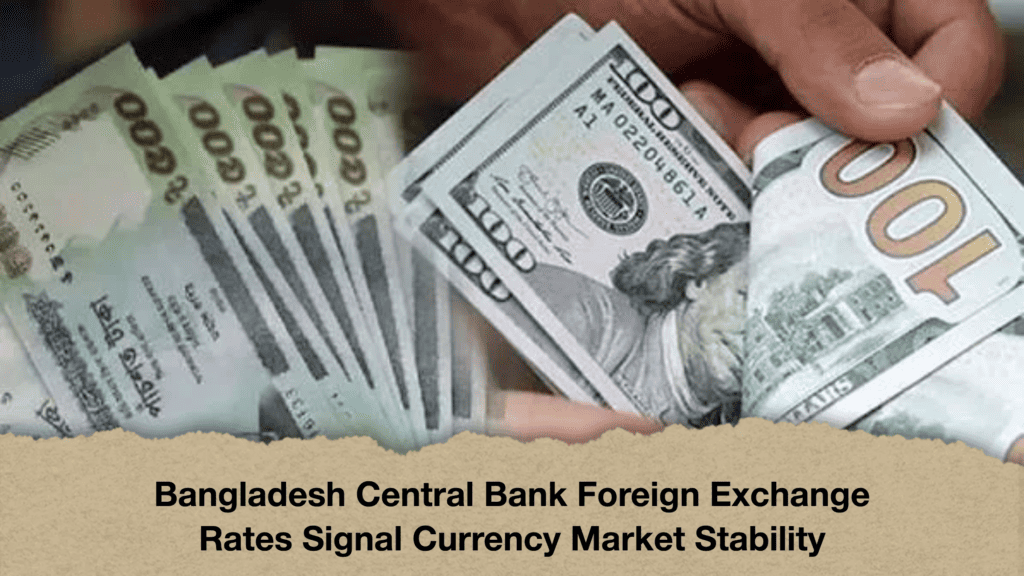
Foreign exchange rates play a foundational role in shaping cross-border commerce, remittance transfers, foreign education expenses, and international travel logistics. For an import-dependent economy like Bangladesh, fluctuations in foreign currencies directly impact domestic price levels, commercial bottom lines, and individual financial decisions. Maintaining a precise understanding of exchange rate dynamics remains essential for businesses and households alike before executing major foreign currency transactions.
Official exchange figures published on 12 October 2026 reflect the latest benchmark rates across eight major global currencies, including the United States Dollar, the British Pound Sterling, the European Euro, the Indian Rupee, the Australian Dollar, the Singapore Dollar, the Chinese Yuan, and the Japanese Yen. However, official disclosures note that these listed rates reflect an underlying system updates timestamp from 5 October 2026. Financial market participants must verify real-time counter rates with commercial institutions to confirm active valuations on the day of trade.
According to the published figures, the United States Dollar maintains a buying rate of 122.85 BDT against a selling rate of 123.00 BDT, representing a tight spread of 0.15 BDT per dollar. The British Pound Sterling continues to hold the highest individual unit valuation among all tracked currencies, quoted at 162.67 BDT for purchases and 162.90 BDT for sales. European and Asian trade currencies show consistent commercial spreads:
-
US Dollar (USD): 122.85 BDT Buying | 123.00 BDT Selling
-
British Pound (GBP): 162.67 BDT Buying | 162.90 BDT Selling
-
Euro (EUR): 138.24 BDT Buying | 138.42 BDT Selling
-
Indian Rupee (INR): 1.28 BDT Buying | 1.28 BDT Selling
-
Australian Dollar (AUD): 85.42 BDT Buying | 85.57 BDT Selling
-
Singapore Dollar (SGD): 95.98 BDT Buying | 96.18 BDT Selling
-
Chinese Yuan (CNY): 18.32 BDT Buying | 18.34 BDT Selling
-
Japanese Yen (JPY): 0.78 BDT Buying | 0.78 BDT Selling
Understanding the structural gap between buying and selling prices is critical for navigating commercial banking channels. The buying rate denotes the price an authorised bank or money exchange institution pays to acquire foreign currency from a customer. Conversely, the selling rate represents the higher price charged by the institution when selling currency back to the customer. While official central bank publications provide a standard baseline, actual over-the-counter rates available to retail clients frequently vary depending on specific institutional service fees, transaction volume, and the mode of transfer employed.
The relative strength and stability of the US Dollar remain particularly influential across the national economy. As the primary settlement currency for international trade, shifts in the dollar exchange rate bear direct consequences for Bangladesh’s import bills, foreign currency reserves management, and overseas remittance receipts. When dollar valuations rise, input costs for imported raw materials, petroleum, and capital machinery increase accordingly. However, total retail inflation depends on a broader blend of economic factors, including international commodity pricing, freight costs, local customs duties, and supply chain efficiencies.
Expatriate workers sending money home, alongside families funding overseas tuition or medical care, must exercise thorough due diligence before carrying out currency conversions. Beyond reviewing published indicative rates, traders should always verify active counter rates, account for intermediary transfer fees, and confirm effective settlement charges with authorised exchange houses or commercial banks prior to executing substantial financial operations.